I’ve never been much into hell. I mean, I don’t believe in Hell, not that I’ve never been there, mostly of my own making. Though I think of Hell as a symbol of alienation and estrangement, it feels more real every day in America. The search for faith and hope that Love has the final word led back to this sermon from a decade ago. I am less the preacher than a listener now, in need of reassurance that cruelty and criminal insanity will not prevail.
Christus Victor: the Harrowing of Hell
Thanks for coming by Views from the Edge. Grace and peace,
Gordon
Gordon C. Stewart, PC(USA) minister (HR), public theologian and social critic; host of Views from the Edge: To See More Clearly; author of Be Still! Departure from Collective Madness (2017, Wipf and Stock), 49 brief meditations on faith and the news; Brooklyn Park, MN, January 25, 2025.
Out of the devastation of hurricanes Helene and Milton, two roads diverge in a sodden wood. One road sees only what is urgent, the immediate needs for rescue and recovery. The other road, less traveled by, also looks farther for what is important. The road we choose in the Nov. 5 election will make all the difference. Listen to weatherman John Morales speak of his decision to do more than report the weather. Have a look.
Nothing is more important than a healthy planet. Nothing. When a candidate for high office calls climate change a hoax, move on. Do the same with “down-ballot” candidates and political parties that tap dance around the question. This election is about reality.
Presidents, senators, justices, and generals have spoken lines they attribute to Alexis de Tocqueville during his visit to America in 1831. “America is great because she is good, and if America ceases to be good, America will cease to be great.” Facing the sin of slavery, James Russell Lowell wrote the poem that became the lyric of a hymn on which I was a raised. “Once to every man and nation, in the strife of truth with falsehood, comes the moment to decide….” This is a moment like that.
Looking for a Foothold
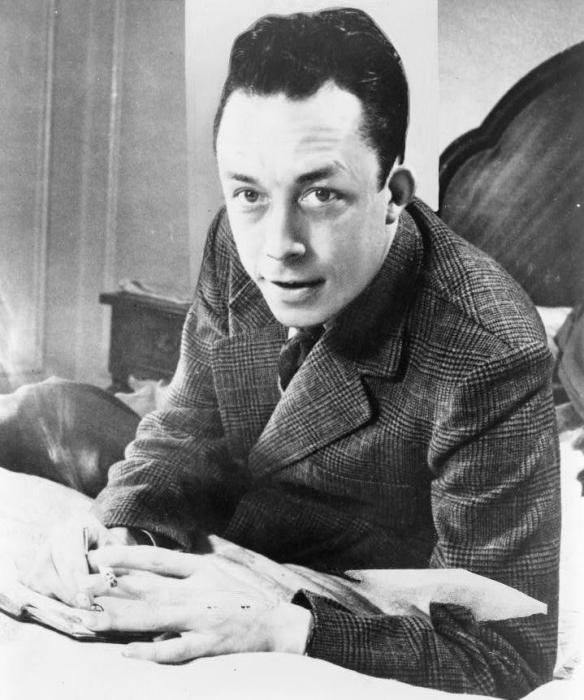
In time, God help us, the divisions among the American electorate will be healed. Yet, before there is healing, is a common weariness that crosses all lines of difference. Nobel Laureate Albert Camus described our situation when he wrote under the dark cloud that swept over the world in the 1930 and ’40s. Camus’s insight into the experience provides insight into how the absence of any foothold produced suffering in a period similar to ours
“The modern mind is in complete disarray,” wrote Camus. “Knowledge has stretched itself to the point where neither the world nor our intelligence can find a foothold. It is a fact that we are suffering from nihilism.”
The Sum of Your Choices
“Life is the sum of your choices.”
Albert Camus
The sum of our choices in this election will be who we are, and will determine what America will become. Votes for candidates and parties that substitute greatness for goodness, while avoiding or denying climate change, are votes against the future.
Vote like life your life, your children’s and grandchildren’s depend on it, because it does.
Gordon C. Stewart, public theologian, author of Be Still! Departure from Collective Madness (2017, Wipf and Stock), Brooklyn Park, MN, October 10, 2024.
I didn’t feel like shouting Hosannas and waving palm branches this Palm Sunday. So I did something else. Harry Emerson Fosdick’s hymn, “God of Grace and God of Glory,” written in 1930, a time as uncertain as this, cried out for attention. “Grant us wisdom, grant us courage, for the facing of this hour.” The title of this sermon was ready before the sermon had been written. Fosdick’s lyrics led me to Psalm 82 addressing “the great assembly of the gods . . . by which all the foundations of the earth are shaken.” Here’s the sermon at Shepherd of the Hill Presbyterian Church in Chaska, MN, the loving congregation that welcomed me for nine years (2005-2014) on the way to retirement.
Thanks to Shepherd of the Hill Elder Chuck Lieber for taping this long-winded sermon on Palm Sunday at Shepherd of the Hill Presbyterian Church in Chaska, MN.
PSALM 82 NIV
God presides in the great assembly; he renders judgment among the “gods”:
“How long will you defend the unjust and show partiality to the wicked?
Defend the weak and the fatherless; uphold the cause of the poor and the oppressed. Rescue the weak and the needy; deliver them from the hand of the wicked.
“The ‘gods’ know nothing, they understand nothing. They walk about in darkness; all the foundations of the earth are shaken.
“I said, ‘You are “gods”; you are all sons of the Most High.’ But you will die like mere mortals; you will fall like every other ruler.”
Arise, God, judge the world, for all nations belong to you.
Psalm 82 niv
Rev. Gordon C. Stewart, public theologian and social commentator, author of Be Still! Departure from Collective Madness (2017, Wipf and Stock Publishers), 49 brief (2-4 pages) on faith and life; Brooklyn Park, MN, April 7, 2024.
"Leave Rage Alone" aired yesterday as a podcast recorded during a rare moment when all of us were in the same boat, waiting for the 2022 election returns. The text for the podcast is printed below."Leave Rage Alone" was written and posted four years ago before Kay and I re-located from Chaska to Brooklyn Park MN to be near grandson Elijah. We share it here in hopes it still speaks.
Searching for stillness
Stillness defines life at the cabin. It’s quiet. The only sounds are bird calls. It is this stillness that draws us here by the wetland. But my heart is not still. It’s preoccupied with evil. This morning’s assigned psalm from The Book of Common Prayer (BCP) speaks to my condition.
Do not fret yourself because of evildoers… For they shall soon wither like the grass… Be still before the LORD… Do not fret yourself over the one who prospers, the one who succeeds in evil schemes. Refrain from anger, leave rage alone; do not fret yourself; it leads only to evil.
Psalm 37 BCP
Leave rage alone.
Last night, after a quiet swim, I put my hearing aids back in, returned to the cabin for dinner, and listened to a podcast of The Beat with Ari Melber which Kay had downloaded on her iPhone. Back home in Chaska, we watch The Beat because it suits our outrage over what is happening to America. But listening to the podcast re-awakened the rage from which I seek relief in the quiet beauty of the disconnected cabin by the wetland. Listening to the podcast disturbed the serenity of the place. It felt like a fatal assault, a return to hell.
Midway through the podcast, I removed my hearing aids again to distance myself from the septic fret of rage. It was the tone of voice that felt like death or a foreign invasion. I was swimming in my own body waste.
The pond and the wetland are changing every day. So is the world. The Trumpeter Swans that brought such joy a month ago are gone. So are the red-wing blackbirds that had feasted on the cat-n-nine tails. And the grass? The grass is green and growing again. But the psalm reminds me that green will fade to brown in autumn until the swans return.
Meanwhile the calendar reminds me. It’s time to call the guy who empties the septic tank, before it gets full and no longer works. — July 19, 2018.
Afterword
The day after the election day, the boat of anxiously awaiting the election results is over. The shared experience of unknowing was perhaps its own kind of sacred moment, a suspension of the lethal spirituality of winners and losers. Is it too much to ask, for the sake of everyone’s health, that we come together again to empty the septic tank before it gets full?
Gordon C. Stewart, public theologian, author of Be Still! Departure from Collective Madness (2017, Wipf and Stock), 49 two-four page essays on faith and public life; Brooklyn Park, MN, November 9, 2022.
After an extended period of dismay and bewilderment, Psalm 39 opened a vein to write again.
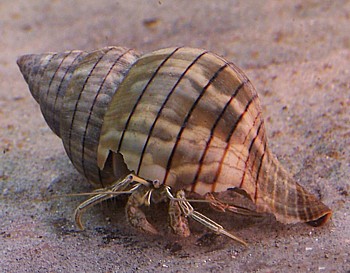
Hermit Crab crawling into an abandoned shell
A Psalmic Meditation of a Hermit Crab
I said, “I will be careful how I act and will not sin by what I say.
I have been careful. A hermit crab at low tide, I sidle into a borrowed shell, not too big and not too small, to hide from birds of prey. I stuff myself inside. When the tide comes in, I may leave this shell. But not now. The sand is hot. The gulls are feeding.
I will be careful what I say around wicked people.”
It’s not just the birds of prey that keep me here. Whatever I say outside will make it hotter for crabs like me. I’m crabby and cranky. “Keep your words to yourself! The world doesn’t need more heat. We all need to cool down.”
So I kept very quiet. I didn’t even say anything good, but I became even more upset.
Despair is a horrible thing. “If you can’t say something nice, don’t say it. Stay in your room until you have something nice to say. You have to be positive.” I have nothing good to say. Nothing calm. Nothing of value. Nothing to cool the beach at noon. Nothing to lower the blistering heat rising in me.
I became very angry inside, and as I thought about it, my anger burned.
Glass shattering, Stop the Steal, Hang Mike Pence, Execute Nancy, Make America Great Again, sounds of threats and violence, cries for help, and the silence from the White House still hurt my ears.
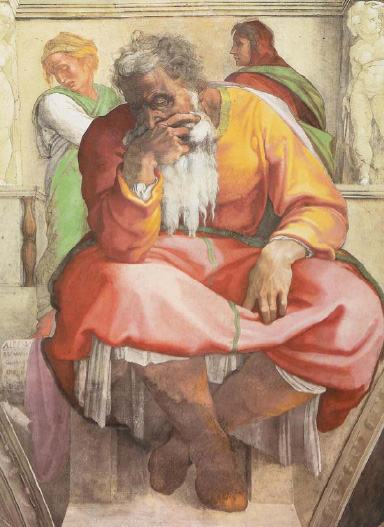
Then I remember how Jeremiah wept. Truth, he said, was dark and deep, and bought a worthless plot of land where hope could live.
The prophet Jeremiah, Michelangelo fresco, Sistine Chapel
So I spoke:
“Lord, tell me when the end will come and how long I will live. Let me know how long I have.
You have given me only a short life; my lifetime is as nothing in your sight; Even those who stand erect arebut a puff of wind.
It’s hard alone outside the shell. The wind is stiff. The sky is dark. Light is White and right; Black is dark and wronged again. Truth sways by a noose from the lynching tree.
When will this end? When will it stop? How will it stop? I’m an old man; my time is short, this short puff of air, soon to disappear.
People are like shadows moving about. All their work is for nothing; they collect things but don’t know who will get them.
My kind and I are like ghosts sidling along the wall of shadows we faintly see in Plato’s cave. We find no respite from the heat and clamor into which we once could crawl — or thought we could. We leave behind a scorched gift to generations yet to come.
“So, Lord, what hope do I have? You are my hope.”
Sea levels have rise, the tides are higher, the forests burning, the rivers drying, fields once lush and green now parched and brown, the planet spinning out of control, like a top our hands have spun. These mortal selves, this factory of gods our hearts conceive, cannot hide from Thee, O Lord, the “I AM” without end, the Breath of Life that breathes a breath through me.
Gordon C. Stewart, author of Be Still! Departure from Collective Madness (2017, Wipf and Stock), host of Views from the Edge: To see More Clearly, Brooklyn Park, MN, January 23, 2023.
Early morning reflection from the dirt road by the wetland pond
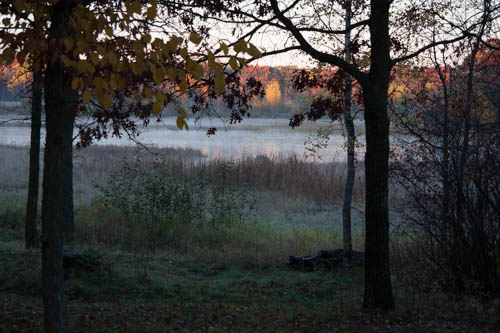
Walking the off the map dirt road where nothing much happens, it’s quiet. The only sounds are bird songs; the only things that lie here are the lily pads lying on the shrinking wetland pond bordered by the cattails and wild flowers between the pond and the unpaved road. Nothing toils or spins. Nothing is anxious here. Not this morning.
Lily pads on a wetland pond
“Consider the lilies of the field, how they grow; they neither toil nor spin; yet, I tell [all of] you [human beings], even Solomon in all his glory was not arrayed like one of these.” (Jesus of Nazareth, Sermon on the Mount, Matthew 6:28b-29.)
There are no Solomons here. No kings. No countries. No states. Nothing seduced by the will-to-power. No illusions of sovereignty. No delusions of grandeur or control. No toiling and spinning like the mind observing it all from the dirt road. Everything is what it is: Yellow Goat’s-Beard, Yarrow, and Golden Clubs; Sweetflag, White Sweet Clover, and Butterfly-Weed; Bugle-Weed, Cuckoo-Flowers that aren’t cuckoo, and Bullhead-Lilies that don’t bully; pink Storkbills, Wild Sorels, Common Milkweeds, and blue-violet Pickerelweed.
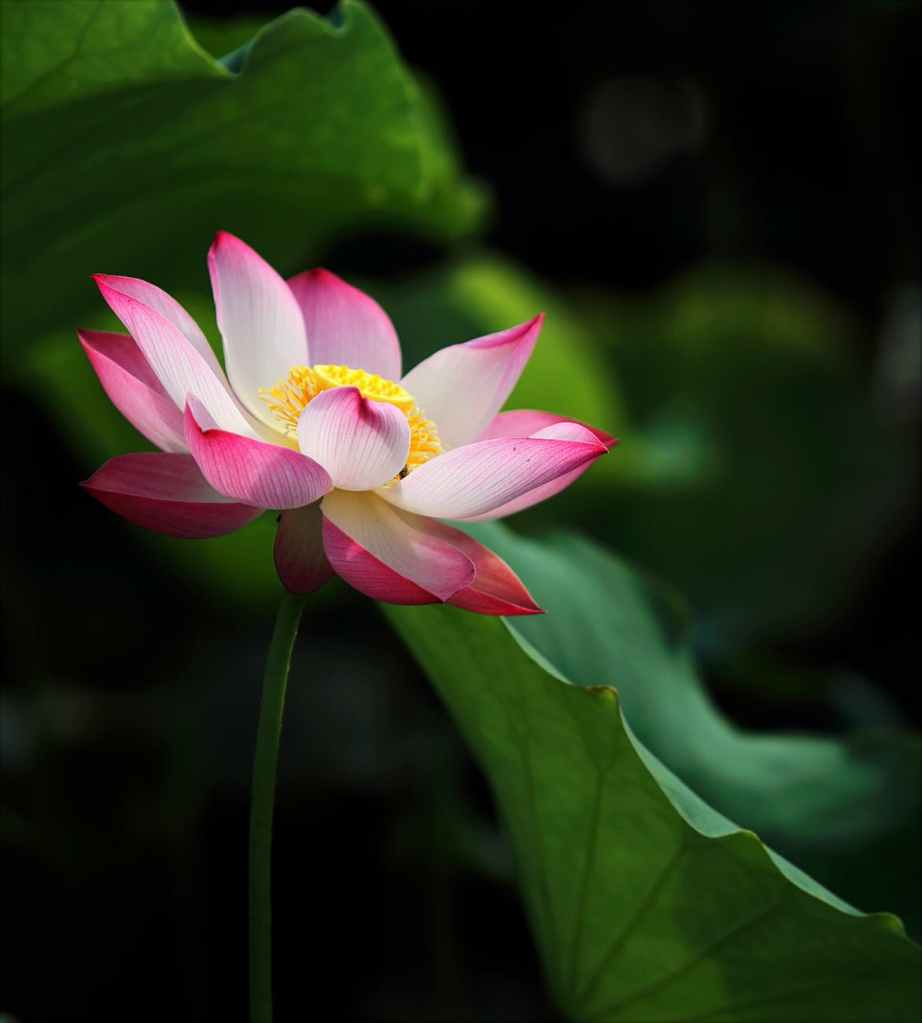
Water lily –Photo by Hiu1ebfu Hou00e0ng on Pexels.com
Only the hunting-blind on the distant hill gives evidence of other spinning heads that toil for the mastery we cannot have. The hunting-blind on stilts high about the pasture waits for trigger fingers. Soon buckshots from the tower will fire babel that breaks the silence of this place. The flowers of the field — the Butterfly-Weed, the Bugle-Weed, and the Cuckoo-Flowers, the Lilies, and the lily pads — are not anxious. They are what they are. What is is what is. What will be will be. They neither toil nor spin.
— Gordon C. Stewart, from the wetland, August 3, 2021



 Views from the Edge