O Let My People Go

For ten or twenty, thirty years or more
the song was sung before the Civil War

by southern slaves in secret. First a call,
and then a sung response that came from all

around, “O let my people go!” And then
another voice, another poet, sang

out still another call, “Tell King Pharaoh!”
And then, “This world’s a wilderness of woe…”

“O let my people go!” Old Lincoln heard
the sad song sung and gave the legal word:

Abolish evil slavery first here,
and finally across the land. For where

no freedom is for some, at risk we all
will be. Each one must listen for the call:

to set each prisoner free.

– Verse “O Let My People Go” by Steve Shoemaker, Urbana, IL, October 23, 2013

Spirituals! (The first one published in 1861, “O Let My People Go,” was transcribed by a YMCA missionary sent to help escaped slaves at Fort Monroe. –Dena J. Epstein, “Sinful Tunes and Spirituals: Black Folk Music to the Civil War,” Univ of Illinois Press, 1977, 2003.)

Editor’s Note: Harriet Tubman was the Moses of the Underground Railroad.

The Slaves Speak to Our Time

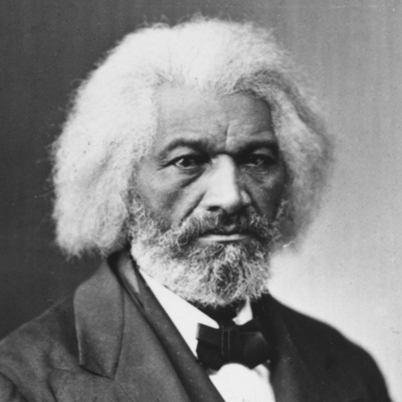
The voice of Frederick Douglass:

Whether we turn to the declarations of the past, or to the professions of the present, the conduct of the nation seems equally hideous and revolting. America is false to the past, false to the present, and solemnly binds herself to be false in the future.

– Rochester, NY, July 4, 1852

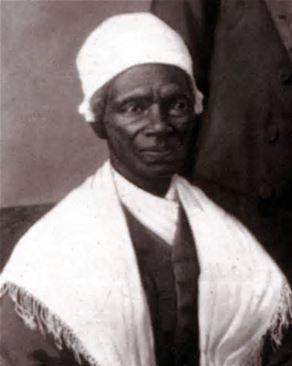
Sojourner Truth

Sojourner Truth

This Tuesday’s Dialogues program will bring the voices of the slaves to the Chapel of Shepherd of the Hill Church in Chaska, MN. The time is 7:00 p.m. Tuesday, October 15.

The evening will begin with Odetta singing “I been ‘buked and I been scorned” and move into the spoken words of 101 year-old ex-slave Fountain Hughes, Sojourner Truth, Frederick Douglass, and Harriet Tubman (“Moses”), and Langston Hughes (“The Freedom Train”) portrayed by local residents Yvette Atkinson and Ray Pleasant in dramatic readings.

Group singing of the music that kept hope alive: There is a balm in Gilead, O Freedom, Swing Low, Sweet Chariot, and Go Down, Moses!

Questions to be discussed by participants:

Frederick Douglass

Frederick Douglass

What does disenfranchisement look like today in America?

Who/what are the new owners of human property?

Who are the new slaves?

Where is the spirit of emancipation moving today in the U.S.A.? Continue reading

Give up your faith

“For 40 years,” writes Steve, “I had been a Pastor on college campuses where many students were of the marrying age, and perhaps because I would not accept money for weddings, was often asked to officiate.”

Verse -“Give Up Your Faith”

was what I told several Christians
who were wanting to marry
someone of another Faith.
“It’s the Christian thing to do,”
I said. “Give up what you love
for the person you love.”
(“Remember the Golden Rule?”)

Only a very few became Muslim,
or Buddhist, or Hindu or Jewish,
but I felt those who did were
showing clearly the love of Jesus…
I was glad to be an evangelist.

– Steve Shoemaker, Urbana, IL, October 11, 2013

Creating hell in the name of heaven

Imagine there’s no heaven
It’s easy if you try
No hell below us
Above us only sky
Imagine all the people living for today
– John Lennon

The bombs were heard in my living room last night.

The echoes of last Sunday’s suicide bombing of a church in Pakistan that killed 80 people sounded in the voices of two Pakistani members of Shepherd of the Hill Presbyterian Church in Chaska, Minnesota where I serve as pastor. Twelve members of the church had gathered to talk about something totally unrelated to Pakistan, Afghanistan, or Christianity and Islam. We were there to share. The quiet horror of Samuel and Nasrin – “I was sad all day.” – was like a bomb going off in the living room. I ask myself, why? What is happening?

I am a Christian, a disciple of Jesus. Strange as it may seem, I often feel the way John Lennon did. I dream of a different kind of world where there are no more bombings or shootings in a Kenyan mall, in Peshawar and Lahore, Pakistan, in Baghdad, Damascus, or Boston in the name of God. I am tired of all claims to righteousness, whether professedly religious or professedly secular. I would like to wipe the human GPS of its magnetic field between due North heaven) and due South (hell) and re-orient us all toward the rising sun.

The voices that fight for heaven to erase hell do not all sound the same. They speak Urdu, Parsi, Arabic, Hebrew, and English. They claim different names: Muslim, Jewish, Christian, and sometimes secular. They live in different parts of the planet in different time zones and different climates. But if you listen, they all sound alike and they do the same thing.

They do not look up at the sky. They look down. They march in lockstep rhythm because the Quran or the Bible or nationalism tells them to. They live for tomorrow – for heaven or some version of it – not for today. One doesn’t have to strain to see what’s happening, and, when anyone sees it, how can one help but imagine a different world, a different kind of humanity: one without religion?

The bombing in Peshawar last Sunday is said to have been a payback for American drone strikes that had killed innocent civilians in Pakistan. For the suicide bombers, the Cross was the emblem on the shields and helmets of Christian Crusaders. Back then the Knights Templar of Holy War killed with swords. Today the suicide bombers associate the Cross with the drone attacks of the Christian West.

Religion is with us and, depending on how one defines it, always will be. A wise elder statesman, Elliot Richardson, observed toward the end of his life that religion is the problem, but that if we erased all of the religions were erased from the face of the Earth, they would re-invent themselves in a heartbeat. Why? Because that’s how we’re made. As defined by the likes of Emile Durkheim, Margaret Meade and Paul Tillich, religion spans a much wider terrain than the belief systems for which heaven and hell are essential. Furthermore, whether or not we are professedly religious, each of us has some kind of inner GPS, some version of a societal ideal (heaven) and a social and personal horror (hell).

What’s happening across the world is profoundly and earth-shakingly religious. Though our languages are as different as Arabic is from English, and as far from each other as Peshawar and a mall in Kenya are from a Quran-burning church in Florida, the voices of Abraham’s three children (Judaism, Christianity, and Islam) all sound the same whenever we create hell on Earth in the name of heaven.

For the Pakistani friends in my living room last night the Cross stands for a divine interruption of the cycle of violence and all claims to righteousness. In the crucifixion of a Palestinian Jew of the First Century C.E. what we see is anything but the excuse for a crusade to eliminate hell in the name of heaven.
The Jesus we seek to follow threw his life into the spokes of the wheel of violence to stop it, and we must do the same.

Every Sunday worship service concludes with a “Charge” – an instruction in how to live.

Go forth into the world in peace.
Have courage.
Hold on to that which is good.
Return no one evil for evil.
Support the weak.

When the bombs tear through a church or a mosque or a neighborhood in the name of our imagined heaven for the righteous, we need to remember that there are Muslims, Jews, secularists, and other religious practitioners who seek to practice the way of peace…”living for today” throwing themselves into the spokes of the wheel of violence.

The World through the Eyes of Sukkot

A sermon at Shepherd of the Hill Presbyterian Church in Chaska, Minnesota.

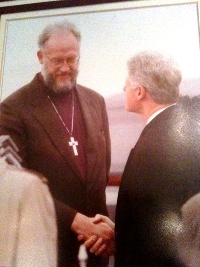
Meeting President Bill Clinton

January 28, 1998

He gave the State of the Union address
the night before, and flew on Air Force One
to our college town in the middle-west
to check out press and public reaction.
(The sex with an intern story made news
the week before.) For six years he had met
not politicians, but “Local Heroes”
at airports (Do-Gooders the Democrat
Party chose.)
Our church worked with homeless men.
As Pastor, I was picked to shake his hand
as he came off the plane (in a long line
with 14 other folks.) He called each one
of us by name. He firmly gripped my hand,
looked in my eyes, pretending to be fine…/

– Steve Shoemaker, Urbana, IL, January 28, 1988

Steve Shoemaker with President Bill Clinton

Steve Shoemaker with President Bill Clinton

Join Steve next Tuesday at 7:00 p.m. at Shepherd of the Hill Presbyterian Church.

Tower of Strength

Why Atlas, Samson, Hercules, Paul Bunyan
and Superman aren’t with us anymore…
and why the latest SuperHero won’t last.

He was strong. Unlike some men his size
power pulsed, constrained–there was no fat.
He stood tall. His eyes looked down on those
passing by who turned and stared, impressed.
He would smile. He joked when asked his height,
Five feet…twenty!” Childhood awe returned
(big is best, is boss.) Authority
is imposed. The strong do what they want.

He had never been a little child–
young, but never small. Assumed adult,
he was proud to grapple, fight and hold,
lift and shoulder, carry, guard, protect.
Work was good, but work was never done.
Satisfaction was postponed. Trials like
cancer cells dividing, unrestrained,
overwhelmed him. Tasks enough to make
gods despair. Then buildings built decayed,
bridges fell, and wars blazed in the land
he had calmed before. He went to bed.
The world’s weight will break the strongest man.

-Steve Shoemaker
[Published in Response, Journal of the Lutheran
Society for Worship, Music and the Arts, No. 3,
1976.]

EDITOR’S NOTE: Apologies to Steve for the formatting. The first three lines were originally centered. The blog hasn’t cooperated this morning. Art fell victim to technology. BUT without te3chnology “Tower of Strength” would not have come your way.

Join Steve at Shepherd of the Hill Presbyterian Church in Chaska, MN Tuesday, October 1 at 7:00 p.m. for a Tuesday Dialogues program featuring Steve’s poetry.

Atlas and St. Patrick Cathedral

Atlas and St. Patrick Cathedral

The Donkey’s Questions

Matthew’s Gospel has two asses (donkeys), not one, in its Palm Sunday narrative. “They brought the ass and the colt, and put their garments on them, and he sat thereon.” Steve Shoemaker’s versed ponders the scene from the standpoint of the colt.

Verse – The Donkey’s Questions on Palm Sunday,
according to St. Matthew

He searched for just the right stick…
but then he never hit me? Why
go to all that trouble? Pick
the answer: 1. that he would try
directing the singing? 2.
to lean on when the day was through?

Why does he ride on my mom
while I’m just trotting alongside?
What does “Halleluja” mean?
Who’ll pick up clothes after the ride?
Now he shifts and rides on me–
he breaks the stick and makes a “T.”
His face looks like he’s had a loss…
Is he thinking of that cross?

– Steve Shoemaker, Urbana, IL,

On the Road to Damascus

This sermon connects the interruption of Paul’s journey to Syria with the recent U.S. threat to bomb Syria to destroy evil in the name of goodness.

Human Evolution

This NPR piece Attenborough’s muddled thinking can’t stop human evolution came to our attention this morning by way of David Earle from New Zealand.

David’s blog is In the Company of Hysterical Women.

His comment on yesterday’s Views from the Edge post The American Religion reads, in part:

Fortunately Sir David is totally wrong on all counts. It is only a small fraction of humanity that benefit for these improvements and even then, it has little to no measurable impact apparently on generic change across population. …

But he is tapping into a wider sentiment that some day we might be so in control of our own destiny that we are no longer subject to this nasty, animal based thing called evolution.

Isn’t that when we force our way back to the garden and eat from the second tree?

Editor’s note: David is referring to the Genesis story (Gen. 2 and 3) where what David calls “the “first tree” is the tree of the knowledge of good and evil (the tree of control/mastery by which they will “be like God”). “The second tree” is the tree of life (by which the characters in the story would become eternal.)

The Garden story is not history; it’s anthropology and theology. It never happened; it’s always happening.

Your thoughts on the matter are welcome. Leave a comment to promote the discussion.