Congressman Elijah Cummings (RIP) took congressional oversight seriously. Overseeing the Department of Homeland Security, he is like a mother bear protecting her cubs. His judgment rises from compassion. Addressing convicted felon Michael Cohen, he speaks like a grandfather to a grandson.
Rep. Elijah Cummings (RIP), former Chair of the U.S. House of Representatives Oversight Committee
We have met the enemy
The Truth and Reconciliation Commission of South Africa broke through the wall of apartheid. Can a process of honest confession (truth-telling), and forgiveness reconcile us in America?
In the real world, I have often confused good and evil. I come up short until I remember that I live in Pogo’s world. “We have met the enemy, and he is us.” Like the biblical prophets, Elijah Cummings confronted the worst in us and encouraged the best in us. “We can do better,” he says. I wonder if we can. “We’re better than this.” I wonder whether we are.
STOP! Listen up!
“If you bite and devour one another,” wrote the Apostle Paul to a church whose people were biting and devouring each other, “watch out that you are not consumed by each other.” (Epistle to the Galatians 5:15). The warning is more than a suggestion. In the Greek text, “WATCH OUT!” is to morality and ethics what “Halt!” is to soldiers:“STOP! LISTEN UP!”
Groaning too deep for words
What makes us human is not power or the capacity to create chaos and division. Or to make noise. Or to take center stage. Noisy gongs and clanging cymbals distract us from hearing the groaning that rumbles deep within every human heart. These groans are the labor pains by which a better Michael Cohen, a better Donald Trump, a better America, a better world, and a better us are born.
Gordon C. Stewart, public theologian, author of Be Still! Departure from Collective Madness (2017 Wipf & Stock), Brooklyn Park, MN, July 16, 2025.
Before Mitchell Dahood’s Anchor Bible Commentary on the Psalms (Psalms II) caught my attention, I had read Psalm 94 as addressing ‘the God of vengeance’. I don’t like vengeance, retaliation, or retribution. I see their results every day in others and in myself. “I am your retribution,” says Donald Trump on the campaign trail. The way of Jesus counters vengeance with mercy, retaliation with forgiveness, retribution with the sweet taste of kindness.
The God of vindication, Yahweh,
The God of vindication, shine forth.
It was the God of vengeance whose wrath terrified Augustinian monk Martin Luther until Paul’s Epistle to the Romans relieved his distress. “God of vengeance” is mistaken; God was sovereign, yet His heart was for us; not against us. We were no less sinful than Luther had said, but Divine love surpasses our sin. One is ‘justified’ by divine grace through faith.
Father Dahood, Professor of Language and Literature at the Pontifical Institute in Rome, translates the Hebrew word which most translations render as ‘vengeance’ altogether differently. Psalm 94 addresses” the God of vindication.”
I confess that I sometimes hope for vengeance. “’Vengeance is mine; I will repay,’ says the Lord.” So where is it? Is it hiding? If so, why? Is it a projection? Painting God in our image? A Benedictine spiritual guide once replied to my statement, “I don’t believe in Hell” with “Well, we Benedictines say that Hell is real… but there’s probably nobody in it.” The monk was preserving God’s sovereignty as Judge, while maintaining God’s essence as Love.
Whether it’s God of vengeance or vindication, I feel the psalmist’s cry for God to show up, shine forth, come out of hiding. Show Yourself. Vindicate Yourself!
Dahood’s translation is also strange for spelling out the Hebrew Name for God. The Hebrew name was originally four consonants without verbs: YHWH, the inscrutable Name given to Moses out of the burning bush on Mount Horeb. “I Am,” “I Am Who I Am” or “I will be Who I will be.” The Name too holy to speak is above every name – the Breath that breathes in me, in us, in all life. Who , then, am I––little I— to come before You. Who am I to shrink You to a name, you who are the Mystery beyond and within the chaos, neither friend nor foe, “Immortal, Invisible, God only wise, in light inaccessible hid from our eyes.”
Rise, judge of the world,
give the presumptuous their deserts
I want the world to be judged by an angry God, a vengeful God, but that God is AWOL –– either absent or indifferent to the carnage inflicted on the people of Gaza and Ukraine, indifferent to the wounded, dead and dying, the maimed and the starving, the blank eyes of babies and children dying of malnutrition.
Here in the USA, disinformation replaces reality. Presumption is everywhere without consequence. It sits behind desks in Moscow and in Washington, D.C. God’s name is spoken, but it is a god of vengeance that is invoked. Presumption waves a chain saw, smashes the good, destroys the boundaries that keep life human and humane.
How much longer shall the wicked, O Yahweh,
How much longer will the wicked exult?
I watch the still-to-be sentenced convicted felon entertain his followers, alone on stage at a campaign rally, moving awkwardly, like a teenager who never learned to dance, swaying to the music of YMCA. I see an arena full of adoring fans who have no problem watching the 35-minute visible display of self-absorption.
How long will they pour forth defiant words,
    shall all the evildoers flaunt themselves?
I watch the richest man in the world jump up and down on stage like a clueless clown, brandishing a chain-saw to rescue prisoners held captive by the forest whose shade and shelter keep them free and sane. I ask what is wrong with us. What has become of us?
Your people, Yahweh, they crushed, and your patrimony they afflicted. Widow and stranger they killed, the orphan they murdered, Thinking “Yah does not see, Jacob’ God takes no notice.”
There is no Higher Power to judge our cruelty, no Holy One to hear their speeches or rebuke their misuse of authority. Though God is dead to them, ‘God-talk’ remains useful for their purposes. “God saved me,” says the POTUS after surviving two assassination attempts. “I felt then, and I believe even more so now, that my life was saved by God to make America great again.”
Learn some sagacity, you dolts, fools, when will you understand? Yahweh knows how vapid are men’s thoughts.
Our thinking is askew and dangerous. Our thoughts are vapid, a narcissistic revolt against our finitude, presuming dominance over the web of nature, indifferent or willfully blind to the harm our presumption has wrought: the increasing frequency of 100-year storms, winds, and fire that leave wide swaths of Hawaii, Los Angeles, and Ashville in embers and ashes; the rising sea levels, floods, and tsunamis which the Māori and other aboriginal peoples see as signs that the gods were angry — a clear message to run to higher ground; the warning of climatologists that we are at the point of climate departure when there is no way back.
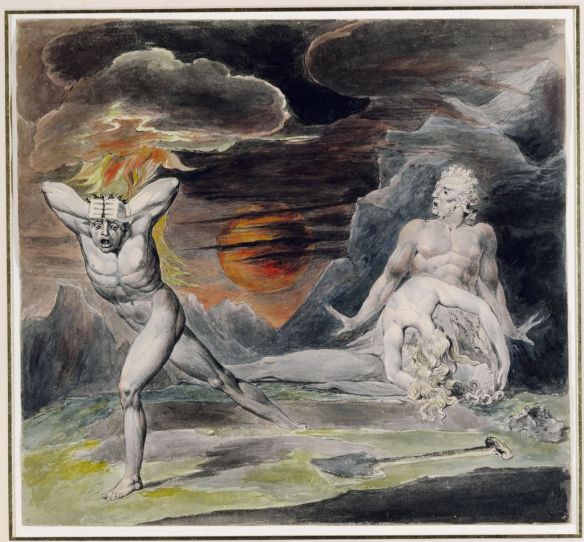
William Blake painting of “Cain fleeing from the wrath of God “as Adam and Eve look on in horror following the fratricide.
I think of ‘Hevel’ — The Hebrew name translated into English as Abel, the slain brother in the Genesis story of Cain (Kay-in) and Abel (Hevel) — and wonder what the story-teller is telling us by naming the murdered brother Hevel (a mere short breath) and by leaving us with the image of Hevel’s blood crying from the ground. I hear Hevel’s voice screaming from the ground in Palestine, Ukraine, Sudan, Sandy Hill, Uvalde, Parkland, Ferguson, Minneapolis. How ‘vapid’ are my thoughts. I am a puff of air, nothing less and nothing more than a vapor that appears in the morning and by evening vanishes. “What is your life?” asks the Epistle of James. “For you are a mist that appears for a little time and then vanishes.”
How have we mortals become such dolts that we would regard our species as inextinguishable? How does a Puff like me become wise? How does a descendant of Cain atone for spilling Hevel’s blood on the ground? How will I, a puff of air, live less pretentiously, more humbly before the Breath of Life itself, YHWH, God only wise, hid from my eyes?
I think of Elie Wiesel’s story of Rebbe Baruch and his grandson Yahiel. Wiesel tells the story in Four Hasidic Masters and Their Struggles with Melancholy. When Yahiel walks into his grandfather’s study in tears, Rebbe Baruch greets him with great tenderness. “Why are you crying, Yahiel?” His answer opens the door for Baruch to teach Yahiel about his relationship to God, and the character of God. Yahiel and his friend had been playing Hide-‘n-Seek, but the game ended before they had finished. Yahiel had hid so well that his friend gave up looking for him. He ran home in tears
“That’s not fair,” says Yahiel to his grandfather.
“God is hiding, too, Yahiel,” says the Rebbe. “God is crying because we have stopped searching.”
YHWH is hiding. God, too, is crying.
Gordon C. Stewart, public theologian, host of Views from the Edge, author of Be Still! Departure from Collective Madness (2017, Wipf and Stock), Brooklyn Park, MN, April 29, 2025
”There’s a gullible side to the American people. They can be easily misled. Religion is the best device used to mislead them.” — Michael Moore
Like the “Make America Great Again Bible,” the Trump campaign’s “Fear Not” marketing pitch preys on religious gullibility. For Christians, “fear not” brings to mind Jesus’s assurance: “Fear not, little flock, for it is your Father’s pleasure to give you the kingdom.” It also reminds us of the angels’ message to shepherds, abiding in their fields by night” in Matthew’s birth narrative.
How and why anyone would send the chain e-mail message asking me to “Forward this message to 10 friends… I want to spread the LOVE,” is puzzling.
The message came with a photo advertisement for a “FEAR NOT” coffee mug, featuring former president Trump in a MAGA hat. His fist is raised in defiant resolve with “Old Glory” waving in the background.
So, there you have it. FEAR NOT and LOVE together on a coffee mug featuring a mug shot of the “Chosen One” who uses the word G-d on occasions when it’s useful. What could be better?
The Relationship between Fear and Love
Fear and love lie next to each other at the heart of Christian faith. The First Letter of John describes the relationship this way. “There is no fear in love. But perfect love casts out fear, because fear has to do with punishment. The one who fears is not made perfect in love.”—1 John 4:18
The Christian story of Jesus as the Christ (the Messiah) begins and ends with fear.
And the angel said unto [the shepherds] ‘’Fear not: for, behold, I bring you good tidings of great joy, which shall be to all people. For unto you is born this day in the city of David a Savior, which is Christ the Lord.’” – Gospel According to Luke 2:10, KJV.
In the Garden of Gethsemane, Jesus of Nazareth prays to be spared the horror awaiting him the next day. His plea is not granted. Yet Christians profess him Lord and Savior. He suffers torture and death on a cross outside the city walls on the Hill of Skulls. Before the wrenching cry of abandonment, “Eloi, Eloi, lama sabchtani?” (My God, my God, why have You forsaken me?”), Jesus cries out from the cross, “Father, forgive them, for they do not know what they are doing.”
A surprising way to end a Gospel
The original ending of the Gospel Mark, the earliest of the four New Testament Gospels, ends with fear. Young’s Literary Translation reads as follows:
And, having come forth quickly, they fled from the sepulchre, and trembling and amazement had seized them, and to no one said they anything, for they were afraid.
The Monday following the second attempt on his life, the Trump campaign announced that “Democrats’ rhetoric inspired another attempt on former President Trump’s life.” Recalling the earlier attack in Butler, PA, the former president spoke in religious terms.
“There’s something going on,” he said. “I mean, perhaps it’s God wanting me to be President to save this country. Nobody knows.” — Antonio Hitchens, The New Yorker, September 18, 2024.
An image on the Trump coffee mug also features graphic image that intertwines two American twisted into angel’s wings. The words at the top read:
“GOD SAID: NOT TODAY”
Alexis de Tocqueville’s Reflection on America
“Not until I went into the churches of America and heard her pulpits flame with righteousness did I understand the secret of her genius and power. America is great because America is good, and if America ever ceases to be good, America will cease to be great.” — Alexis de Tocqueville
Whether Tocqueville said it, or the presidents, senators, and other Americans in high places mistakenly attributed it to Tocqueville, makes little difference to its wisdom and warning. Without goodness, there can be no greatness.
Gordon C. Stewart, public theologian, author of Be Still! Departure from Collective Madness (2017, Wipf & Stock), Brooklyn Park, MN, Dec. 15, 2024 (revised from unpublished draft written Sept. 20, 2024).
Pull down thy vanity, it is not man Made courage, or made order, or made grace Pull down thy vanity, I say pull down. Learn of the green world that can be thy place .
Ezra Pound, Canto LXXLI
They’re not after me. They’re after you. I’m just standing in the way.
There’s been a mistake
There’s been a mistake. I don’t know you; you don’t know me. No one is coming after me. I’m not that important. Neither are you. No one with their wits about them could believe you are the only one who keeps “them” from getting to me. But the pitch has a familiar ring.
The old, old story?
It sounds like “the old, old story of Jesus and his glory, of Jesus and his love,” but this story is a far cry from the one in the New Testament. The Biblical story includes a warning, attributed to Jesus: “Many will come in my name, saying, ‘I am the Messiah,’ and they will lead many astray.”
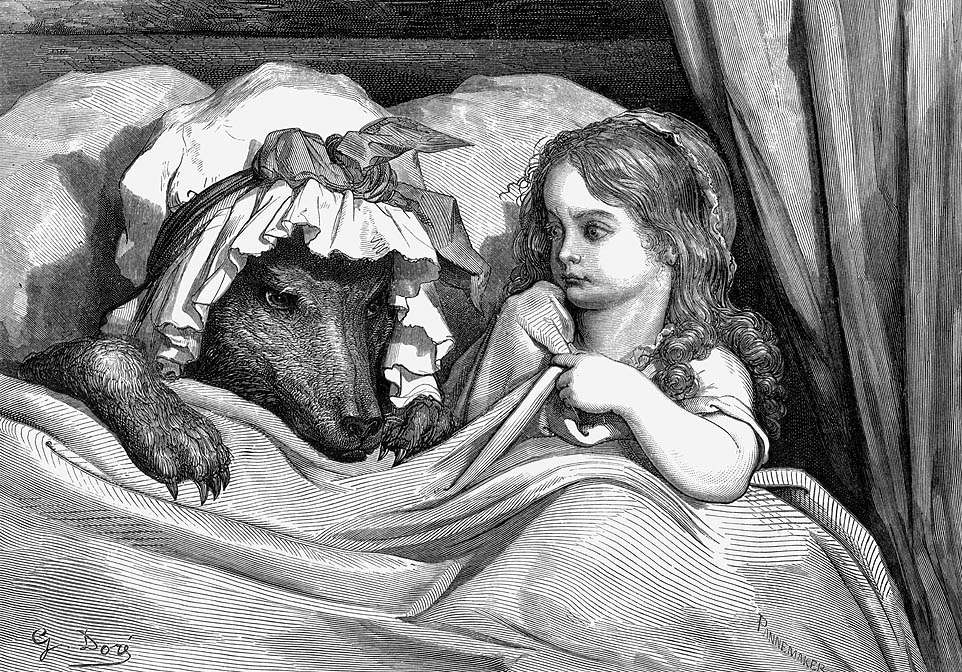
It’s a biblical way of saying, “Don’t mistake a wolf disguised as Little Red Riding Hood’s Grandma for the Good Shepherd who lays down his life for the sheep.
Life with Buddy
Even a parrot can quote scripture. But there’s a difference: the parrot has no idea what it’s saying. Human beings do. Take Buddy, for example. Shortly after arriving for a visit with old friends, the phone rang. Harry stayed put. Knowing that any call to Harry could be an emergency, we encouraged Harry or Anna to feel free to take the call.
Harry raised his finger to his lips. Anna smiled and whispered, “Shhhh!
The phone continued to ring. When it stopped, a voice from an adjacent room yelled, “Harry! It’s for you! Harry. . . it’s for you!”
If imitation is the highest form of flattery, an African Grey Parrot doesn’t know it. After Buddy had fooled us with his imitation of the phone ringing, with precise intervals between the rings, and calling Harry to the phone, Buddy went on to recite the 23rd Psalm. “The Lord is my shepherd; I shall not want…” before imitating the sounds of Anna he’d heard every morning: brushing her teeth, gargling, and other sounds not fit to print.
Shakespeare: “O, what a goodly outside falsehood hath!”
“The devil can cite Scripture for his purpose,” wrote Shakespeare in The Merchant of Venice. “An evil soul producing holy witness Is like a villain with a smiling cheek, a goodly apple rotten at the heart. O, what a goodly outside falsehood hath!”
Gordon C. Stewart, public theologian, host of Views from the Edge: To See More Clearly, and author of Be Still! Departure from Collective Madness (2017 Wipf & Stock), Brooklyn Park, MN.
In the eyes of QAnon and Christian fundamentalism, I’m a heretic. I don’t believe in Satan. Not that Satan, the devilish opponent of God. But trying to make some sense of life these days has led me to take another look at Satan.
The biblical Satan is the personification of trickery and the reptilian impulses that lie in wait in every mortal psyche. Satan is a con artist. “You will not die,” whispers the serpent to the mortals in the Genesis story of humanity’s fall from paradisaical innocence. Likewise, in the wilderness temptations of Matthew and Luke, it is Satan who lures “the man for others” (Dietrich Bonhoeffer’s description of Christ) to being a man who cares only for himself. Satin is the personification of the lies that flips reality on its head. Satan is a Con Artist.
Con artistry is never far away. Sometimes we come face-to-face with it. I see it inside the courtroom in New York City where a jury wrestles to disentangling truth from falsehood, evidence from sham, honesty from fraudulence, in full view national figures, members of the U.S. House of Representatives take their seats in room as visiting dignitaries who are surely recognizable to at least one member of the jury. Their physical presence is intimidating; it strikes me as its own kind of witness and jury tampering, a violation of the defendant’s gag order.
Outside the courtroom, I see these same Members of the United States House of Representatives, each of whom has sworn the Constitutional oath of office, line up take their turns behind the microphone and media cameras to denounce the judicial system, malign court personnel, the judge, prosecutors and their families, and read aloud. Up is down and down is up; right is wrong and wrong is right; truth-telling is out; conning is in. I hear Pinocchio’s surrogates betray their oaths of office in hopes of becoming Pinocchio’s right hand. Jiminy Cricket is a distant memory. Conscience is nowhere to be found.
Yesterday confirmed what I know of the biblical Satan who never was but always is wherever there’s an Achilles’ Heel – the vulnerability of mortals to the Con that I and we can do no wrong.
Gordon C. Stewart, public theologian, host of Views from the Edge, author of Be Still! Departure from Collective Madness (2017 Wipf and Stock), Brooklyn Park, MN, May15, 2024.
Flashback and Portent — The Epidemic of Gun Violence
Flashing back to February 1, 2013 feels like a flash forward to America in 2021. An evening in a small church in Chaska, Minnesota on gun violence gave hints of what was coming in eight years later. It was a glimpse into the apocalyptic mind and heart that led to the insurrection of January 6.
February 1, 2013 Opening of First Tuesday Dialogues’ series on gun violence
The parking lot was full. Until that night, First Tuesday Dialogues’ attendance had ranged between 35-75 people. Attendance that night was 138.
The threat of disruption and violence did not materialize. Everyone entered respectfully. But there was a storm cloud hovering over the room. I wondered when the thunder and lightning would come.
I welcomed the crowd, laid out Dialogues’ simple practices and ground rules — respectful listening and speaking with no interruption, no cheering, no booing, no clapping.
The evening began with a half-hour exchange between the city’s Chief of Police and the Carver County Sheriff expressing different views on the increase of massacres like the one at Sandy Hill in Newtown.
The tone was set for a respectful conversation.
The Invisible Guest named John
A Q&A with the chief and sheriff was allotted 20 minutes. A woman in the last row was the first to raise a hand. She was handed the microphone and began by expressing anger that we were having such a discussion. The Second Amendment was the Second Amendment. No government was going to take away her guns. She then began reading from a John Birch Society manuscript. Lots of people clapped and shouted their approval.
A woman a across the aisle was in tears. I gave her the microphone. She stood to ask a question. “Has anyone here lost a loved one to gun violence?”
Four or five hands went up, but before she could tell her story, the first speaker shouted at her, “That has nothing to do with the Second Amendment!” Shouts again rang out. I reminded everyone of the Dialogues’ expectations. If you are holding the microphone, the floor is yours. When you are not holding the microphone, you listen. No rebuttals. No clapping. No shouting. No us versus them.
The woman who’d been crying answered her own question. “I have,” she said, and told the wrenching story story from her childhood. Her story was chilling. The wounds were still fresh. The room was quiet.
The Coming Apocalypse
Two voices later voices foreshadowed America eight years later. The first spoke with passion. Obama and the feds were coming to take his guns. The government is going down. The economy will collapse. The dollar won’t have any value. Grocery store shelves would be empty. Those who are not prepared would have no food to feed their families. We need to get ready for the chaos that’s coming.
The man who next held the microphone agreed. The economy is built on sand. It will collapse. It will be “every man for himself.” If you don’t have a secure bunker full of food to last you a year, you’re in trouble. If you don’t have a secure bunker, build one. Now! When your neighbor comes asking for food, too bad. Have your guns ready.
Like the person who had turned the Q&A into a time for monologues, this speaker had a manuscript from which he quoted. His apocalyptic tone and message felt like the street corner preacher’s citing The Revelation to Saint John, the last book of the Christian Bible, shouting about the end of the world, but this apocalypse was different. Real god-fearing patriots don’t rant on street corners. They don’t preach, and they don’t kneel. They rise up to expose and overthrow the communists, socialists and other collectivists who control of the world. Real patriots stand and fight He was reading from the John Birch Societymanual.
The evening ended peacefully. There was no physical violence. Gun rights advocates were thankful and looking forward to the next event. Others participants expressed fear of violence or discomfort with the rudeness. They would not be back for the next event in the series.
A Dilemma
If Dialogue’s programs success were measured by attendance, the first evening had exceeded expectations. If drawing people of opposing views were the measure, the evening had been a success. Although there had been raw moments that tested the Dialogues norms, the expressions of opinion had been honest. Nothing was left on the table or kept under the table.
During the days that followed, we learned that an estimated 180 people had chosen to attend a public hearing on gun control at the state Capitol. There would be hearing to keep them away from the Feb. 19 program focusing on the Second Amendment. Those who had been at the Capitol were reported to be less respectful and more extreme. We should expect the crowd to double on the 19th.
Stay tuned for “Insurrection and Faith (Part 3).
Gordon C. Stewart, author of Be Still! Departure from Collective Madness (2017 Wipf and Stock), 49 short (2-4 pages) social commentaries on public life. Chaska, Minnesota, February 13, 2021
The daily White House updates on the coronavirus pandemic bring to mind the Medieval folklore of Faust’s bargain with Mephistopheles (the devil). Faust surrenders his soul for the diabolical blessings of wealth, power, and fame.
Dr. Fauci, Dr. Trump, and Dr. Birx
President Donald Trump
Dr. Anthony Fauci, Director of the National Institute of Allergy and Infectious Diseases (L); President Donald J. Trump (C); Ambassador Deborah Birx, White House Coronavirus Task Force Response Coordinator (R)
We see and hear POTUS Donald Trump; then we see and hear Dr. Fauci, and Dr. Birx. Two of three have M.D. degrees required to diagnose and dispense medication. The other has no degree and no license to practice medicine but repeatedly ignores and contradicts Dr. Birx and Dr. Fauci.
Yesterday’s White House update (April 23) offers the latest conflict between knowledge and what seems like insanity. The president referred to “emerging” research showing that the increased sunlight and higher humidity of spring and summer kill the virus. Past studies have not found good evidence to support the theory. But that’s not the worst of it.
Noting unidentified research into the effects of disinfectants on killing the virus, the president went further off the rails by wondering aloud whether a disinfectant could be injected into people because the virus “does a tremendous number on the lungs, so it would be interesting to check that.” Where is Sigmund Freud when we need him?
Sigmund Freud’s Case Study in Demonic Neurosis
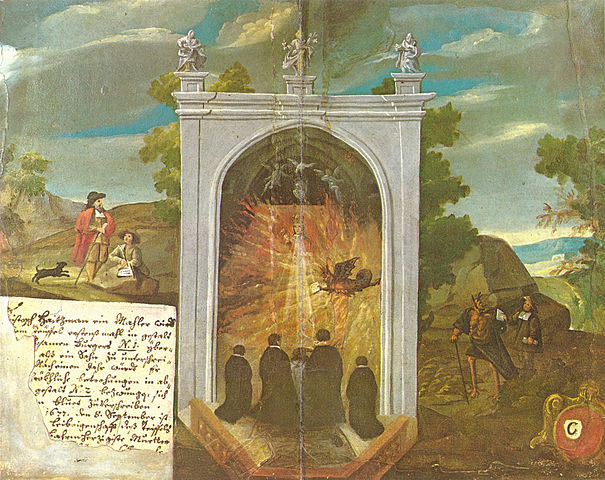
We are children of the Enlightenment. Few of us believe in real life Faustian bargains with the Devil. But Sigmund Freud became intrigued by Johann Christoph Haizmann (1651-1700), a Bavarian-born Austrian painter, after reading Haizmann’s newly recovered narrative description (L) and triptych painting (below) of his Faustian bargain.
Haizmann’s personal description of his experience became the occasion for Sigmund Freud’s and Gaston Vandendriessche’s research on “the Haizmann case” became a part of the study of psychology and psychiatry.
Votive triptych by Johann Christoph Haizmann’s (1651/52 – 14 March 1700). Left: Satan is depicted as a fine burgher, while Haizmann signs a pact with ink. Right: The Devil reappears a year later and forces Haizmann to sign another pact with his own blood. Middle: The Virgin Mary makes the Devil return the second pact during an exorcism.
The Burgher and the Deal with the Devil
Of interest to us here is Haizmann’s depiction of the Devil as “a fine burgher” in the left panel of Haizmann’s triptych. ‘Burgher’ was a title of the medieval a privileged social class. Public officials were drawn from among the burgher class of medieval towns and cities. Haizmann’s choice of a burgher as the Devil in disguise is its own repudiation of wealth, privilege, and power. Only the Virgin Mary could free him from the pact with the Devil.
Freud de-mythologized the religious language and metaphors by which Haizmann had understood himself and his world. In 2020 only a quack would speak of demonic possession! Yet the biblical pictures of demonic possession still have a way of reaching parts of us we cannot explain or escape. Every one of us is a little insane at night, or locked in during the coronavirus pandemic. Few of us keep our twitter feeds on the pillow to push away the darkness. Few of us belong go the burgher class, yet there is something about Donald Trump that was with us before is election and will remain with us after he is gone: the age-old demonic dreams of wealth, privilege, and power.
We speak of neuroses and psychoses instead of demons or the devil the way Haizmann did. But still, there is the haunting memory of King Saul dropping into the abyss of insanity, throwing his spear at David, and the man who had been possessed by the Legion of demons before Jesus asked his name and sent them into the herd of swine. What is happening to us in America defies rational explanation. How does it happen that we allow a soul-less burgher who imagines injecting Lysol into our veins to take the world stage with Dr. Birx and Dr. Fauci?
The Art of the Deal and the Deal with the Devil
The Art of the Deal put Donald Trump on the world stage. Art of the Deal is an autobiography. But it’s not. According to the publisher and the book’s ghost writer, Tony Schwartz, Mr. Trump never wrote a line, but continues to say he was he author. Now that the coronavirus has shut down the economy he tricks himself into being a doctor who always knows best.
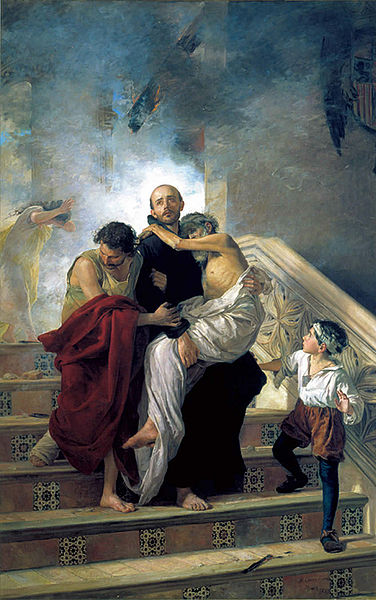
By way of contrast, Johan Christoph Haizmann, relieved from the frantic need for the burghers’ recognition. He joined the Brothers Hospitallers of Saint John of God, aka, the Brothers of Mercy to spend the rest of his life serving the poor, and the sick of body and mind.
Manuel Gómez-Moreno González: San Juan de Dios salvando a los enfermos de incendio del Hospital Real (English: Saint John of God saving the sick from fire at the Royal Hospital)
Black Saturday isn’t part of everyone’s experience; even many Christians don’t know it by that name. They know it as Holy Saturday, the day of dreadful silence that follows Good Friday. Jesus is dead. “It is finished.” It’s dark. There is not yet a resurrection. Jesus’s words of horror hurt our ears. Not the consoling words: “Father, forgive them, for they don’t know what they’re doing.” Nor his reply to the penitent hanging to his right, “Today, you will be with me in paradise.” Nor his care for his mother: “Woman, behold your son.” and to the un-named apostle, “Behold your mother.”
On Black Saturday we remember what we easily forget on other days: Jesus’s wrenching cry of god-forsakenness. Eloi, Eloi! Lema sebachtani? “My God, my God, why have you forsaken me?”; the thrust of the centurion’s spear opening a gash his side. “It is finished.”
Black Saturday and Shouts of Blackmail
Black Saturday feels darker this year by the ascendancy of the scapegoat mechanism at work in the trial and execution of Jesus, i.e. the consolidation of power by creating the scapegoat which must be sacrificed/killed to save the nation. But as the Alleluias will remind us tomorrow, you cannot kill love. You cannot kill goodness. You cannot kill the truth. Today’s White House “Resolute Reads” repeats the scapegoating with this quote from The New York Post:
“These left-leaning outlets don’t even care that their covering for Dems is so blatant. The Times took heat just this month for changing a headline, “Democrats Block Action” on the $2.2 trillion rescue plan, to “Partisan Divide Threatens Deal.” Yet that didn’t stop Thursday’s changeroo.
“No wonder Dems are so willing to resort to blackmail: They can count on their puppets in the press to never report it that way.”
New York Post April 9 editorial quoted in the White House daily update.
Black Saturday and Easter Sunday — Ego cannot defeat Soul
Into this Black Saturday reflection a stranger’s post arrives with a positive note that strikes a chord with me. Perhaps it will with you.
Andrew Cuomo’s Faith for All

Andrew Cuomo today is a phenomenon. He speaks every day about the coronavirus and his press conferences have become must-see tv. Why? Many reasons, but at heart he speaks to spiritual yearning in all people, a yearning that focuses not on religion and/or God, but on the truth and depth of our common humanity.

The Governor of New York State has become the voice of leadership and compassion during the coronavirus pandemic. His daily talks have become a time to hear the facts, face the reality, and listen to a calm voice of reason, hope and challenge. Beyond the arena of New York politics, about which most Americans know nothing, he has been received by the nation as a man to whom we can relate. He helps us transcend political divisiveness and helps us realize that we are all human beings.

He is a Roman Catholic, but one that many in his church would choose to excommunicate. Under his guidance, New York recognizes gay marriage and has the most humane abortion law to be found in America. It is clear from his presence that he is a man of deep faith, but also one whose faith is not determined by institutional religious authority. One might argue that his ability to speak to everyone is a result of decades of honing his political acumen, but that would be a shallow understanding. At least in these press conferences, Cuomo strikes a deep spiritual chord that resonates with most people.

To begin with, he respects everyone, whatever their religion or lack thereof, whether they celebrate Passover, Easter, Christmas, Ramadan or Kwanza, and you cannot help but feel that his respect is genuine. For public safety, however, public gatherings are prohibited. There is no exception for religious services, weddings or funerals. The kind of flagrant violation of stay-at-home policy exhibited by arrogant ministers in other states is strictly forbidden by Cuomo in NY.

Along with his acceptance of respectful others is a self-confidence that enables honest straight talk, incorporating a stature that can empathize with those who are hurting, both emotionally and physically. Essential to this data-driven attitude is a refusal to speculate, whether about the future of the pandemic or indeed about anything that might be called mysterious or mystical. His boldest statement about mystery asserted that although we are socially distanced we are spiritually connected, but he didn’t know how.

The only use of the word “God” is in the context of describing someone who risks their life for others. “God bless them”. God is also intimated in the phrase “keeping them in our thoughts and prayers”. But in both instances, the phrase seems to be more a term of popular culture than an actual assertion of faith. The closest Cuomo gets to a confession of faith is in his assertion that love wins. Love wins out over fear and anger. It also wins out over economic considerations. And to the calls by right wing voices to let the old and infirm die because they contribute nothing to society anyway, Cuomo responds with scorn and utter disbelief. No one is expendable. Loving and caring for one another is the essence of our humanity. Life is not reducible to numbers. This holds true not only for the elderly and infirm, but also for the outcast of society, the poor and the weak, those who labor for naught and strive in vain. If there is any refrain in his speaking, it is Cuomo’s prophetic insistence that no one will be left behind, that love reaches out to all and compels us to create a just society.
This is a moment, he says, for the world, for our country and state, for us as individuals. “Moment” is a word that he uses often, referring to a time in our lives when great change becomes possible. Stripped of diversions and escapes, we are free to explore our inner angels, to learn, to read, to listen in silence to the silence. The great danger, Cuomo believes, is giving in to the fear of the unknown that awaits us vis a vis both the virus as well as our own future. Too easily reason succumbs to fear and is overtaken by irrationality and panic. It is at this point that he says that this not the NY way, by which he means that this is not the human way, the way of strength, smartness, unity, and…love.

This is a message that reverberates across the country and probably around the world. It does not say, hey look at me and my needs. It says we are all in this together. And it does not say: learn how to do yoga, or meditate, or pray, or become a mystic. It simply says, appreciate the moment, accept the pain, do good, look ahead and celebrate the time when you can be together again with friends and loved ones, and, most importantly, share your love with all.

Many Americans, it seems, hear and understand.
If you’d welcome a live-streamed Easter celebration, click HERE for the 10:30 a.m. CT service of Westminster Presbyterian Church in downtown Minneapolis, or HERE for The House of Hope Presbyterian Church in Saint Paul, MN.
Gordon C. Stewart, Chaska, MN, Black Saturday, April 11, 7:30 p.m. CST.
“Wouldn’t it be great to have all of the churches full [on Easter]? You know the churches aren’t allowed, essentially, to have much of a congregation there,” said President Trump in a Fox News interview. “You’ll have packed churches all over our country. I think it would be a beautiful time.”
Christianity Lite
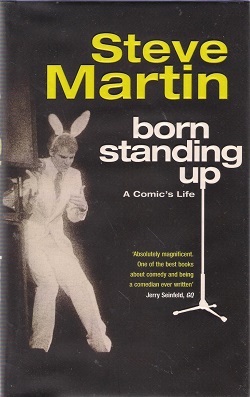
It won’t happen. Except, maybe, at the Tampa Bay megachurch, whose pastor’s arrest made headlines. But if it should happen that the churches are packed this Eastern, they would be filled with six-packs of “Christianity Lite” — the religion of “The Life of Brian” (Monty Python) and “Happy Feet” (Steve Martin).
The book cover for Steve Martin’s book Born Standing Up: A Comic’s Life draws laughs because comedy routines like “Happy Feet” are wonderfully outrageous critiques of real life rip-offs that masquerade as Easter joy -“the power of positive thinking” and “the prosperity gospel” — that replace the real joy that comes out of horror.
Out of sorrow and death
“Agony in the Garden” from door of cathedral in Beaumont, Texas
Easter is not about the Easter Bunny and Happy Feet. It’s the Church’s celebration of the resurrection of the Jesus who was “crucified, dead, and buried” (Apostles Creed). It’s not “happy”; it’s thoughtfully joyful.
Easter comes after Holy Week’s contemplation on the Passion, focusing the mind and heart on Jesus moving steadily toward his own state execution while his closest companions betray him, deny knowing him, fail to stay awake with him, abandon him in the moment he feels utterly abandoned — Eli, Eli, lema sabachthani(“My God, my God, why have you forsaken me?”) — and return home in that dead silence when nothing but death seems certain.
Reaping what we sow
Ralph Drollinger of Capitol Ministries is a White House “faith advisor” who leads a weekly Bible study attended by White House staff, members of the House and Senate, their staff, and other federal workers. He and Paula White, the other “faith advisor” in the White House, have the President’s ear. That’s deeply troubling.
As COVID-19 circles the globe ignoring national boundaries and borders, Mr. Drollinger attributes the coronavirus pandemic to “the consequential wrath of God.” We are reaping the consequences of what we have sown: radical “environmentalism” that goes against our Creator”; “the suppression of truth” by atheists and those who don’t believe the Bible is the inerrant, literal word of God; and the acceptance of what he calls “a sensation toward homosexuality.”
The Parable of the Sower in the Gospel of Matthew
And he told them many things in parables, saying: “Listen! A sower went out to sow. And as he sowed, some seeds fell on the path, and the birds came and ate them up. Other seeds fell on rocky ground, where they did not have much soil, and they sprang up quickly, since they had no depth of soil. But when the sun rose, they were scorched; and since they had no root, they withered away. Other seeds fell among thorns, and the thorns grew up and choked them. Other seeds fell on good soil and brought forth grain, some a hundredfold, some sixty, some thirty. Let anyone with ears listen!” -- Matthew 13:3-9 NRSV
The focus of the parable is not “the consequential wrath of God” and, perhaps, we are not the sowers but the soil into which God sows the seed. The Parable of the Sower offers an invitation to live now as the good soil that produces a joyful harvest in the Sower’s field.
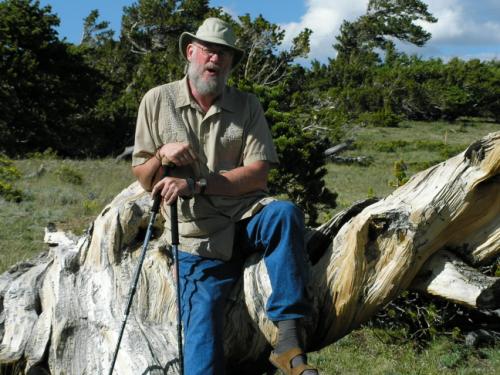
Seen here with his 6’8″ frame squeezed into his seat on a flight to somewhere, Steve Shoemaker (1942-2016) wrote poetry. Often the verses came to him in the dark. At 3:00 or 4:00 A.M. Steve would turn to his right side so as not to disturb Nadja, and commit the verses to his iPhone. The poem was waiting in the in-box in the morning.
Often he led the reader through the lines to a surprising last line that shined a humorous light on all that had come before.
LENT
I will give up writing poems for Lent.
I will give up eating desserts for Lent.
I will give up sex for Lent.
I will give up thinking about sex for Lent.
I will give up lying for Lent.
I will give up bragging for Lent.
I will give up exaggerating for Lent.
I will give up self-centeredness for Lent.
________________________________
I will give up self-denial for Lent.
— Steve Shoemaker RIP, Ash Wednesday, March 5, 2013.
In this era of ill-humor and self-indulgence, Steve’s tongue-in-cheek verses ring the bell on the distortions of our best intentions and our shared need to focus on what lies beyond the self.
This photograph shows Steve sitting on an ancient bristlecone pine at 11,000+ feet in Colorado. — GCS, Feb. 25, 2020.












 Views from the Edge