When Truth Has Stumbled in the Streets

“Truth has stumbled in the streets, honesty cannot enter. Truth is nowhere to be found, and whoever shuns evil becomes a prey.” — Book of Isaiah 59: 14b-15a

The Press Conference

Moments ago House Minority Leader Kevin McCarthy performed a Fred Astaire song-and- dance act, after which a “press corp” composed of theater critics, ballet dancers, singers, and actors from Broadway had time to asked embarrassing questions. The Minority Leader was frequently off-key. Every other step was a diversion. Some taps were an About-Face. It’s hard to tap dance in hip-boot waders.

Tap dancing in hip-boots

Mr. McCarthy offered no explanations for his well-documented changes of mind, reversals and U-Turns. If you were listening carefully, you might have heard an off-stage prompter’s cue from an unhappy puppeteer: “A b o u t Face!” But the tap dancer didn’t know which way to face. Without a moral compass it’s easy to get lost.

"No one calls for justice; no one pleads his case with integrity." -- Isaiah 59:4a

I watched it live on C-Span. No pundit told me what I was seeing and hearing, and no “Breaking News!” announcements made my heart race.

Truth is not an artifact

Truth-telling never was popular. Yet it was a founding virtue in American culture. “We hold these truths to be self-evident….” We didn’t, of course, but we said we did. Truth was the premise of all that followed in the Declaration of Independence. In 2022 truth is a relic, a dead virtue like Latin, rolling in the dust; nothing is self-evident. Or could it be that truth abides in America; you just have to hunt for it? Yet, even hunting for truth for the sake of goodness can be a u-turn toward evil, as it did seven decades ago until a truth-teller named Welsh and a truth-seeking reporter named Murrow confronted the demonic crusading behind the pretense of goodness.

"They rely on empty arguments and speak lies; they conceive trouble and give birth to evil." -- Isaiah 59:4

A sense of decency

When Senator Joseph McCarthy (R-WI) attacked a young attorney in Mr. Welsh’s law firm as a suspected communist or communist sympathizer, Welsh had had enough, and said so: “Let us not assassinate this lad further, Senator. You’ve done enough. Have you no sense of decency, sir, at long last? Have you left no sense of decency?“

“See It Now”
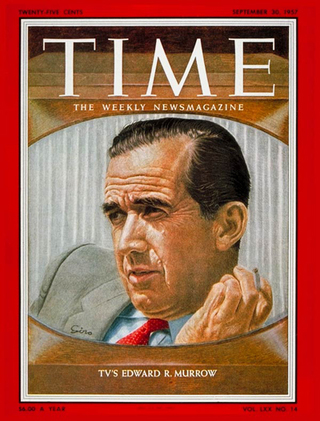
March 9, 1954 Murrow’s “Report on Sen. Joseph McCarthy” aired on his popular CBS program “See It Now” featuring excerpts in which the junior Senator from Wisconsin repeatedly contradicted himself. Joseph Welsh’s rebuke — “Let us not … Have you left no sense of decency”— swept across the country. Viewer letters to CBS ran 15-1 in favor of Murrow’s report.

Attack on the Press as “a Jackal Pack”

When Murrow offered the senator a full half-hour on “See It Now” to respond to the report in any way he might choose, McCarthy delayed his appearance until April 6. McCarthy did not appear in person. Instead, he provided CBS with a filmed response, accusing Murrow of being a communist-sympathizer, or worse. The transcript of McCarthy’s defense included an attack on the press as “jackal pack”:

Ordinarily, I would not take time out from the important work at hand to answer Murrow. However, in this case I feel justified in doing so because Murrow is a symbol, a leader, and the cleverest of the jackal pack which is always found at the throat of anyone who dares to expose individual Communists and traitors.

Excerpt, Sen. Joseph McCarthy rebuttal on “See It Now” (April 6, 1953)
"They hatch the eggs of vipers, and spin a spider's web." -- Isaiah 59:5a

Murrow later noted that McCarthy “made no reference to any statements of fact that we made” and addressed McCarthy’s accusations against himself. If the best defense is a good offense, McCarthy’s single-note smear strategy was no match for truth. Senator McCarthy was censured by the Senate, but his spirit and appeal to fear never left.

Common Decency

This sordid history is embedded in American culture. We’ve become a culture of distrust, suspicion, accusation, and division. There is no Edward R. Murrow, and if there is one or many, the multiplicity of news sources insures that the American public will no longer see or hear the same things across the political divide.

"So justice is far from us, and righteousness does not reach us. We look for light, but all is darkness; for brightness, but we walk in deep shadows. Like the blind we grope along the wall, feeling our way like those without eyes." -- Isaiah 59:10a

The descendants of Joseph McCarthy are feeding truth, decency, and the Constitution through the shredder. If you want to see reality with your own eyes and hear it with your own ears, tune in to C-Span and C-Span 2 to discern truth from falsehood, good from evil, transparency from obfuscation, a ballet from a tap dance in hip boots.

— Gordon C. Stewart, Brooklyn Park, MN, Jan. 12, 2022.

January 6 — Epiphanies

A Day of Infamy

The day after the attack on Pearl Harbor, POTUS Franklin Delano Roosevelt addressed a joint session of Congress. “Yesterday, December 7, 1941—a date which will live in infamy…” he began. His oft-cited words could have been repeated the day after the attack on the U. S. Capitol January 6, 2020.

The POTUS defeated in the 2020 election called no special session of Congress on January 7, 2021. The day before (Jan. 6, 2021) the President stayed in the Oval Office dining room watching the rampage through the halls of Congress, and Capitol Police rushing Members of Congress, the Vice President and their staff members into hiding. He kept his eyes glued to the unfolding images as if watching contestants on Jeopardy.

When finally he spoke after 187 minutes of silence, he told those who had breached the Capitol “…So go home. We love you, you’re very special. We’ve seen what happens, you see the way others are treated that are so bad and so evil. I know how you feel. But go home, and go home in peace.” There was no special session of Congress, as on the day after Pearl Harbor. Congress impeached Mr. Trump for the second time over the objection of Jim Jordan (pictured below), Marjorie Taylor Greene, and others. Loyalist senators voted to acquit him. January 6, 2020 will be remembered as the day the Big Lie and Stop the Steal almost stole democracy.

Marjorie Taylor Greene 🇺🇸
@mtgreenee

  1. We must remove Adam Schiff from Congress.
    It’s not enough to take him off committees.
    He has heinously abused power & LIED repeatedly to the American people to weaponize the government to attack his political enemies.
    He’s a Communists.
    All Communists must be expelled.
    10:03 AM · Dec 15, 2021·Twitter for iPhone

Blacklisted – on the LIST (Click Here)

Painting public figures as Communists has a history. In 1952 and following, the right wing of the Republican Party created a “blacklist” of Communists and Communist sympathizers.

The List

10 PUBLIC FIGURES

Helen Keller
Leonard Bernstein
Burl Ives
Pete Seeger
Artie Shaw
Zero Mostel
Charlie Chaplin
Langston Hughes
Orson Welles
Dolores del Rio

+Adam Schiff (added 12/15/22

Epiphany

The date of the 2021 Capitol insurrection coincided with the Feast of the Epiphany which my church celebrates every January 6th, no matter the current circumstances. On Epiphany the heart is lifted by the Gospel of Matthew’s story of the Magi (wisdom figures) who have come from afar, kneeling before a newborn as fragile as any newborn to offer their gifts of gold, frankincense, and myrrh.

It was and is a question of kneeling

Prior to their arrival at Bethlehem, these sages from the East go to “Herod the king” asking for directions to the place where the new king has been born. A “troubled” King Herod summons his advisors to gather information. He then summons the “wise men” secretly to ascertain from them when the star had appeared. Herod gives them directions to Betlehem, and tells them to come back to him when they have found the child, “that I too may come and worship him.”

The Magi do not return to Herod. “And warned in a dream not to return to Herod, they departed for their own country by another way.” Herod is furious. Herod never disappears. Cunning and deceit never end. Darkness remains. But the Light –the star shining over an animal shelter — remains. Last year Epiphany there was darkness and there was light. A would-be king trembles and flies into a slaughter of innocents. For years to come, January 6 the memory of a violent insurrection and the Feast of the Epiphany will sit side-by-side. May we have the wisdom to follow the Light that cannot overcome the darkness.

Pete Seeger

The two competing images of the wise visitors to Bethlehem and of Herod’s cunning will through light on reality as it is. If Burl Ives and Pete Seeger were branded as Communists, I wonder about Dolly Parton. Dolly did appear with Big Bird on Sesame Street.

“What a Friend We Have in Jesus” is an old favorite of Protestant Christians. Pete Seeger (RIP) knew what happens when we look to Congress to save us.

For more information on the history of blacklisting, click Blacklisting by the House Un-America Affairs Committee.

Gordon C. Stewart, public theologian, author of Be Still! Departure from Collective Madness (2017 Wipf and Stock), Brooklyn Park, MN 55443.

Isabell’s Smile

The most beautiful thing we can experience is the mysterious,” wrote Albert Einstein. “It is the source of all true art and all science. He to whom this emotion is a stranger, who can no longer pause to wonder and stand rapt in awe, is as good as dead: his eyes are closed.” 

Albert Einstein

Isabell’s Wonder and her Grandfather’s Wondering

Christmas felt different this year. Until four-month-old granddaughter Isabell smiled, gurgled, and giggled back from the blanket on the floor. Before that I had been stuck in the soul-wrecking kind of wonder, not the wondrous kind of wonder Einstein described. No sugar plums danced in my head.

Photograph of Isabell Smiling
Four-month-old Isabell, Christmas day, 2021

Events of the past year were tumbling over each other. I hear the sound of a paper shredder and wonder whether any copies of the Constitution will survive the shredders. I see the Mother of Exiles, her lamp still held high, but dimming, while the torches of hate grow bright to erase Emma Lazarus’s poem welcoming “the poor, huddled masses, and tempest-tost, yearning to be free.” I hear the torch-bearers chanting in Charlottesville “You will not replace us! Jews will not replace us!” and hear the Munich Beer Hall Putsch in my language. I see the party of Lincoln riding the wave of the Big Lie and wonder when patriotism became treasonous and “open carry” the closest synonym of freedom. I see the gallows outside the Capitol, hear the shouts “Hang Mike Pence” and “Execute Nancy,” and wonder how individual freedom was severed from responsibility, and who decided only whites neighbor. I wonder what happened to the Golden Rule and the parable of the Good Samaritan. I wonder whether the demons of national exceptionalism and white supremacy can be exorcized, and if and when the 100-year fires, hurricanes, tornadoes, droughts, and floods will knock sense into climate change-deniers before the murder-suicide pact leaves no one to be replaced. I wonder what will become of us. I have to wonder.

Bethlehem and an Empty Chair for Elijah

We are no closer to Isaiah’s vision of the peaceable kingdom than the day Jesus was born in Bethlehem. The Hebrew prophets’ “Day of the Lord” or its New Testament equivalent, “the Kingdom of God” is harder to imagine when Herod seems closer than the wisdom of the Wise. Elijah’s empty chair at the annual Seder meal is kept empty as a sign of hope against hope that the Messianic kingdom of Isaiah’s vision and Jesus’ preaching are more than pipe dreams.

Isabell knows nothing about any of this. She does not wonder the way I do. Shel smiles back at her grumpy grandfather, wiggling, gurgling, and giggling with joy. Isabell is no stranger to Einstein’s “beautiful thing” — the ‘thing’ that is not a ‘thing’.

The Experience of the Sacred

Fred and Jo never met Isabell. They were in their mid-90s and mid-80s when she first opened her eyes. She never saw Jo and Fred walking hand-in-hand around the retirement center. If it weren’t for the gray hair and hint of a limp, on onlooker might mistake them for teenagers. Their love was as fresh as the morning dew. The luster of love’s delight had not dimmed or faded until Jo’s daily greeting —“Good morning, Dear. How are you today?”— stopped. Two years later, her heart stopped also.

When the funeral home attendants arrived at the Memory Care Center, Fred had settled himself in the chair at the foot of the bed. Respecting his grief and wanting to protect him from viewing their work, the attendants invited him to leave the room until they were finished. Fred declined their invitation. He stayed in the room to watch each step of the process of preparing the deceased’s body, and followed the attendants and the body down the elevator and out to the hearse.

When asked later what his experience had been watching the whole process while deep in grief, Fred looked at me and paused. . . for a long time. The look on his face was quizzical. “I’m looking for the right words,” he said. “I can’t explain it. “‘Wondrous’ is the only word that comes to mind.” “I can’t explain it.” “It was ‘wondrous’!”

In that moment 90-year-old Fred and four-month-old Isabell were on the same page, alive and pausing in wonder at the beauty of it all.

“There are in life a few moments so beautiful that even words are a sort of profanity.” (Diana Palmer)

Diana Palmer

Gordon C. Stewart, public theologian, author of Be Still! Departure from Collective Madness (217 Wipf & Stock), Brooklyn Park, MN, Dec. 29, 2021.

Have We Forgotten How to Listen?

About the Author

Thanks to Janet Morrison of Harrisburg, NC for accepting our invitation to elaborate on her comment on Harry Strong’s Biases series. Janet is a writer, blogger, and published author. Information about Janet and her work is available on Janet’s Writing Blog or Janet Morrrison Books.com. Views from the Edge added the headings and graphics to the original text of “Have We Forgotten How to Listen?”

Have We Forgotten How to Listen?

by Janet Morrison

Throughout much of 2021 I participated in an online group discussion of LEAPFROG: How to Hold a Civil Conversation in an Uncivil Era, by Janet Givens, M.A. The recent “Blind Biases” series of posts by Harry L. Strong on Gordon C. Stewart’s “Views from the Edge” blog reminded me of Ms. Givens’ thought-provoking book. 

How do we have that difficult conversation with someone with whom we disagree? 

Our nation is more polarized now than in any other time in my life. The assassination of a U.S. President, the Civil Rights Movement, the racial desegregation of the public school I attended, the “Cold War,” the anti-Vietnam War demonstrations, the near-eradication of polio, the “space race” with the U.S.S.R., the tearing down of the Berlin Wall, the breaking up of the Soviet Union, the advent of the internet, 9/11, global warming, and an attempted coup at the U.S. Capitol have been the soundtrack of my life.

From verbal filters to open floodgates

Whereas, polite society used to dictate a level of restraint in public discourse, social media and a former U.S. President who demonstrated no such verbal filter, opened the floodgates for anyone and everyone to voice their opinions as often and as loudly as they desired. 

The result of this shift is that the individuals with the most extreme views feel emboldened to not only voice their opinions but to launch vile personal attacks against anyone who dares to disagree. With all filters turned off, we have transitioned into a country in which everyone is expressing their opinions and no one is listening.

LEAPFROG

The “L” in Ms. Givens’ LEAPFROG book stands for listening. It made me think about the necessity of listening if we’re to have a productive conversation on any level.

In our compulsion to force our ideas down the throats of others, we’ve lost our ability to listen. 

When’s the last time you listened to someone whose views on politics differed from yours? No. I mean, did you really listen? Or were you so wrapped up in your viewpoint and your desire to convert the other person to your way of thinking that you didn’t genuinely listen to the other party?

We’re all guilty. We’ve not only brought all our biases to the table; we’ve forgotten our table manners. 

We’ve forgotten how to listen.

Alert and ready for the Unexpected 

Merriam-Webster’s Collegiate Dictionary, Tenth Edition, 2001 defines the word listen as follows: “(1) to pay attention to sound…; (2) to hear something with thoughtful attention:  give consideration…; (3) to be alert to catch an expected sound.” If I may be so bold, I would add a fourth: to be alert to catch an unexpected sound, or word, or explanation. 

Our modern lives are filled with noise. The TV is always on at home. The radio is always on in the car, often tuned into talk radio. Music or a cellphone conversation is always playing in our ears. We’re so attuned to hearing something 24/7 that we can’t go grocery shopping or jogging without having earbuds in our ears. Silence makes us uneasy. Without being aware of it, we’ve trained ourselves to listen to what we want to hear, and this training has conditioned us not to have to listen to anything we don’t want to hear.

Our modern lives are filled with noise. The TV is always on at home. The radio is always on in the car, often tuned into talk radio. Music or a cellphone conversation is always playing in our ears. We’re so attuned to hearing something 24/7 that we can’t go grocery shopping or jogging without having earbuds in our ears. Silence makes us uneasy. Without being aware of it, we’ve trained ourselves to listen to what we want to hear, and this training has conditioned us not to have to listen to anything we don’t want to hear.

Let that sink in. Has our desire to surround ourselves and our very ears only with those sounds we want to hear led us to become closed-minded to truly listening to “the other side” when it comes to the difficult issues of the day? Have we lost our ability to listen? Have we lost our curiosity?

I’m Guilty

I’m guilty. I don’t watch the cable news channels that I know espouse political views with which I disagree. When I hear someone whose viewpoints are in opposition to mine, my knee-jerk reaction is to get angry and make judgments. I admit that I don’t care why their world view is so different from mine. I can’t fathom why they think the way they do, and I’m guilty of not trying to see things from their perspective.

I grew up in a fairly homogeneous community. There weren’t any rich kids in my school. Most people went to church. Most people obeyed the law. As far as I knew, until a few years ago, everyone I grew up with saw the world pretty much the way I did. When I was growing up, I knew there were Republicans and Democrats, but people rarely advertised their political affiliation.

People of various political leanings could be friends. Those who made a point to reveal their political party registration didn’t demonize those of the other party. They could socialize and attend church together. They could even discuss politics and remain friends. They could display the American flag at their homes without being labeled as agreeing with a particular political party. They could get vaccinated against diseases without being ostracized.

One of the sad things for me in this era of polarization is learning that people I thought I knew well, I don’t really know. How can children who were raised like I was raised become adults with whom I have nothing in common?

The most frightening thing about this is that we each love our country; however, we love it in ways that mean we can’t have a civil conversation about it. We not only aren’t listening to each other, we have lost the patience, the energy, the tolerance, and the curiosity to listen to one another.

Until we listen

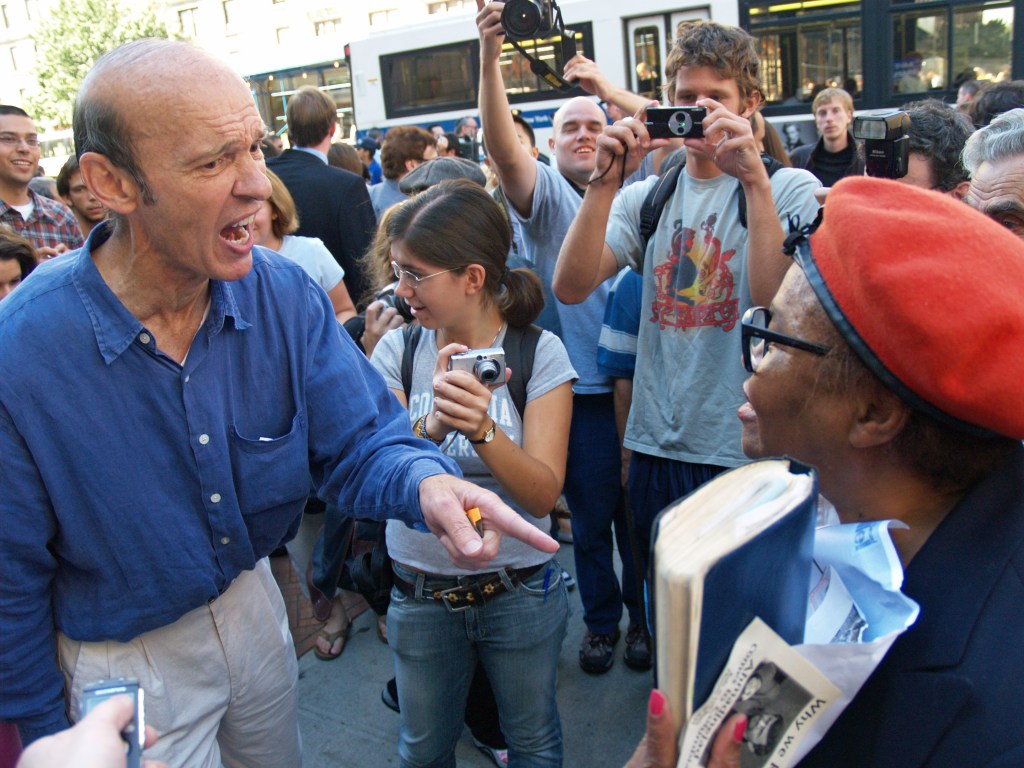
Two people in a heated argument about religion when Mahmoud Ahmadinejad spoke at Columbia University. Photo by David Shankbone, uploaded from Wikimedia, licensed under the Creative Commons Attribution-Share Alike 3.0 Unported license.

Until we learn to listen, family gatherings will escalate into shouting matches and hurt feelings. Congregations will divide into cliques and inflict wounds on our collective Body of Christ. Knowing another person’s political affiliation will influence all our dealings and interactions with them.

Until we recapture our ability to listen and want to know why the other person sees things the way they do, we’re spinning our wheels.

Until both parties to the conversation bring honesty, frankness, and a genuine curiosity to the discussion, our country is not going to move out of this predicament we find ourselves in.

Until we are willing to listen, we can’t call it a conversation. 

Until we listen, we won’t discover what we have in common. 9/11 did that for us. I pray it doesn’t take such a tragedy to reunite us.

Tell us what you’re thinking. Let’s talk.

Go back

Your message has been sent

Warning
Warning
Warning

Warning.

Gordon C. Stewart, host of Views from the Edge, author of Be Still: Departure from Collective Madness (2017 Wipf & Stock), Brooklyn Park, MN, Dec. 20, 2021.

Blind Biases 3

Third of the four-part series Blind Biases” by Harry L. Strong

“People can’t see what they can’t see.”

— Brian McLaren

Catching Up to Lean Forward

Today we turn to the final four (4) of thirteen (13) biases identified by author, activist, and public theologian, Brian D. McLaren, which, McLaren believes, contribute significantly to the hatred, hostility, and polarization that pervades so much of our nation and world today.  Previously, we have noted nine (9) additional biases that McLaren suspects explain partially why we see things so differently from one another.  These include Confirmation Bias; Complexity Bias; Community Bias; Complementarity Bias; Competency Bias; Consciousness Bias; Comfort or Complacency Bias; Conservative/Liberal Bias; and Confidence Bias.  To glean a more thorough understanding of what these biases entail and how they create stumbling blocks to healthy communication and understanding among people with conflicting opinions, the reference appears below to Brian McLaren’s e-book, Why Don’t They Get It? Overcoming Bias in Others (and Yourself).  So, what are four other biases that can dramatically impact our views of life and the world?  McLaren cites these:

Catastrophe or Normalcy Bias: I remember dramatic catastrophes but don’t notice gradual decline (or improvement).

Contact Bias: When I don’t have intense and sustained personal contact with “the other,” my prejudices and false assumptions go unchallenged.

Ca$h Bia$: It’s hard for me to see something when my way of making a living requires me not to see it.

Conspiracy Bias: Under stress or shame, our brains are attracted to stories that relieve us, exonerate us, or portray us as innocent victims of malicious conspirators. [1]

A Window and a Mirror

Did any one of these prompt you to think to yourself: “Oops!  ‘Never thought about that before, but that sounds like ME!”  If you identified one (or more) of those biases in yourself, good for you!  Give yourself a pat on the back for your openness and your vulnerability!  That’s one of the reasons McLaren published his e-book in the first place – so readers like us (you and I) would see our reflection in a mirror and ask: “OK, so now what?  Now that I’ve acknowledged this blind spot, how can I do something about it?  What can I do to change my perspective?”  The other reason McLaren believed his literary venture had some merit was so he could inspire folks like us to recognize biases in others who may not view the world the same way we do AND to motivate us to take the courageous step of looking out our window and reaching out to our sisters and brothers in pursuit of understanding and healing.

Contact Bias: Guilty as Charged

If you zeroed in on “Contact Bias” the way I did, perhaps that’s already occurred to you.  When I was serving as a pastor in a university community like Ames, Iowa, or State College, Pennsylvania, or in an urban setting like Trenton, New Jersey, or Memphis, Tennessee, daily I found myself encountering people who were not like me in appearance, heritage, values, economic status, lifestyle, faith perspective, and a myriad other ways.  Now, living in a golf course community in a town of 20,000 on the western slope of Colorado, hard as it is to hear: “When I don’t have intense and sustained personal contact with ‘the other,’ my prejudices and false assumptions go unchallenged.”  Contact bias: guilty as charged.

So, if like me, you’ve identified Contact Bias as one likely impediment to your ability to understand and appreciate why other people may see things differently than you do, what can we (you and I) do about it? Fortunately, our instructor/mentor, Brian McLaren, can help.  His e-book is not just an academic analysis of our polarization plight.  Brian offers us some very practical bridge-building guidelines, at least one for each of the thirteen (13) biases he identifies.  What does he suggest related to Contact Bias?

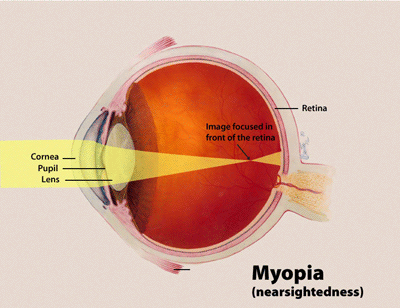
Beyond Myopia (Nearsightedness)

Diagram of Myopia (Nearsightedness)

McLaren points us to Jesus and his intentional, unique way of reaching out to the other, including the other at the table, and putting the other in the spotlight by giving the other a voice.

We may protest: “But how does that help us when there are so few “others” in our geographical area?”  

I think McLaren might say something like this: “Maybe you need to reassess your definition of “others.”  The conflicts that plague our nation are not all related to racial ethnic, socio-economic, or religious differences.  No matter how homogeneous you may think your community is, topics like vaccinations, masking, gun control, individual rights vs. the common good, states’ rights vs. federal mandates are just a few of the issues that are traumatizing and polarizing our nation these days.  No matter how isolated and insulated you think you are where you live, what if you were to broaden your horizons a bit by exploring books, magazines, websites, blogs, news channels, and other venues that are outside your community?  

Remember that Community Bias? “It’s almost impossible to see what our community doesn’t, can’t, or won’t see.”  “Community” can refer to like-minded folks as well as to geography.  Nobody said it was going to be easy, but, one-on-one or in small groups, you can humanize the other by giving people with diverse opinions a spotlight and a voice.  Be intentional about trying to facilitate understanding and deeper relationships.  Again, like Jesus, engage people in storytelling and active, conscious listening.”

Sneak Peak

Wouldn’t it be great if we could conclude our consideration of Blind Biases by identifying Five Ways We Can Help Others to See What They Can’t See?  Guess what?  Brian McLaren can make that happen!  I look forward to getting together with you one more time for Blind Biases 4.  Meanwhile, let’s reflect on these wise words from Stephen Covey (which McLaren quotes in his chapter on Contact Bias): “When you show deep empathy toward others, their defensive energy goes down, and positive energy replaces it.  That’s when you can get more creative in solving problems.”  Harry

)[1] Brian McLaren, Why Don’t They Get It? Overcoming Bias in Others (and Yourself), Self-published: 2019), e-book.

Rebranding Reality: Blackwater and Facebook

Spider-Man

Elijah was Spider-Man this Halloween. No one was fooled. Everyone knows Spider-Man isn’t a four years-old and that Spider-Man exists only in the comics. As It turned out, Elijah’s head was too big for the mask! Elijah’s not the only one whose head is too big for its mask. Facebook is trick-or-treating with a new mask, hoping we won’t see or remember what’s under it.

Rebranding

Re-branding has a history. Not every company is as lucky as Apple. Who doesn’t like apples? Facebook’s new name — Meta — doesn’t change what’s under the mask any more than Xe Services changed Blackwater U.S.A two years after Blackwater “security” guards killed 17 un-armed Iraqi civilians and injured 20 more in Baghdad in 2007. When Blackwater changed its name to Xe in 2009, Views from the Edge highlighted the danger of a privately-owned standing army for-hire on American soil. Click here for the article re-published by Minnpost.com.

From Blackwater to Academi

Changing a name doesn’t change a thing. In 2011, Xe Services was rebranded “Academi”– a training center for military and police special operations. In 2014, Academi merged with Triple Canopy, a rival security company owned by the Constellis Group. But it was and still is a “private security company” of well-trained Army Special Operations personnel, Green Berets, Rangers, SEALs, MARSOC Critical Skills Operators, and other retired armed forces personnel, operating away from public scrutiny in the black waters of its 6,000-acre training ground in North Carolina.

From Facebook to Meta

The same is true of Facebook. Rebranded last week after a whistleblower exposed Facebook and the founder with an ego is too big to hide behind a mask, Facebook is still what it was before it re-presented itself as “Meta”. The rebranding doesn’t remove the spider or erase the algorithm spiderweb in which Facebook users are forever trapped. You can put a mask on a spider but it’s still a spider. In fact, it makes it worse. It “creates” a “metaverse” of “avatars,” and “afterparties” that bring users closer than we dared imagine. “Horrison” is the name of the new “Meta” platform.

Time will tell

If rebranding Blackwater as Academi and Facebook as Meta succeeds in fooling us, it will be because they know better than we how short the American memory is. The companies founded by Erik Prince and Mark Zuckerberg have placed their bets that the American public won’t remember what’s behind the masks. They believe we’re stupid. Only time will tell.


Gordon C. Stewart, public theologian, author of Be Still! Departure from Collective Madness (2017 Wipf and Stock), November 2, 2020.

The Barbed-Wire Fence

A Childhood Memory: Buddy and I

No fence divided the neighboring properties on Church Lane the day my family arrived in Broomall. The little girl next door and I quickly became playmates. We went back-and-forth with no thought of things like property lines. My yard was her yard; her yard was mine. Until the day the Singletons bought the property and she was gone.

Buddy Singleton was five years-old. So was I. Buddy and I soon became playmates. We played freely in each other’s yards. No one owns a tree. Buddy climbed our Red Maple, I climbed Buddy’s old Oak tree. Until the day the fence went up. Buddy could no longer get to me; I could not get to him. The gate locked Buddy in and kept me out.

Every day we talked through the chain link fence with the barbed wire at the top. “C’mon over,” said Buddy. The only way to “come over” was to climb the fence. So I did! Until my foot slipped near the top. The barbed wire punctured my left hand and left me hanging like a banana nor yet ripe for falling. My mother heard the screaming and lifted me from the fence. I still have the scar to prove it happened.

Photo by Kaique Rocha on Pexels.com

Then and Now

The fence that separates neighbors is higher now. Rarely do we we talk through the fence that separates us. We’ve learned to stay on our side of the fence. I no longer climb your Oak tree. You no longer climb my Red Maple. Neither of us invites the other to “c’mon over” and, if they do, we decline. Once you’ve hung from the barbed wire, you learn not to try it again. But the fence is not all barbed wire. It’s a chain-link fence. We can talk with each other through the fence without impaling ourselves, if we have the will to engage with the other. “The time for talking is past,” said an old friend. “I’m done! The time for thinking is over. You can’t talk to these people. It’s time for the barricades.”

The Barricades?

I know the feeling. But the time for talking is never over. The time for thinking is never over. However strongly I disagree with or despise the neighbor on the other side of the fence, however deeply I agree with Eugene Robinson’s question — “How dumb can a nation get and still survive?”(Washington Post, October 7, 2021) — as much as I want to back away from the fence to the club house in my Maple tree, something nags me to remember the commandment I prefer to ignore: to love my neighbor as myself. If I dare to look, I will find the enemy I despise inside myself.

Talking through the Chain-Links of the Barbed-Wire Fence

The time for contemplation and self-criticism is always now. It’s always time for thinking. It’s still the time for talking through the fence and trying to understand how and why people on opposite sides of the fence think, feel, and act as we do. Barbed-wire fences do not make good neighbors! “Something there is that doesn’t love a [fence].”

Brian Maclaren offers a way to talk through the openings if the chain-links fence.

People can’t see what they can’t see. Their biases get in the way, surrounding them like a high wall, trapping them in ignorance, deception, and illusion. No amount of reasoning and argument will get through to them, unless we first learn how to break down the walls of bias. . . .

Brian Mclaren, Why Don’t They Get It? Overcoming Bias in Others (and Yourself)
(Self-published: 2019), e-book.

To be continued with a look at Brian McLaren’s 13 walls of bias that shape how and why we see ourselves, each other, and the world at the barbed-wire fence.

Gordon C. Stewart, author of Be Still! Departure from Collective Madness (2017 Wipf and Stock), Brooklyn Park, MN, October 18, 2021.

What I was and am not; what I am and wasn’t

This reflection is dated, but it still speaks for me with one huge exception. The 2020 election was still to come. There had been no “Stop the Steal,” no refusal to concede, no attempt to stop the peaceful transfer of power, no January 6 attempted coup d’etat, no widespread threats and assaults against local school board members, etc.

TO SEE MORE CLEARLY

Seeing more clearly takes time. It takes experience. It demands patience — with myself and with others — and it takes courage. Courage to let go of ideas we took for granted: who we are, what we aspired to become, our place in the cosmos.

Paul Tillich knew about courage and patience. The first professor to be dismissed from his teaching position during the rise of the Third Reich, Tillich came to see faith as “the courage to be” — and “to be” means being in motion, growing, changing, dying, leaving parts of ourselves behind. Neither courage alone nor patience alone is the courage to be.

Which leads me back to where we began. If you now see homophobia, anti-Semitism, white nationalism, and climate change-denial as offensive, what do you do in relation to a homophobic anti-Semitic white nationalist climate change-denier?

SELF-KNOWLEDGE AND SELF-CRITICISM

I have never been a white nationalist. Neither have you, I suspect. But, looking back, I see that my classmates and I drank from the well of white nationalism. Every school day began with our hands over our hearts, facing the flag.

Photo of school children reciting the American Pledge of Allegiance.

“I pledge allegiance to the flag of the United States of America and to the Republic for which it stands, one Nation, under God, indivisible, with liberty and justice for all.”

Although we might have wondered why we were pledging allegiance to a piece of cloth, we didn’t give it much thought. We took it less as a statement of national aspiration than as a statement of national exceptionalism, a statement of fact.

But it wasn’t a fact. We learned that America was deeply divisible — between white western slave traders and the African men, women, and children they kidnapped, bought, and sold on the slave blocks; between the European settlers and the North American continent’s first people, cheated of their treaty rights, stripped of their land, religious practices, sovereignty, and civil rights; between professing Puritan Christians and the “witches” of Salem, burned at the stake as people “unfit for our society”; between the real Americans — the Christians — and the Christ-killers; between the straight majority and the LGBTQ minority who suffered alone in silence; between the landed aristocracy of the founding fathers and the laborers who bled picking cotton in the cotton fields in the south and worked without labor bargaining power and protections in the factories of the industrial north.

That was the “world” in which I lived, and that was the world that lived in me. As I continued through the years, I did my best to replace naïveté with consciousness, challenging the myth of American exceptionalism as a reformer, social critic, and activist.

I learned in time that unless I wanted to be a pompous ass, patience was required with others and with myself. “The sins of the fathers are visited upon the children to the third and fourth generation” is the Bible’s version of Plutonium-239’s half-life of 24,000 years. It describes the toxic waste passed down river from one generation to the next.

BALANCING COURAGE AND PATIENCE

Nuclear waste doesn’t disappear. Neither does the sin of exceptionalism in its racial, economic, gender, religious, and national manifestations. The toxic waste of exceptionalism — the conviction that one’s nation, race, culture, creed, gender, class . . . or species . . . is the exception to history and nature — is the unacknowledged original sin we manage to make original every day by exalting ourselves over others and over nature itself.

FEMA photograph of helicopter fighting California forest fire.
FEMA photograph of helicopter over California forest fire.

CLIMATE CHANGE AND THE REPUBLIC

As the climate change clock ticks toward midnight, patience seems less of a virtue than courage acting now. We who pledged allegiance to the flag “and to the Republic for which it stands” are losing patience with each other. We are ‘indivisible’ only if we decide we are. If we and those we elect place our flawed understandings of our personal interests above our responsibility to honor and maintain the Republic, our not-so original original sin may be our last.

It takes courage to confess one’s participation in the evils we deplore. And it takes patience with those who seem to have logs in their eyes. “If we say we have no sin,” declared the minister Sunday mornings in the church of my childhood, “we deceive ourselves, and the truth is not in us, but if we confess our sin, God is faithful and just to forgive us our sins, and to cleanse us from all unrighteousness.”

The minister who invited us to own up to sins of omission and commission was the man I knew at home as Dad. I wonder what Dad would do if he could see us now.

Gordon C. Stewart, Chaska, MN, Nov. 30, 2019.

American Perception

Introduction

A recent Minnesota Poll sent me back to the “draft” file to retrieve John M. Miller’s one-page commentary reflecting on results of a Pew Research Center poll asking where people get their news in 2021. John is an old friend and colleague influenced by Dutch philosopher of religion Willem Zuurdeeg, Professor of the Philosophy of Religion at McCormick Theological Seminary in Chicago. John is a voracious reader who reads widely, but his writing makes clear that he listened more carefully than most to his old professor.

Reading too much — thinking too little

Each student is in danger of reading too much and thinking too little. If one section of this book should commend itself especially to the reader, he (sic) should not begin with reading more about this topic, but first of all reconsider his own thinking on the subject. A bibliography tempts the student to extend his reading and to postpone his own philosophizing.

— Willem Zuurdeeg, author of An Analytical Philosophy of Religion and Man Before Chaos: Philosophy Is Born of a Cry.


Some Highly Distressing Statistics re: “The News”

by John M. Miller

The Pew Research Center recently published the sources from which Americans prefer to receive the news. From the highest percentage to the lowest, here are the results:             

Television – 35%
News websites or apps – 26%;
Search engines – 12%;
Social media – 11%;
Radio – 7%;
Print publications – 5%;
Podcasts – 3%;
No news source – 1%.

This means that 87% of the respondents to the poll prefer to get their news on a screen, either a computerized screen or a TV screen. To me that is simply astonishing. For generations print publications were virtually the only source of news. Then radio, and then television, came along. But this poll says it is the Internet that is now the dominant source for news (news websites and apps, search engines, social media, and podcasts.)

Short and Simple

It also is painfully disheartening to me that only 5% of Americans prefer to read news in vetted written form: newspapers or news magazines. They are the only media that truly give thorough coverage of any news stories, yet 95% of the American public prefer brief, less detailed information about what is happening in the world. They want it kept simple.  

Liminal and Subliminal Biases: Talking without pause

Almost all news that is available on television or the Internet has a recognizable bias: Republican/Democrat; conservative/liberal; local/state; national/international. etc. That is true in many news publications as well, but the bias there is “liminal” as opposed to subliminal. The “hot medium” of a screen does more of a number on us than print does, because we can read at our own pace and reflect on what we are reading to whatever depth we choose. However, the faces on the screen just keep talking without pause. 

Little Time to Ponder

If we are watching news on a screen, subconsciously we are swept along at whatever pace the news is being reported, and either it does or does not fully register with us. In other words, we may or may not completely absorb what is said, but we have very little time to ponder it if we intend to hear and see what is next reported.

Deliberate Ignorance

One percentage number in this poll is a total sham. That is the one per cent of everyone who responded by saying they avail themselves of no news sources at all. Were that an accurate number, it would be highly encouraging, but surely it is untrue. Far more than 1% of Americans are deliberately ignorant of “the news.” Therefore the rest of the numbers are somewhat skewed. But the lowest poll number is highly suspect.

News Sources and American Perception

What happens when these news sources genuinely reflect the American perception of the news? Donald Trump: that’s what. It is not surprising that Trump won in 2016. On the other hand, it is therefore amazing that Joe Biden won in 2020. Maybe Americans have learned that it is imperative to pay more attention to real news. If so, what a wondrous advancement that is!  

        – March 16, 2021

John M. Miller, the OLD Philosopher, is Pastor of The Chapel Without Walls on Hilton Head Island, SC. More of his writings may be viewed at www.chapelwithoutwalls.org. Republished by Views from the Edge, Saturday, October 2, 2021.


Gordon

Gordon C. Stewart, Chaska, author of Be Still! Departure from Collective Madness (2017 Wipf and Stock), 49 brief reflections on faith and life, available from the publisher HERE and from Amazon HERE; Chaska, MN,


America at the Precipice

Two American Founders

The Founders Archives of the National Archives preserves a letter to Ben Franklin eighteen months before the Declaration of Independence was issued. Ben Franklin, the Philadelphia “Quaker,” became a household name. Charles Thomson (1729-1824), the Philadelphia Presbyterian, did not, and that’s a shame.

Charles Thomson was the Secretary of the First and Second Continental Congress, a quiet Founder on the road from colonial rule to an independent democratic republic. The official Declaration of Independence had only two signatures, the President and the Secretary of First Continental Congress: John Witherspoon and Charles Thomson.

He held the office of Secretary from 1774 throughout the American Revolution until the adoption of the Constitution. Thomson’s correspondence with his friend Benjamin Franklin is learned and passionate. His translation of the Bible and the Septuagint from Greek into English is the first English Bible published in America. Thomson’s love of language and range of literature is evident in his letter to Franklin.

Charles Thomson Letter to Benjamin Franklin

“When I look back,” wrote Thomson to Franklin in London, “and consider the warm affection which the colonists had for Great Britain till the present reign, the untainted loyalty unshaken fidelity and cheerful confidence that universally prevailed till that time, and then view the present heartburnings, Jealousies, gloom and despair, I am ready to ask, with the poet, ‘Are there not some chosen thunders in the stores of heaven armed with uncommon wrath to blast those Men,’ who by their cursed schemes of policy are dragging friends and brothers into the horrors of civil War and involving their country in ruin?”
Thomson Letter to Franklin, Nov. 1, 1774

Charles Thomson and Cato, A Tragedy


The poet whose words Thomson cited were from James Addison, the anti-royalist English poet-playwright, whose play, “Cato, a Tragedy” was widely read and often quoted by the Founders of the new nation. Whether intentionally or inadvertently, Thomson changed the “Cato” text from singular to plural to suit the circumstances that enraged him. “Blast the Man” (the king) became “Blast those Men” (i.e. Parliament) who had violated the rights and freedoms of the American colonies’ rights and freedoms under British law.

Dragging their Country into Ruin

The circumstances of November 1, 1774 have changed, but Charles Thomson’s unusual outburst is as fresh today as the day he wrote to Franklin. The longing for a king exceeds the bounds of time. The anxiety that hangs over us makes our heads spin; we long for solid ground, something solid that does not change. So it is that a political party and a portion of the American public have come to mistake treason for patriotism, a bully with a savior, a quack with a swan, and have followed the strong man’s quackery into the halls and offices of the Congress that makes America a democratic republic. When we confuse patriotism with terrorism, Charles Thomson’s letter from the Founders Archives is more than archival.

Teetering on the Edge of the Precipice

When a hollow man and hollow party hollow out the core of what we have thought we valued, the question from Cato’s tragedy rumbles like thunder from the heavens. Charles Thomson’s renderings from Cato fit the eve of a threatened sequel to January 6, when the democratic republic once again “teeters on the very edge of the precipice.”

Toward Healing the Wounds

Will we in 2022 share the hope and prayer with which Charles Thomson ended his letter of November 1, 1774: “Even yet,” he wrote, “the wounds may be healed and peace and love restored; But we are on the very edge of the precipice. I am sir your affectionate Friend and humble Servant.– Chas Thomson”

--Gordon C. Stewart, Public theologian, author of Be Still! Departure from Collective Madness (2017, Wipf and Stock), September 17, 2021.