Critique of American Exceptionalism published today by MinnPost

MINNPOST published “In the 2012 race for the White House, Is religion fair game?” this morning. Click THIS LINK to read the piece on MinnPost.com.

The first commenter on MinnPost didn’t like it. Here’s the comment:

September 5, 2012 – 8:21am.

but you’ve overlooked the obvious.

This nation was founded on the principle of religious liberty.  The Declaration of Independence mentions God four times and describes the uniqueness of America in that, unlike Europe, where power flows from God to the Throne to the People, in America “we are endowed by our Creator” … power flows from God to the people and then to government.

The issue of religion in this campaign hasn’t been about whether the Mormon practice of tithing is one this society should consider adopting (“If 10% is good enough for God it should be good enough for government.”  –  Romney gave $4 million to the church last year) or whether Obama’s connection to black liberation theology and its demand for “social justice” is compatible with a free society.  No, it’s been more basic than that.

When Paul Ryan reminded us in his acceptance speech that “our rights come from God,” leftwing websites and TV talking heads took issue with that.  Some even expressed outrage as if they’ve never read the Declaration.  They insisted that our rights come not from God but from Government!

And as if to formalize their party’s transition to secular humanism this week, we’ve learned that the democrats have removed any mention of God from their party platform.

So the discussion of religion IS fair game in this election, but not in the minutiae that you suggest, but whether the majority of the citizenry even understands that our founding was based on religious liberty and inalienable rights and is codified in the Constitution that exists to protect them, because frankly, Reverand, I’m beginning to doubt it.

Leave your own comment on the MINNPOST site or here on Views from the Edge. See previously published commentaries on the intersection of religioin and politics, and American exceptionalism on Views from the Edge for more on the subject

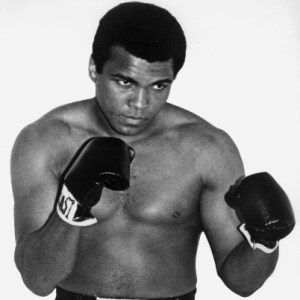
“It’s Muhammed Ali!”

I only saw him once. Close up.

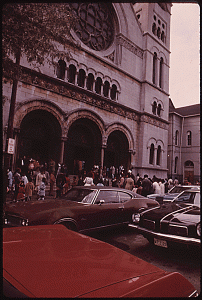
Holy Angels Catholic Church

Holy Angels Catholic Church, the African-American Catholic Church in South Side Chicago, was packed. Father George Clements, a bold community leader on the South Side, had convened the community meeting.

I don’t recall why we were there that afternoon. I only remember who was there.

Two pews in front of us sat a Michelangelo-chiseled figure of flesh and blood in a black suit. Massive square shoulders, thick muscled neck, beyond regal…a Greek god, Atlas perhaps, sitting erect and still, near the back of the crowed church. There was no mistaking who he was.

Muhammed Ali

“It’s Cassius Clay!” I blurted out to my fiancee…in what I thought was a whisper… pointing to the large man two rows in front of us.

MUHAMMED ALI!” came the woman’s corrective voice from behind us. The young, embarrassed, white Christian seminarian thanked her, apologized, and sat quietly the rest of the afternoon.

Ali, the World Champion, had changed his name from Cassius Clay. He had joined the Nation of Islam. Ali refused military induction as a conscientious objector. His conviction would overturned by the U.S.Supreme Court. At the time he refused to step forward for induction to serve in the Viet Nam War, he asked:

“Why should they ask me to put on a uniform and go ten thousand miles from home and drop bombs and bullets on brown people in Vietnam while so-called Negro people in Louisville are treated like dogs and denied simple human rights?”

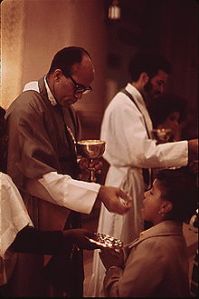
Father George H. Clements went on to become the first African-American in the Archdiocese of Chicago to be appointed to the position of Pastor.

Father George H. Clements at Mass

As Pastor of Holy Angels, Fr. George Clements moved a statue of St. Anthony and set up an altar honoring Dr. King following Dr. King’s assassination. When the archdiocese expressed its disapproval, Fr. Clements refused to reconsider.

Acclamatio populorum—”the people acclaim a saint,” he said. “If the cardinal wants it down, he’ll have to take it down himself.”

The Martin Luther King, Jr. statue remained in place.

Fr. Clements would later become famous as the first priest to adopt a child. He added a new title -“Dad” – as the adoptive father of four African-American children, and founded One Church – One Child, a movement in his parish inviting African-American families to adopt homeless African-American children. The program became nation-wide and still exists today.

Republican Convention Religious Crusade

The rousing video from the Republican National Convention (“Believe”) played like an evangelistic crusade waiting for an altar call.

From the musical crescendos to the hyped voice to the pentecostal elation of the crowd, it was religious to the core. Here’s the definition of “religion” that leads to the claim:

“Religion is the state of being grasped by an ultimate concern, a concern which qualifies all other concerns as preliminary and which itself contains the answer to the question of a meaning of our life.”Paul Tillich

The makers of the video know how quick we are to shed a tear. Especially when at a crusade that plays all the chords of American “civil religion” as argued in the recent “Views from the Edge” post on American religion and American politics.

Tillich was the first professor dimissed from his university teaching position by the  German Third Reich. Like the Germans at the Service Club meeting in an earlier post here, he knew that religion is not confined to the four walls of a church, synagogue, or mosque. It is the state of “being grasped by….”

What “grasps those who viewed the “Believe” video?
A poor attempt to answer the quesiton appeared yesterday (“Believe in America“). The post was too obscure to make its point. Thus, this folllow-up elaboration.
The god of the “Believe” video is America iteself. It is the god of American exceptionalism. The video stirs the heart with the cunning of Kafka’s Green Dragon and the seductive voices of Kafka’s The Sirens who know they cannot deliver what we long for. Their wombs cannot give birth to any kind of future.

The following exchange followed the earlier “American Religion and American Politics” post. Both C.A. and I see the world as the theater of God’s glory but also as the Theater of the Absurd.

C.A. left this comment:

If my small experience is any guide, you may get hammered on this one, Gordon.  When someone has been brought up on American exceptionalism, especially if coupled with Caucasian exceptionalism, and one kind of Christian belief the three can be so ingrown as to be more than subconscious,  virtually unconscious.  Working together, they justify any negative behavior that the person believes, and cause outright rejection of much that he or she hears or reads about as impossible. …

I replied:

C.A., You just wrapped it all up very nicely. Willem Zuurdeeg, a Dutch philosopher of religion, linguistic philosopher and phenomenologist, concluded that our deepest “convictions” are unexamined – below the surface of conscious awareness, so obviously true to us that they are what you call “virtually unconscious.” The compelling conviction hinted at by American civil religion is what Zuurdeeg described as an Ordered Home , a world order. In this case. the world revolves around tjhe doctrines of white supremacy and national supiority. These are the spiritual and moral centers.

“Views from the Edge’s” most popular post is the one about the Germans at the Service Club.  It’s gone viral.

“Five folks from Germany recently visited central Illinois as part of a local service club program to improve international understanding.

At one point they asked me about something they did not understand:  why do Americans begin so many gatherings with a ‘”patriotic” song, the Pledge of Allegiance, and a prayer?

Perhaps especially because they were from Germany, remembering the horrors of two world wars begun partly from excessive beliefs in the superiority of their nation and religion, they were sensitive to expressions of exceptionalism at U.S.A. sports events and service club meetings.

What Tillich, Zuurdeeg, and the Germans at the American service club meeting were seeing was a religious people hypnotized by Kafka’s Sirens and Green Dragon.

Go to yesterday’s post “Believing in America” to see the juxtaposition of the Kafka parables and the Convention video.

Leave your comment or question. And thanks again for visiting.

“Believe” in America

The Sirens

These are the seductive voices of the night; the Sirens, too, sang that way. It would be doing [the Sirens] an injustice to think that they wanted to seduce; they knew they had claws and sterile wombs, and they lamented this aloud. They could not help it if their laments sounded so beautiful.

 Franz Kafka, Parables and Paradoxes

The Green Dragon

The door opened and what entered the room, fat and succulent, its sides voluptuously swelling, footless, pushing itself along on its entire underside, was the green dragon. Formal salutation. I asked him to come right in. He regretted that he could not do that, as he was too long. This meant that the door had to remain open, which was rather awkward. He smiled, half in embarrassment, half cunningly, and began: “Drawn hither by your longing, I come pushing myself along from afar off, and underneath am now scraped quite sore. But I am glad to do it. Gladly do I come, gladly do I offer myself to you.”

Franz Kafka, Parables and Paradoxes

Click HERE for Franz Kafka biographical information published by The Kafka Project.

childlike, not childish

childlike, not childish

trusting, not gullible

fun-loving, not reckless

innocent, not ignorant

curious, not complacent

imaginative, not irrational

creative, not conventional

questioning, not badgering

laughing, not pouting

loving, not leveraging

self-aware, not selfish

a winner and not a whiner

– Steve Shoemaker, August 29, 2012

So there you have it. Are you being childlike today or childish? When Jesus took the child on his knee and told his students that it was to the little children that the kingdom of heaven belonged, he was referring to childlikeness, not childishness.

Today think about keeping a journal. Notice when, where, and with whom you are childlike:

  • trusting
  • fun-loving
  • innocent
  • curious
  • imaginative
  • creative
  • questioning
  • laughing
  • loving
  • self-aware
  • a winner?

And when, where, and with whom you find yourself being childish:

  • gullible
  • reckless
  • ignorant
  • complacent
  • irrational
  • conventional
  • badgering
  • pouting
  • leveraging
  • selfish
  • whining?

I tried it yesterday. Oh, my!!! Best of luck.

Is religion fair game this campaign season?

Is religion fair game in the campaign for the White House and in American electoral politics generally?

The question put to John Fitzgerald Kennedy in 1960 about his Roman Catholic faith led to a long period when a line was drawn between religion and politics. Religion was a private matter; politics was a public matter. Aside from the  occasional story about church attendance and Jimmy Carter’s statement about lusting in his heart, religion in the White House and in American public life was considered off the table of public scrutiny.

Questions about candidate Barack Obama’s religion in the campaign leading to the 2008 election changed that. The attacks came from two sides. One attack alleged that Sen. Obama was a secret Muslim; the other doubted the genuineness of his Christian faith and insinuating that he was a secret Marxist. After the one-minute excerpt from one of Rev. Wright’s long sermons went viral on the internet and on the evening news, the question was whether Sen. Obama agreed with Mr. Wright that on 9/11 “the chickens had come home to roost.” Religion had suddenly re-appeared from the shadows of American public life. The Obama campaign stumbled at the development but quickly recovered when the candidate himself dissociated himself from Rev. Wright’s views and effectively articulated his own to the satisfaction of the American people, followed by a masterful speech in Philadelphia about race in America.

In the 2012 campaign for the White House, do we consider religion as fair game for the public’s right to know, or are we better advised to return to the 48 year hiatus between 1960 and 2008?

Mr. Romney is a Mormon, a leader in The Church of Jesus Christ of the Latter Day Saints (LDS). One can argue that his religion should not be a factor in voter decision-making. The distaste of the impugning of John Fitzgerald Kennedy’s fitness for office led, in part, to a hands-off position. Religion in American public life is regarded as a question of one’s preference of cuisine. It’s a matter of personal taste. Religion is about opinion, not truth or reality itself; one person’s opinion is as good as another. For some of us, all that matters is that a person be “religious,” while, for others, religious adherence represents a failure of intelligence. But for all of us in America, tolerance is the virtue that glues together a pluralistic democratic republic. We are not a theocracy. We are a pluralist society where personal freedom is honored, especially in religion.

Is there not, however, something missing in a complete divorce between religion and politics? More than that, the idea of the divorce is based on a shallow definition of religion as professed creed rather than beliefs one practices daily in personal and public life.

There is an underlying “civil religion,” as Robert Bellah described it, which binds Americans together. At the core of it is the conviction, spoken and unspoken, that the United States of America is the exception to the way of history: the rising and falling of nations. America is the exception. We are proud people. We love our country. Whether or not it is spoken aloud, the ideas of the chosen people and the city set on a hill –a peculiar nation with a manifest destiny to bring light to the rest of the world – is the central belief of American civil religion. It is a peculiar unexamined and mostly un-articulated rip off of the biblical call to Abraham. The allusions to it are mostly between the lines. Sometimes, as in electoral campaigns, it is actually said out loud, and in such times we get to ask whether that is what we Americans really believe…about ourselves, about other nations, and about God.

Listen to the speeches. The idea of American exceptionalism (the idea of singular “election”) runs like the mighty Mississippi through the justifications and rationales for American religious, economic, and military expansionism from the earliest days of westward expansion to the “pre-emptive war” in Iraq and the crusade to bring democracy to the Middle East. Anyone who disagrees is a pagan, part of an Axis of Evil.

The subtle and not so-subtle synthesis of religion and politics that comprises American civil religion has always been a fact of the American ethos. In that sense, religion is always at work in American public life. The only question is whether we are willing to re-examine what we believe as a people.

It is not just agnostics or atheists who take offense at this marriage between religion and politics, the divine and the human, the divine and the chosen people. For Jews, Christians, and Muslims the idea of national exceptionalism lifts the nation to the place of an idol of worship that usurps the mystery and majesty of God and the universality of the Creator’s love

Institutional religion and the American civil religion alike inform, shape, and sometimes determine how a candidate will exercise the duties of elected office.

Gov. Romney, a Mormon, and President Obama, a Christian, will represent their parties on the November ballot. The question for the American electorate is not whether the candidate is Mormon, Christian, Jewish, Muslim, or none of the above. The question is how the candidate’s religious beliefs inform how he will conduct domestic and foreign policy in a world increasingly suspicious of America’s belief in its unique divine call and destiny. The Oval office is where those dreaded decisions are often made.

On the road to the White House, President Obama has discussed publicly how his faith plays itself out in public policy. Governor Romney has yet to discuss with the American people how his deepest beliefs will inform the exercise of his duties of office, should he be elected President in November.

The closest one gets to hearing or seeing his core beliefs are the frequent moments when Governor Romney deflects a question by proclaiming how great a country this is and telling us how much he loves it. Which may be a clue to what he most deeply believes. We won’t know until we ask.

Nothing better fits the ideology of American exceptionalism than Mormonism, an American-centric religion that sees the Americas as the geographical center of history itself: the location of humanity’s origin in a real Garden of Eden alleged to have been in the State of Missouri and the place where Christ will come again at the Second Coming.  Human history – from the beginning to the end – is a peculiarly American story.  America is Alpha and Omega, holy ground in a profane world. Such a view explains, in part, why the Church of Jesus Christ of the Latter Day Saints is the fastest growing religion in the United States. It puts in the open the unspoken doctrine of America civil religion that sees America as God’s chosen people.

A great fear of people from other nations and cultures is whether the American people will elect whichever candidate for the U.S. Presidency shouts “Yes” the loudest. Galileo challenged the anthropocentric belief that the sun revolved around the Earth. The church found him guilty of heresy. The question now is whether we will continue to believe the myth that the world and the universe itself revolve around America. Every four years we Americans have the opportunity to reflect critically on what we do and do not want to say about ourselves, our neighbors, and the Divine.

A thoughtful, vigorous debate, led by a dogged free press, offers the best hope for an electorate prepared to meet the complex challenges of the world in the 21st Century. The world is watching, and the planet itself is waiting to see what we do.

Religion, in the broadest sense, is not only fair game. It is the game.

The Protect Democracy Pledge

Ezra Klein offers his reflection on “Why Grover Norquist’s anti-tax pledge works — even among voters who support taxes.”

“Want to know why Republicans sign Grover Norquist’s Tax-Payer Protection Pledge? Because it helps them win elections. Want to know why the pledge isn’t broken more often? Because breaking it makes them likelier to lose elections — even among voters who support tax increases.

“Grover Norquist’s pledge works. Here’s how. (Joshua Roberts – Reuters) That, at least, is what a new study (pdf) by Stanford’s Michael Tomz and Berkeley’s Robert Van Houweling concludes.”

The  recent study at Stanford may hold a key to how to fix the American campaign system. Here’s the line that caught my eye:

“[I]t’s very hard for a politician to find a political upside in breaking the pledge…”

Grover Norquist is onto something. According to the study, the ones who win are the ones who have taken the pledge. Americans respect candidates and elected officials who stand for something. Norquist’s pledge is the only one out there. Perhaps we need a new pledge to the American people. But where to start?

In the run up to November 2012, the political handlers have hit the delete button on an old Commandment.  “You shall not bear false witness against your neighbor” now reads “You shall bear false witness against your neighbor.” It’s the only way to get elected.

To “bear witness” is to testify to the truth.  The rule of law depends upon it.  When things are in dispute, witnesses are sworn in before they testify – bearing witness to what they saw, what they experienced, what they know to be true. In lesser matters where there might be mischief or misrepresentation, documents require the stamp of a notary public whose seal bears witness to (verifies) the document’s authenticity.

Perhaps campaign reform could learn from these practices and Grover Norquist’s Tax-Payer Protection Pledge.

It’s surreal and ultimately inadvisable, but imagine that in order for a candidate, a political party, or PAC to use the public airwaves for political advertising in this democratic republic, they would be required to appear before a judge to

“swear to tell the truth, the whole truth and nothing but the truth to the American people, so help me God.”

The American people’s electoral decisions depend on the integrity of the democratic process, part of which is the campaigns that elect candidates to public office. The public airwaves belong to the American people. No one goes on the air without taking the pledge of truthful witness.

When candidates, parties or campaign surrogates are charged and found guilty, they would lose their privilege of air time for a fixed period. They would again appear before the court to take the pledge that commits them to bear truthful witness to the American people

Such an idea is surreal, even to the point of being Orwellian – “Big Brother” censoring what goes over the state intercom. It will never happen.

But what if voters who care deeply about the integrity of the electoral process tear a page from Grover Norquist’s notebook by creating a pledge of our own?

“The Protect Democracy Pledge” would invite candidates to “swear to tell the truth, the whole truth, and nothing but the truth” as a first step to gaining possible support. It would also require them to declare that they are not beholden to any other pledge but the oath of office to protect the Constitution of the United States of America. Like the Tax-Payer-Protection Pledge, signing The Protect Democracy Pledge to bear truthful witness would become the first step in earning a voter’s consideration for election to office.

Stranger things have happened. Look at Grover Norquist. His pledge works because candidates pledge to stand by it. Read Ezra Klein’s piece. Isn’t it time for a different kind of pledge that will allow candidates to stand for something: the protection of democracy itself?

Death in the Wood of Ephraim (Dennis Aubrey)

Dennis Aubrey of Via Lucis posted Death in the Wood of Ephraim (Dennis Aubrey), a one-of-a-kind reflection on the biblical David and the death of his slain rebellious son Absalom.

Dennis and PJ continually bring to the internet something very special: their thoughtful interplay between their photographs of Romanesque and Gothic architecture and commentaries on what they experience while photographing them and researching their histories.

Via Lucis is an example of the spiritual and artistic integration of external (visible) and internal (invisible) reality. This morning I left this comment for Dennis:

Dennis, this is such a profound reflection, in my view. Once again you weave the thread through the highs of joy and the depths of sin and sorrow in ways that move us beyond the separation of light and shadow/darkness that too often keeps us in spiritual and moral diapers, separating the sheep from the goats. Your note gives me hope that the time preparing for the pulpit is not in vain, especially when it is appreciated by someone who does not define himself as a practicing Christian. Friedrich Schleiermacher spent his life in conversation with “the cultured despisers” (i.e., good, rational people whose sophistication had led them to conclude that religion was a relic  that impedes the sure ascent of historical progress).  In your photography and writings I find a conversation partner who lives at the razor’s edge between belief and disbelief, joy and despair, the heights and the abyss of nothingness, and the honest search for hope and truth beyond the illusion of inevitable progress. If Romanesque architecture “induces internal experience and reflection…” – the internal experience of the external expression of Gothic – your photography and commentaries continually weave the two together to achieve a rare depth, and a balance between the seen and unseen, the external and internal. I am deeply grateful. – Gordon

If you go to Dennis’s site, please take a moment to comment. Or you may leave a comment here.

Latest “All Things Considered” commentary

During campaign season, maintaining serenity is a good trick

by Gordon C. Stewart, “All Things Considered” guest commentary (MPR)

Aired August 20, 2012

Click HERE for the Minnesota Public Radio publication, including an Audio link. Here’s the text.
.

Some days are brightened by a trip to the nursing home.

Take last Monday, for instance.

The members of the group that meets every Monday at 10 a.m. shuffle in on their walkers, or roll in, in their wheel chairs.

Ninety-seven-year-old Frances (not her real name; nor are the others to follow) walks in without assistance. Her 78-year-old son is dying of cancer. Another relative, 30 years younger than she, is next door in the memory care unit. “Good morning!” she says.

Georgana has been confined to a wheelchair all her life. But her mind is as sharp as her sense of humor. Gwen, who’ll be 90 this week, is coming to the end with hospice care. Pat, recently moved from Assisted Living to the Care Center, is in a wheelchair. All 12 of them smile and offer each other greetings: “Good morning!”

This morning I’ve watched too many campaign ads brought to my computer by Unedited Politics, a website that republishes campaign ads and political speeches without editorial comment. I’m all stirred up.

The 12 people from the nursing home have been drawn here by their desire for light. “Rejoice!” says the reading for the morning. “I have learned the secret of being content in any and every situation ….”

I ask: How do you rejoice in a nursing home? What is the secret of being content when your body and your mind don’t do what they once did?

Listening to their reflections reminds me of how small our footprint is on the larger world. They share my distress about the news, but their years have taught them to recognize light wherever it meets them and to relish the little things of daily life: a smile, a kind word, the cardinal and the squirrels playing outside their windows, a sense of inner peace, a strange contentment. I hope to be more like them — to pay more attention to the things that are beautiful, admirable and lovely.

While they shuffle out on their walkers and roll out in their wheelchairs, Frances, Georgana, Gwen, Pat and the rest of the ad hoc community at the nursing home thank me for coming and wish me a good week. They have lightened my step. I’ll still pay attention to the news, but I’ll listen and watch with a greater lightness of being.

Getting to “the Still Point”

Steve Shoemaker sent this Breath Prayer on March 24, 2012 during Holy Week based on Jesus’ word to another criminal hanging on the cross next to him. I waited until now to post it on Views from the Edge.

Prayers (breathing) –  8 syllables in (inhale); 8 out (exhale)

– Steve Shoemaker

Jesus Christ, Child of God, Savior: (teacher) Have mercy on me, your sister.

(brother).  (on us your siblings.)

(Have mercy on me, a sinner.)

Gracious God, Jesus Christ, Spirit:

Give me (us) peace, patience, joy and love.

Loving God, you create, sustain:

give us dreams, energy and skill.

Holy Spirit, Comforter, Fire:

Mold us, move us, keep us alive.

Mysterious Divinity:

Show us what we can know and do.

We have left the path, lost our way:

Forgive us, O God; set us straight.

Your grace and love surround us, God:

Help us be grateful, loving, kind.

Our life will soon be over, God:

Remember us in paradise…

I waited until now to share this prayer. It strikes me as an antidote to the onslaught of misery and hate during this campaign season. Breathing Prayer calms my soul, slows down my whirring mind, and brings it down into the heart. The ancient practices of Breath Prayer and Lectio Divina move me into the great Stillness at “the still point of the turning world”… where the dance is.

At the still point of the turning world. Neither flesh nor fleshless;
Neither
from nor towards; at the still point, there the dance is,
But neither arrest
nor movement. And do not call it fixity,
Where past and future are gathered.
Neither movement from nor towards,
Neither ascent nor decline. Except for the
point, the still point,There would be no dance, and there is only the
dance.

T.S. Eliot, 1888-1965), The Four Quartets.

For more on Breath Prayer and the variety of prayer in the Christian tradition, click on this link: Ten Ways to Pray: A Short Guide to a Long History of Talking with God.