
Old Friends

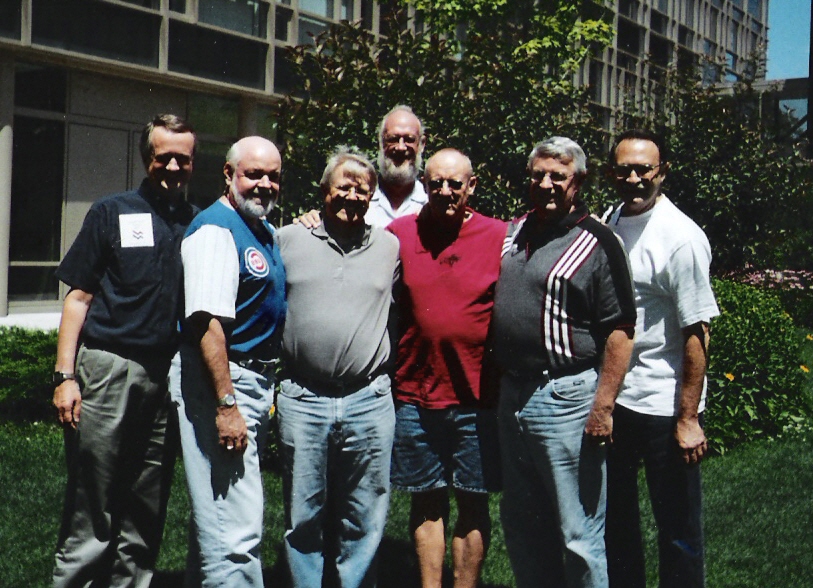
Dale Hartwig (red shirt) and the Chicago Seven Gathering, McCormick Theological Seminary, 2004.

Dale Hartwig (red shirt) and the Chicago Seven Gathering, McCormick Theological Seminary, 2004.

This morning news arrived of the passing of an old friend. Dale is a classmate, one of seven who call ourselves The Chicago Seven. The Seven met annually until 2004 when the gathering was reduced to Six because of Dale’s advancing Parkinson’s. The gatherings have continued to be powerful bonds of friendship, but never again so meaningful as when there were Seven.

MEMORIAL TRIBUTE to be shared at the Celebration of Life & Victory over Death for DALE HARTWIG

Dale was such a joy for all of the Chicago Seven (now Six). His quiet spirituality brought a stillness to the room, or tears, and so much reality and the tenderness of a poet. The last time all seven of us McCormick alums gathered in Chicago, we sat around a long table sharing our thoughts and work. Dale and I were sitting next to each other, as we often did, at one end of the table. When it came his turn, Dale moved some papers in front of me and asked that his words be read. His contribution, as I recall it, was a Greek exegesis from a New Testament text that reminded us of his love for biblical exegesis, he being the only one of us who left seminary to become more proficient in NT Greek than when we left. His sharing also included a poem he had written. As I read it aloud on his behalf – his surrogate voice – he began to weep because his words had been heard! Here’s the poem in memory of that sacred Hartwig moment – one of many – that the rest of us will forever cherish.

“THE SURROGATE VOICE” – GORDON C. STEWART (WRITTEN IN THANKSGIVING FOR THE CHICAGO GATHERING ’04)

As the surrogate voice reads on,
the author sits and sobs
his wrenching tears from primal depth;
from some abyss of joy
or nothingness…or both.

The author’s sighs and piercing sobs-
arrest routine,
invoke a hush,
dumb-found the wordy room.

He cannot speak,
his Parkinson’s tongue tied,
his voice is mute, in solitude confined,
all but sobs too deep for words.
Another now has become
his voice, offering aloud with dummy voice
the muted contribution
in poetic verse the ventriloquist’s voice has penned.

The abyss of muted isolation ope’d,
his words, re-voiced aloud,
hush the seven to sacred silence, all…
except from him, their author.

Whence comes this primal cry:
From depths of deep despair and death,
from loneliness, or depths of joy
We do not know.

The surrogate voice reads on
through author’s sobs and sighs,
through his uncertain gasps for air
and our uncertain care.

The iron prison gates – the guards
of his despair – unlock and open out
to turn his tears from prison’s hole
to tears of comrade joy.

His word is spoken, his voice is heard,
a word expressed
in depth and Primal Blessing,
pardoned from the voiceless hell.

The stone rolls back,
rolls back, rolls back,
from the brother’s prison’s tomb,
the chains of sadness snap and break!

At one, at one, we seven stand,
in Primal Silence before the open tomb,
as tears of loss, of gain, of tongues released
re-Voice unbroken chords of brotherhood.

Rizpah and her children

As the snowstorm cancelled schools in Minnesota last week, 90 year-old Lorraine Garrison was surrounded by family and friends who celebrated her life.

Lorraine’s grandson, Jeff, reminded the minister of the story of Rizpah, the diligent mother who perched her body on the rock after two of her children were hanged by the Gibeonites, and stayed there for five months to keep the birds and animals of prey away. Lorraine was a Rizpah, watching over her adult children and her grandchildren from her room in the nursing home in Chaska.

“Rizpah” – Alfred, Lord Tennyson (1809–1892)

Sin? O, yes, we are sinners, I know—let all that be, 60
And read me a Bible verse of the Lord’s goodwill toward men—
“Full of compassion and mercy, the Lord”—let me hear it again;
“Full of compassion and mercy—long-suffering.” Yes, O, yes!
For the lawyer is born but to murder—the Saviour lives but to bless.

He’ll never put on the black cap except for the worst of the worst, 65
And the first may be last—I have heard it in church—and the last may be first.
Suffering—O, long-suffering—yes, as the Lord must know,
Year after year in the mist and the wind and the shower and the snow.

Heard, have you? what? they have told you he never repented his sin.
How do they know it? are they his mother? are you of his kin? 70
Heard! have you ever heard, when the storm on the downs began,
The wind that’ll wail like a child and the sea that’ll moan like a man?

Election, Election, and Reprobation—it’s all very well.
But I go to-night to my boy, and I shall not find him in Hell.
For I cared so much for my boy that the Lord has look’d into my care, 75
And He means me I’m sure to be happy with Willy, I know not where.

The story comes from Second Book Samuel 21:10-11: “And Rizpah the daughter of Aiah took sackcloth, and spread it for her upon the rock, from the beginning of harvest until water dropped upon them out of heaven, and suffered neither the birds of the air to rest on them by day, nor the beasts of the field by night. And it was told David what Rizpah the daughter of Aiah, the concubine of Saul, had done.”

Thank God for the Rizpahs of this world who will never let Willy get lost.

I look in the mirror and what do I see?

“I look in the mirror and what do I see? A toothless wonder comin’ after me. I want to be young again” I’m thinking after the tooth extraction. It’s my rendition of Swing low, sweet chariot’s “I looked over Jordan and what did I see….”

Who is this older me and the Me that’s comin’ after me? Has God ever lost a tooth? Has God ever looked in the mirror and protested the reflection? Has God ever stepped on the scale in the morning, counted the days on the calendar, googled the weather channel, picked up the dog’s poop, poured Mirilax in the coffee to stay “regular”? Taken three Ibuprofen to keep the swelling down? Has God ever come to the end of a day and wondered why the dentist said “Good Morning!”

Beyonce on the floor of Congress

Video

Congressional leaders are singing off key, inviting a national food fight. They want us to believe they’re soul-singers. But the sound is wooden. No heart. No soul. Instead we hear only of sequestration, protestation, damnation, remonstration, and gyration, but no gestation, no universal gun registration. Only sequestration.

Bring in Beyoncé! “Swing low, sweet chariot, coming fo’ to carry me home. I looked over Jordan and what did I see? A band of angels comin’ after me, comin’ fo’ to carry me home.”

If you agree that Congress is acting like the prisoners before Beyoncé came to their rescue, send this link to your Congressional Representatives. Tell ’em Paul Robeson, Johnny Cash, Etta James, and Beyoncé told you to. 🙂

Jazz – the language of love and awe

“Who is your favorite jazz pianist?”

“Bill Evans,” came the quick reply from Ted Godbout, the jazz pianist who came to us out of the blue as a candidate for the music position at the little church in Chaska, MN where jazz is the language of love and awe.

In the news Michael Jordan is defending himself against a young man’s claim that he is Air Jordan’s “love child” who deserves more of Michael’s time. Listening to Ted Godbout at his audition, I wondered….

We sent Ted’s DNA to the lab for testing :-). He’s that good. And only 29! Ted leads the music at Shepherd of the Hill for the first this Sunday, March 10.

Extracts from the Visitors page of the church website speak of the language of jazz.

Imagine a place…

a church, actually, your church,……

where it is a safe place to land, for a bit of time

while you marvel….

and wonder, and revel in

love…..

and justice…..

and mercy….

where the questions get clearer and

better questions replace them….

where your heart burns to return

Again and again……

where jazz is the language of love……

and love, the language of

Awe…….

where God is a three letter word again….

spoken to soothe your tired feet…

On your journey of becoming

more of who Love intended you to be,

(since you have heard it said, “fear not….”)

An Acrostic on Jazz improvisation

Steve Shoemaker sent this today after learning that Ted Godbout, an outstanding jazz pianist, is joining us at Shepherd of the Hill Church in Chaska.

PENTECOST
(TO BE READ ALOUD)
An Acrostic

Perhaps a jazz improvisation says

Exactly what is thinkable about

New life, fresh breath…the Holy Spirit. Has

There ever been a music without doubt

Except jazz? Faith, improvisation cause

Circles of sound to rise and fly throughout

Our cosmos. Tongues of flame are seen on heads

Singing or playing solos. Then without

Time passing–a new language: Jesus! Jazz!

– Steve Shoemaker, Urbana, IL

Sequestration Silver Lining

Budget Control Act

Budget Control Act

Only a deadlocked Congress could produce this unintentional miracle.

The military-defense budget has been a sacred cow. Proponents of Department of Defense budget cuts were tarred and feathered as weak on national security.

Perhaps only ‘Sequestration” – this unthinkable package of defense and entitlement program cuts that neither major party thought tolerable – could make it happen. I can hear the applause from the angels and from President Dwight David Eisenhower, whose last words from the Oval Office warned that the rise of the Military-Industrial-Complex was the greatest threat to democracy, even while they weep over the indiscriminate human impacts of Sequestration.

Somewhere over the rainbow….bluebirds…instead of drones…fly. Could it also be that sometimes God really does act in strange and mysterious ways…?

Thick heads and the deeper truth

Micah 6:8

“God has told you people what is good–
and what the Lord requires of you:
do justice, love mercy,
and walk humbly with your God.”

One third of the Jewish Bible
is in poetry:
all the prophets, all the proverbs,
Job and all the Psalms.
Fables, sagas, metaphors–we
take it literally?
No, its truth is deeper, wider
than the sea. Our souls
leap or cry, our hearts sing or sigh.

We are called to act by holy
words in parallel:
every idea is repeated–
image, example,
contrast…thick heads hit again and
yet again. As sheep
we need a good shepherd or we
stray. For us to keep
ten commandments we need poetry.

– Steve Shoemaker, Urbana, IL, March 4, 2013

The Voting Rights Act and the Scowl

Justices Sotomayor and Scalia

Justices Sotomayor and Scalia

The Voting Rights Act for which so many of us fought is at risk in a case before the U.S. Supreme Court.

Yesterday Associate Justice Antonin Scalia, one of the Justices who will decide on the constitutionality of Section 5 of the Voting Rights Act, called it a “perpetuation of racial entitlement.” His statement shocked the court and those in the courtroom.

Justice Scalia showed visible contempt for President Obama sitting behind the President at the Second Inauguration. He never looked up. He sat there like the Man…in his Doctor of Jurisprudence graduation hat…with a scowl on his face. His Jesuit professors are pulling their hair out.

Of humanity, earth, and teshuvah

by Gordon C. Stewart, Feb. 27, 2013. Copyright

The Gospel reading for next Sunday tells of Jesus speaking about terrorism and violence, and an urgent invitation to turn.

Some people tell Jesus “about the Galileans whose blood Pilate had mingled with their sacrifices.” The speakers seem to be contrasting the Galileans – known for their armed resistance to Roman rule – and the Jerusalemites. Jesus himself is a Galilean! As often happens, the non-Galileans are putting him to the test, and as he does so often and so ably, Jesus the Galilean Jewish rabbi begins by appearing to agree with their prejudice. He asks whether these violent Galileans were any different from the rest of the Galileans. One can almost hear the applause from the more sophisticated Jerusalemites.

Then he quickly shifts ground to a scene in Jerusalem. He asks them whether the eighteen saboteurs “upon the tower of Siloam fell, and slew them, do you think they were worse sinners than all others in Jerusalem? No,” he says, “but unless you (plural) reform/ repent, you will all likewise perish.”

Here is the text in an unfamiliar form from The Orthodox Jewish Bible (OJB) Copyright © 2002, 2003, 2008, 2010, 2011 by Artists for Israel International.

Lukas 13:1-9

1 Now on the same occasion there were some present reporting to Rebbe, Melech HaMoshiach about the men of the Galil whose blood Pilate mixed with their zevakhim (sacrifices).

2 And, in reply, Moshiach said, Do you think that these men of the Galil were greater chote’im (sinners) than all others of the Galil, because they suffered this shud (misfortune)?

3 Lo (no), I say, but unless you make teshuva, you will all likewise perish.

4 Or do you think that those shmonah asar (eighteen) upon whom the migdal (tower) in Shiloach fell and killed them, do you think that they were greater chote’im (sinners) than all the Bnei Adam living in Yerushalayim?

5 Lo (no), I tell you, but unless you make teshuva, you will all likewise perish.

6 And Rebbe, Melech HaMoshiach was speaking this mashal. A certain man had an etz te’enah (fig tree) which had been planted in his kerem, and he came seeking pri (fruit) on it, and he did not find any. [YESHAYAH 5:2; YIRMEYAH 8:13]

7 So he said to the keeper of the kerem, Hinei shalosh shanim (three years) I come seeking pri on this etz te’enah (fig tree) and I do not find any. Therefore, cut it down! Why is it even using up the adamah (ground)?

8 But in reply he says to him, Adoni, leave it also this year, until I may dig around it and may throw fertilizer [dung] on it,

9 And if indeed it produces pri in the future, tov me’od (very well); otherwise, you will cut down it [Ro 11:23].

The “mashal” (a familiar proverb or parable) he re-interprets is already part of his and his hearers’ self-understanding from Yeshayah (Isaiah) 5:2; Yirmeyah (Jeremiah) 8:13.

Reading the text in a form much closer to the original context of Jesus’ linguistic-religious-cultural-political-economic context serves to awaken me to hear it with new ears.

Jesus is speaking about collective social life – politics, economics, religion, resistance, keeping the faith. He is calling for thorough-going societal transformation – from blaming others (the Galileans) to looking in the mirror to be startled by the log that is in one’s own eye, individually and collectively: the underlying violence in our way of being in the world, taking up “ground” on this beautiful planet.

In Hebrew Scripture the human species, Adam, is derived from Adamah – earth, soil, dirt, ground. We, the fig tree, are here to produce sweet figs.

The Owner of the vineyard with the barren fig tree shows two traits in this Mashal: disappointment and frustration (“Why is it even using up the ground?”) and the extraordinary patience that allows it more time to produce the sweet fruit for which it was created.

As I look out to the world outside, and as I look in the mirror in the morning, I feel a tiny shiver of G-d’s frustration and long-suffering with the likes of us. I wonder what it will take before we see the reflection of ourselves and our way of the violence of terrorists. Are they any different from the rest of the people in the Galil, Yerushalayim, Chaska, or Washington, D.C.? When and how shall we make teshuvah?