Unknown's avatar

About Gordon C. Stewart

I've always liked quiet. And, like most people, I've experienced the world's madness. "Be Still! Departure from Collective Madness" (Wipf and Stock Publishers, Jan. 2017) distills 47 years of experiencing stillness and madness as a campus minister and Presbyterian pastor (IL, WI, NY, OH, and MN), poverty criminal law firm executive director, and social commentator. Our cat Lady Barclay reminds me to calm down and be much more still than I would be without her.

Looking and Seeing – Thoreau


What you see, not what you look at, is what you get. Or is it?

Is something there you don’t see? Is what you see there because you put it there?

The relation between subject and object is an ancient philosophical question that’s not about to go away.

When I saw the Thoreau poster, I saw the darkness behind the words. Then it drew me to the light – the sunrise or sunset. But, which is it: a sunset preceding darkness, or sunrise bringing the light? Or are we seeing cars, pavement, poles, and signs? What would Thoreau see?


Write Here, Write Now

Write a post entirely in the present tense.

Source: Write Here, Write Now

I Want to be an Egret – a Snowbird’s encounter with the real birds.

I want to be an Egret

I want to be an Egret

image1In the estuary 100 yards from our deck, 18+ Egrets, Great Blue Herons, and Wood Storks have gathered in mid-day prayer at low tide.

They’re facing the same direction like worshipers in a mosque, or a church, or a choir facing a Maestro before the downbeat that opens the symphony. They stand perfectly still. Their heads are raised, looking up, focused on the sun as it moves the day from sunrise to mid-day to sundown to the night that will be broken again, as always, with daybreak.

The estuary is part of a tidal river that leaves the wide bay beyond our porch shallow and nearly empty at low tide. A feast of mud, oysters, clams, and small fish enough to satisfy them all. In the morning they turn their prayer mats to the East and give thanks for the new day. From noon to three, they look up, slowly turning their mats from East to South to West, unaware of the smell of smoke billowing up into the VRBO renters’ temporary shelter from the owners below, the cheap plastic chair that broke under me on the balcony, or the sceptic tank that overflowed onto the driveway after five inches of rain the other day.

Today I want to be an Egret or a Great Blue Heron. We came here to sit in the sun like the birds, to be more natural at thanksgiving, freer from the plastic, the smoke, the greed, the cold. I’ve decided to be a Great Blue Heron, an Egret, or maybe one of the forgiving, cooing mourning doves perched on the telephone wire between our place and the estuary bay.

Life is good! Life is for the birds!

  • Gordon C. Stewart, Snowbird, Tampa, FL, January 20, 2016.


The Way We Eat

A prompt on Modern Families got me to thinking. 

“If one of your late ancestors were to come back from the dead and join you for dinner, what things about your family would this person find the most shocking?” 

How would you answer? Here’s my shot at the question. 

Well…for starters, most folks don’t join each other for dinner anymore.

My grandparents and parents honored a long-standing family tradition.  They ate dinner around the dining room table. ALL of them. At the same time. In the same place.

But we didn’t just eat together. We lingered together. We served each other. We passed the food in large bowls – mashed potatoes, green beans, peas, stuffing, salad – family style. No one ate until all had been served.

In their generations, the roles were clearly defined. Mom wore and apron and cooked the meal. She sat at one end of the table. Dad, sitting  at the opposite end (the head of the table) with the carving knife served the entree on plates to the other members of the family. If it was a turkey, for instance, he carved the bird in front of us at the table.

“Skip, you like dark meat.” He’d carve from the thigh or the leg. “Don, you like both white and dark.” “Bob, you like the leg and a wing.” And so it went, until we all had been served according to our liking, and we all had served each other.

Mom and Dad lived long enough to see the change in their children’s family eating habits and graciously, if sadly, accepted the fact that there was no longer a set time for dinner, there were soccer games, Little League games, concerts, and the demands of this, that, and the other that tore apart the cherished hour when the kids and parents all checked in on the day and discussed the big issues of the news.

My grandparents would be shocked by the fraying of common life, the loss of careful attentiveness to each member of the family’s preferences, likes and dislikes, the substitution of the automat for the dining room table.

If they came back from the dead, they would wonder how and why sharing and serving around the table and nightly dinner conversations have vanished, replaced by family members staring at their iPhones, texting people who aren’t in the room. They might re-frame Shakespeare’s question in Hamlet, “To be, or not to be?” They might say:

“To eat alone, quickly, or to eat at the dinner table with others, slowly?” – that is the question.

I think I’ll turn on the TV, go to the fridge to see what’s there, send a text or two, and enjoy the ballgame.

  • Gordon C. Stewart, Chaska, MN, January 18, 2016

 

Link

Last Monday I learned of a student’s tragic death in Saint Paul. This morning I read this remarkable reflection. The writer and blog are new to me. I’ve chose to “follow” this site.

The Donald at 11 year old

Imagine a class room of 11 year olds. Donald Trump takes on the teacher!

Click Li’l Donald to enjoy Bill Flanagan’s story in the The New Yorker. 

About Us: One Little Corner

I’ve always had a sense of living at the edge of the world. It’s not a bad thing. It’s not a good thing. It’s just the way it’s always been for me. But, as I watch and listen from my little corner of the world, something’s changed. I have a growing sense of blah, blah, blah, both others’ and my own.

Ours is an anxious time that cries out for a foothold. Speech is the primary way we establish a foothold in changing times.

“Threatened by nonbeing, by chaos, and meaninglessness, man looks for a foothold in the Imperishable,” wrote Dutch philosopher Willem Zuurdeeg years ago in Man Before Chaos: Philosophy Is Born in a Cry.

Influenced by Zuurdeeg’s work, I look and listen for the footholds – unspoken convictions that rarely get discussed – in the battlefield of ideas “where ignorant armies clash by night” (Matthew Arnold, “Dover Beach“). Just below the words, or between them, lie the ideological, prejudicial, cultural, national, class, political, religious, and economic ideals and convictions (footholds) by which we secure our existence in the face of the threat of nonexistence.

My friend and colleague Steve Shoemaker adds his poetry and verse – unique voice that draws readers to Views from the Edge. Over the years, our number of posts have been about the same with Steve’s being the more popular by far.  The frequency of Steve’s contributions has decreased in the past few months following diagnosis and treatment for pancreatic cancer. His recent posts on death and dying continue the joyful sense of humor and play that draw people to his poetry and verse.

Whether Views from the Edge (VFTE) contributes to thoughtful social criticism and a deeper appreciation of life, or adds more to the blah, blah, blah, is for readers to decide. Like other writers, we just can’t help ourselves!

NOTE: This post About Us is part of an assignment for a three-week course with WordPress.com. I’m also re-doing the tagline and the platform. Thanks for your patience.


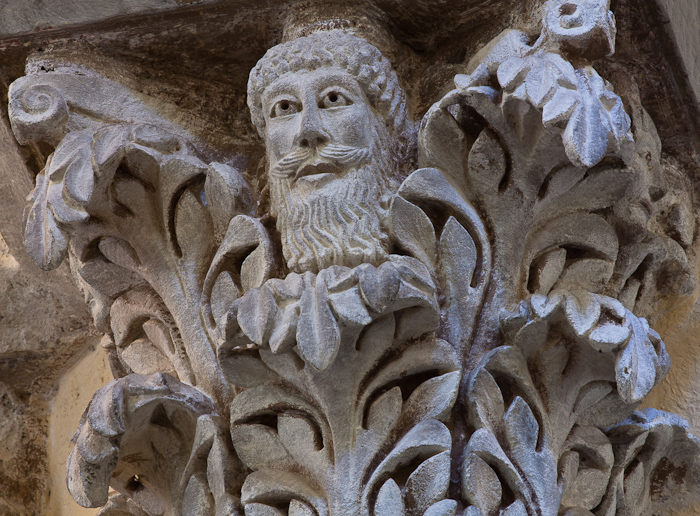
The Green Man

Every generation tends to think of itself as superior to its predecessors. Ours is no different. Sometimes we’re right. Often, we’re wrong. We ignore or don’t know history.

Take, for example, the consciousness of green and climate change – the discovery, or is it the re-discovery, of nature as the context of human life. We tend to think it’s a new consciousness that sets aside the longer consciousness by which the human race justified ravaging the earth.

The Green Man in Clermont-Ferrant, Photo by Dennis Aubrey, Via Lucis Photography

The Green Man in Clermont-Ferrant, Photo by Dennis Aubrey, Via Lucis Photography

But, then, along comes the forgotten Green Man of Romanesque churches build in the Medieval Period, one version of which is featured in Dennis Aubrey’s post “A Green Man in Clermont-Ferrand” on Via Lucis Photography of Religious Architecture.

I turn to Via Lucis whenever I feel the need to get out of my skin, to shed the ignorant arrogance of the 21st Century presumption of progress and superiority.

The whole human story is captured in the various Medieval renderings of The Green Man, the human race fatally mis-perceived as “man over nature” and properly conceived as “man within nature”. 

Gordon C. Stewart, Chaska, MN, January 13, 2016

Four Big Questions – I don’t “get” it

I don’t get it. Or maybe I do, but don’t want to.

Some things jade a person’s spirit.  Like the poisonous, partisan punditry that made a lot of noise responding to last night’s State of the Union Address. Blah, blah, blah; blah, blah, blah!

“I don’t get” why, or how, a thoughtful listener could disparage the FOUR BIG QUESTIONS that framed the President’s speech. 

► “How do we give everyone a fair shot at opportunity and security in this new economy?”

► “How do we make technology work for us, and not against us – especially when it comes to solving urgent challenges like climate change?”

► “How do we keep America safe and lead the world without becoming its policeman?”

► “How can we make our politics reflect what’s best in us, and not what’s worst?”

In the run up to the 2016 Presidential Election, President Obama’s last State of the Union Address spelled out the philosophical-ethical questions that every candidate should be asking and answering. Will we, the citizens – the voters – take the cue? Will we test every candidate for President, the Senate, and House of Representatives to assure ourselves that they “get it”: governing in the United States of America requires thoughtful reflection on complex matters that do not lend themselves to simple solutions or demonizing an opponent.

If we, the people,  don’t “get that”, it won’t be because we can’t. It will be because we prefer the poison of partisan blah, blah, blah.

  • Gordon C. Stewart, Jan. 13, 2016.


A New Government of National Concentration

Video

Adolf Hitler rose to power by playing to the fears, anxieties, and anger of the German people. His strategy was to play the strongman who would fix it, make Germany great again. A nation that had regarded itself as exceptional had lost its way, humiliated by defeat in World War I. Hitler focused that anger at the weakness of the post-World War I Weimar Republic whose inept Chancellor and Reichstag (i.e. Congress) he blamed for the nation’s drift. He blames Marxist thinking and Communists. He declares Christianity to be the religion of the German state. By narrowing and scapegoating, he focuses the people’s fears and anxieties on visible targets. It was only a matter of time before Jews, homosexuals, and gypsies joined the ranks of those to be eliminated in a purified Aryan state.

Notice how quietly, how slowly this speech begins. He waits for the crowd to be quiet before he continues to speak. He is taming them. Mesmerizing them. Training them for Fascism. And when he has brought them to heel, he unleashes a tirade that taps into the people’s volcanic desire for a return to national exceptionalism.

“Those who cannot remember the past are condemned to repeat it.” – George Santayana, The Life of Reason, 1905.

  • Gordon C. Stewart, Chaska, MN, Jan. 11, 2016.