In My Arms

Fyodor Dostoevsky in The Brothers Karamazov tells a tale of hell as self-pre-centeredness and self-absorption. The failure of compassion. The story is about a stingy person and a generous God who weeps and, for the moment, flies away.

Once upon a time there was a peas­ant woman and a very wicked woman she was. And she died and did not leave a sin­gle good deed behind. The dev­ils caught her and plunged her into the lake of fire. So her guardian angel stood and won­dered what good deed of hers he could remem­ber to tell to God; ‘she once pulled up an onion in her gar­den,’ said he, ‘and gave it to a beg­gar woman.’ And God answered: ‘You take that onion then, hold it to her in the lake, and let her take hold and be pulled out. And if you can pull her out of the lake, let her come to Par­adise, but if the onion breaks, then the woman must stay where she is.’ The angel ran to the woman and held out the onion to her; ‘Come,’ said he, ‘catch hold and I’ll pull you out.’ And he began cau­tiously pulling her out. He had just pulled her right out, when the other sin­ners in the lake, see­ing how she was being drawn out, began catch­ing hold of her so as to be pulled out with her. But she was a very wicked woman and she began kick­ing them. ‘I’m to be pulled out, not you. It’s my onion, not yours.’ (bold print added by Views from the Edge)

As soon as she said that, the onion broke.  And the woman fell into the lake and she is burn­ing there to this day. So the angel wept and went away.

The story is about the hell of me and “mine” on the one hand, and the angel who weeps, on the other. Will the weeping angel ever return?

Three years ago during the final months of stepdaughter Katherine’s terminal illness, I sought help at the Benedictine Abbey at St. John’s in Collegeville.  I spent three days there in silence, except for meetings in the morning and the evening with a spiritual director.

In the first meeting with Father John, I shared with him the story of Katherine’s cancer.  I was feeling helpless and frustrated.  “Is Katherine a person of faith?” he asked. “Yes,” I said, “but it has nothing to do with that. I don’t believe in hell. I believe in the sovereignty of God. God is Love. I don’t believe in hell, except for the hell we’re going through right now.

“Well,” said Father John, “our tradition says that there probably is a Hell, but it’s likely there’s no one in it!” The good Father was walking the balance between God’s sole prerogative as “judge of the living and the dead,” as the Apostles’ creed says, and the nature of the Judge himself as Love, whose judgments are always a function of God’s mercy.

So…will the angel who fled the old woman come again to the old woman still clutching the half-rotten onion?

Nothing speaks to this so well, in my experience, than Sir Francis Thompson’s “The Hound of Heaven.”

He imagines himself as a rabbit fleeing from the steady, unperturbed steps of a hound.

I fled Him, down the nights and down the days;
I fled Him, down the arches of the years;
I fled Him, down the labyrinthine ways
Of my own mind; and in the midst of tears
I hid from Him, and under running laughter.
Up vistaed hopes I sped;
And shot, precipitated,
Adown Titanic glooms of chasmed fears,
From those strong Feet that followed, followed after.
But with unhurrying chase,
And unperturbèd pace,
Deliberate speed, majestic instancy,
They beat—and a Voice beat
More instant than the Feet—
‘All things betray thee, who betrayest Me’.

Who was the man who wrote these lines? Why and how would he see himself as a rabbit, and God as the hound who was chasing him?

Francis Thompson is remembered as a great English poet. But it was not always so. After attending college to become a doctor like his father, he moved to London in 1885 to become a writer, but ended up on the street selling matches and newspapers. He became addicted to opium, which he first had taken as a remedy for ill-health. Living in destitution and self-destruction, he submitted a poem to a poetry magazine called Merrie England. The magazine’s editors, Wilfrid and Alice Meynell, moved by Thompson’s poem, rescued him from the verge of starvation and self-destruction. They provided safe lodging and arranged for the publication of his first book, Poems, in 1893, which opened the door to a publishing career after favorable reviews in the St James’s Gazette and other venues.

Subsequently Thompson lived as an invalid in Wales and at Storrington. A lifetime of extreme poverty, ill-health, and an addiction to opium took a heavy toll even when he had found success in his last years. According to several accounts, he began an attempted suicide in the depths of despair, but was saved from completing the action through a vision which he believed to have been that of a youthful poet, Thomas Chatterton, who had committed suicide almost a century earlier. Shortly afterwards, a prostitute – whose identity Thompson never revealed – befriended him, gave him lodging, and shared her income with him. Thompson later described her as one who saved his life, a kind of savior. She soon disappeared, however, and never returned. He died of tuberculosis at the age of 48.

Whether man’s heart or life it be which yields
Thee harvest, must Thy harvest-fields
Be dunged with rotten death?

Now of that long pursuit
Comes on at hand the bruit;
That Voice is round me like a bursting sea:
‘And is thy earth so marred,
Shattered in shard on shard?
Lo, all things fly thee, for thou fliest Me!

‘Strange, piteous, futile thing!
Wherefore should any set thee love apart?
Seeing none but I makes much of naught’ (He said),
‘And human love needs human meriting:
How hast thou merited—
Of all man’s clotted clay the dingiest clot?
Alack, thou knowest not
How little worthy of any love thou art!
Whom wilt thou find to love ignoble thee,
Save Me, save only Me?
All which I took from thee I did but take,
Not for thy harms,
But just that thou might’st seek it in My arms.
All which thy child’s mistake
Fancies as lost, I have stored for thee at home:
Rise, clasp My hand, and come!’

Halts by me that footfall:
Is my gloom, after all,
Shade of His hand, outstretched caressingly?
‘Ah, fondest, blindest, weakest,
I am He Whom thou seekest!
Thou dravest love from thee, who dravest Me.’

Neither Dostoevsky’s weeping angel of mercy nor Francis Thompson’s Hound of Heaven is far from us. The scared rabbit cannot outrun the slow, unperturbed steps of Divine Love.

How little worthy of any love thou art!

Whom wilt thou find to love ignoble thee,

Save Me, save only Me?

“All which I took from you, I took not for your harm, but that you might seek it in My arms. All which you mistakenly thought was lost, I have stored for you at home.

“Rise, clasp My hand, and come!”

– A sermon preached at Shepherd of the Hill Presbyterian Church, Chaska, MN, September 9, 2012

Clouds

green storm clouds – Kay Stewart photography

Tonight the storm blew in

Darkness covering the deep.

Green-sky funnel clouds

threatening everything that is

passed over, passed over

blew on past

while beauty rarely seen swept in

as morning follows night.

yellow puffs of mercy,

puffs of wonder,

yellow cotton-candy light

puffed across the sky

pushed by first-light breeze

that cooled the skin

refreshed the air and

took my breath away!

– Gordon C. Stewart, Mother’s Day, 2004

Yellow cotton-candy clouds – Kay Stewart Photography

Bubbles

i used to run through fields

laughing, blowing bubbles

floating up, away

off to Who-knows-where

now I watch the bubbles

burst, burst, burst –

dreams, illusions, hopes,

bursting into nothingness

time and death bursting

all our bubbles

for we are here

but for a time

till some child runs

again through fields

of green, blowing bubbles

that float… up and up

swelling, rising, not yet bursting

each bubble its own

never to be repeated self

precious beyond belief

while we in our old age

move toward the end of time

evaporating into eternity

returning Whence we came.

Bubble

– Gordon C. Stewart, @ 2004

Knuckle Dancing

Click Knuckle Dancing to start your day, as I did this morning. Courtenay of Bluebird Boulevard is one of my favorite writers.- always fresh, inviting, mind-bending, heart-stirring, awakening a deeper consciousness. Had to share it with “Views from the Edge” readers this morning.

Domino Wars

dominos

In Texas and in downstate Illinois

a game of dominos is played by four

(in pairs) with bidding, tricks like Bridge, and more

trash-talking, bragging, cussing, and then boisterous

hollers than at a rodeo or

a harness race.

Each State will grimly say

the other stole the game and does not play

exactly by the rules.  And if a poor

bystander cannot understand how 42

points are made in 7 tricks, then

a Western drawl and terse Midwestern twang

will clash in trying to explain the score.

A hand that takes all points earns 84;

but neither State will play fair anymore…

– Steve Shoemaker, Ubana, IL – April 25, 2012

What QUESTIONS did you ask?

“When I would come home from grade school, my parents would NOT ask, ‘What did you learn at school today?’” reports brilliant scientist Ellis Cowling, North Carolina State University Professor and later Research VP at the University of North Carolina.

“My parents would ask me, ‘What good questions did YOU ask today in school?’”

Thanks to Steve for sharing this memory from his friend at NCSU.

It occurs to me that the question to Ellis is a good one for adults, as well for children. What good questions are you asking today?

A critical mind may not be the key to bliss, but it is the only antidote to answers that make no sense. “The unexamined life is not worth living” (Socrates). Which also means, I suppose, that “the examined life IS worth living.”

After two weeks of partisan convention answers without questions, “What good questions are YOU asking?”

Share them here, if you like. NO platitudes, please. No answers. Just good questions.

Thanks,

Gordon

Critique of American Exceptionalism published today by MinnPost

MINNPOST published “In the 2012 race for the White House, Is religion fair game?” this morning. Click THIS LINK to read the piece on MinnPost.com.

The first commenter on MinnPost didn’t like it. Here’s the comment:

September 5, 2012 – 8:21am.

but you’ve overlooked the obvious.

This nation was founded on the principle of religious liberty.  The Declaration of Independence mentions God four times and describes the uniqueness of America in that, unlike Europe, where power flows from God to the Throne to the People, in America “we are endowed by our Creator” … power flows from God to the people and then to government.

The issue of religion in this campaign hasn’t been about whether the Mormon practice of tithing is one this society should consider adopting (“If 10% is good enough for God it should be good enough for government.”  –  Romney gave $4 million to the church last year) or whether Obama’s connection to black liberation theology and its demand for “social justice” is compatible with a free society.  No, it’s been more basic than that.

When Paul Ryan reminded us in his acceptance speech that “our rights come from God,” leftwing websites and TV talking heads took issue with that.  Some even expressed outrage as if they’ve never read the Declaration.  They insisted that our rights come not from God but from Government!

And as if to formalize their party’s transition to secular humanism this week, we’ve learned that the democrats have removed any mention of God from their party platform.

So the discussion of religion IS fair game in this election, but not in the minutiae that you suggest, but whether the majority of the citizenry even understands that our founding was based on religious liberty and inalienable rights and is codified in the Constitution that exists to protect them, because frankly, Reverand, I’m beginning to doubt it.

Leave your own comment on the MINNPOST site or here on Views from the Edge. See previously published commentaries on the intersection of religioin and politics, and American exceptionalism on Views from the Edge for more on the subject

“It’s Muhammed Ali!”

I only saw him once. Close up.

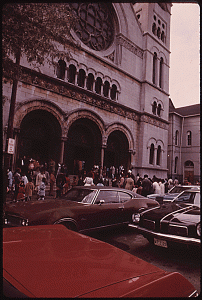
Holy Angels Catholic Church

Holy Angels Catholic Church, the African-American Catholic Church in South Side Chicago, was packed. Father George Clements, a bold community leader on the South Side, had convened the community meeting.

I don’t recall why we were there that afternoon. I only remember who was there.

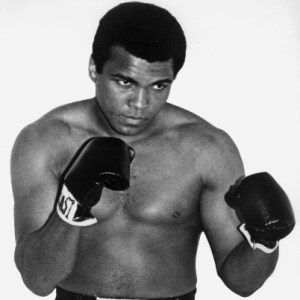
Two pews in front of us sat a Michelangelo-chiseled figure of flesh and blood in a black suit. Massive square shoulders, thick muscled neck, beyond regal…a Greek god, Atlas perhaps, sitting erect and still, near the back of the crowed church. There was no mistaking who he was.

Muhammed Ali

“It’s Cassius Clay!” I blurted out to my fiancee…in what I thought was a whisper… pointing to the large man two rows in front of us.

MUHAMMED ALI!” came the woman’s corrective voice from behind us. The young, embarrassed, white Christian seminarian thanked her, apologized, and sat quietly the rest of the afternoon.

Ali, the World Champion, had changed his name from Cassius Clay. He had joined the Nation of Islam. Ali refused military induction as a conscientious objector. His conviction would overturned by the U.S.Supreme Court. At the time he refused to step forward for induction to serve in the Viet Nam War, he asked:

“Why should they ask me to put on a uniform and go ten thousand miles from home and drop bombs and bullets on brown people in Vietnam while so-called Negro people in Louisville are treated like dogs and denied simple human rights?”

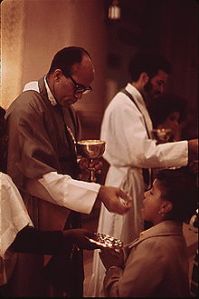
Father George H. Clements went on to become the first African-American in the Archdiocese of Chicago to be appointed to the position of Pastor.

Father George H. Clements at Mass

As Pastor of Holy Angels, Fr. George Clements moved a statue of St. Anthony and set up an altar honoring Dr. King following Dr. King’s assassination. When the archdiocese expressed its disapproval, Fr. Clements refused to reconsider.

Acclamatio populorum—”the people acclaim a saint,” he said. “If the cardinal wants it down, he’ll have to take it down himself.”

The Martin Luther King, Jr. statue remained in place.

Fr. Clements would later become famous as the first priest to adopt a child. He added a new title -“Dad” – as the adoptive father of four African-American children, and founded One Church – One Child, a movement in his parish inviting African-American families to adopt homeless African-American children. The program became nation-wide and still exists today.

The Dogs’ Life

There is only now.

The Master, the Top Dog,

(the alpha male) is gone.

The new guy feeds us:

our eyes begin to go first to him.

We wait, we lounge, we mope

when he puts us out in the pen.

There is room to play,

but he may never return,

never let us back with the pack,

with the kind one, with the shorties…

He’s here now!  We’re back inside!

There may be more food!

Search, bark, gambol, sniff,

tumble, lick, pretend to fight–

why is he taking us back outside

to the pen?

– Steve Shoemaker, Urbana, IL, Sept. 3, 2012

Jack Baker’s Church

A small, white dairy barn had stood alone upon that hill for years.

The town had grown around it.  Now a university professor, architect,

will try and see if he can build a church for students there.

They have almost no money.  But they are Reformed, still Puritans with

simple tastes:

a concrete floor will do with folding chairs, clear windows open to

the light, the street, the passers-by, invite all in.  They meet

around a table, pulpit, bowl, and hear the word.  The room is filled

with song and prayer– the walls, inside and out, like milk are white.

Up high, no steeple, but a box of light, a cupola like on a barn:

just right…

Hessel Park Church

Hessel Park Church

– Steve Shoemaker, Urbana, IL, September 2, 2012