
December 6, 2017, Atlanta, Georgia.
I’m a stranger in Atlanta. I go to the ticket-vending machine to buy the $2.50 ticket for the MARTA, Atlanta’s metro subway system, that will take me to my early morning appointment for a recording session at Day1.org.
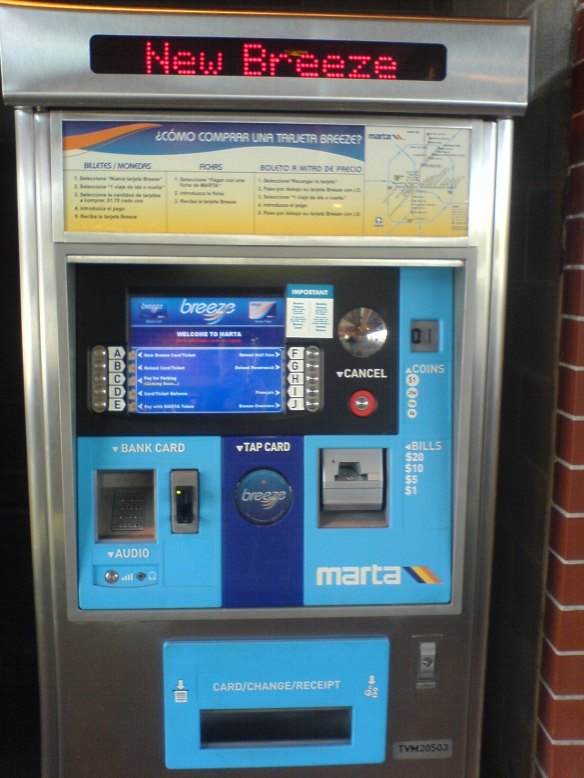
Marta ticket machine
The MARTA machine is not accepting my credit card. “Enter zip code.” I enter the Minnesota zip code. “Credit card not accepted.” I try again. Same result.
A poorly dressed man in his mid-30s or early 40s — it’s hard to tell how old he is — asks if he can help. Strange things happen to strangers on public transportation platforms, but something about him leads me to believe I can trust him. He inserts my credit card with the same result. “Credit card not accepted.”
“Follow me,” he says. He walks over to the turnstiles that admit ticket-payers to the MARTA, goes through, and holds the turnstile open for the penniless stranger who’s been so rudely welcomed to Atlanta by a machine that doesn’t like Minnesotans. Maybe the machine recognized my Minnesota zip code and thinks I’m Senator Al Franken. Maybe if my zip code had been from Alabama where I could vote for Roy Moore, my credit card would have been accepted.
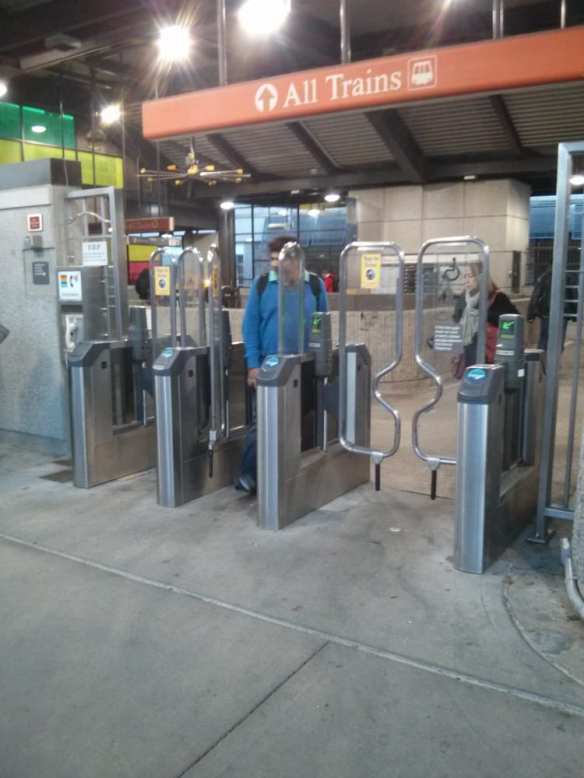
MARTA turnstiles
I follow the rescuer through the turnstile. He extends his hand, introduces himself, and says he’s on his way to work at Goodwill. He learns where the stranger from Minnesota is going, identifies the right stop, and stays with me to tell me when to get off. The Goodwill where he works is one stop beyond mine.
On the platform, waiting for the MARTA train, I ask whether he grew up in Atlanta. Turns out he’s new here. He’s from Miami. I ask what brought him here. “I came to start a new life,” he says. “I’ve been here four months now. The Lord’s been good to me.” I ask no questions and make no assumptions about why he left Miami. “I woke up blind one day. I couldn’t see. Couldn’t see a thing. I prayed to get my sight back and it was given. I gave my life to the Lord to start over. That’s why I’m here.”
He was not evangelizing me. He showed no signs of the emotional manipulations that usually accompany such stories. There was no follow-up “Are you saved?” Just a sharing that seemed honest, if hard to believe or understand. People don’t just wake up blind. And they don’t all of a sudden get their sight back.
“Like the Damascus road,” I say, referring to the conversion of the Apostle Paul who was struck blind but received his sight back as a gift. “Yes,” he says. I ask whether he has a church. “O, yes! The Church of the Jubilee.”
“Ah, the Jubilee — when all wealth is redistributed,” I say, as he smiles a knowing Yes.
From what little I can tell, the man from Miami owns little to nothing in the way America defines wealth. He works at the Goodwill. But he is wealthy. He goes to a Bible study every Wednesday night, “another meeting” Friday nights, and worship on Sunday mornings. The day the machine failed, a man of good will struck blind in Miami became part of the Jubilee and welcomed another stranger whose credit card wasn’t worth a nickel.
- Gordon C. Stewart, Chaska, MN, December 6, 2017.

 Views from the Edge