
I’m hearing voices in my head

This original composition by Momoh Freeman is inspired by Momoh’s fellow Liberian refugee who lost his entire family. Scroll down for what the lyrics and what inspired the song.

“It was the morning of August, 1995 in Liberia when my friend went out to look for some food for him and his family. When he got back, he met the bodies of his family laying there. They were killed by the rebels. He moved to the U.S. in 1997 still carrying the pain and suffering he saw that day. One day he called me and asked me if I could come visit him at the Mental Institution. I said yes. So I went there. He told me what was going on and that he hears voices in his head and all this stuff, so I wrote a song about it. Hope you like it and thanks for watching.” – Momoh Freeman

Lyrics (copyrighted)

V1. I’m hearing voices in my head.
They are telling me I’m not good enough.
I asked myself what’s going on…… I think my
mind is playing tricks on me… can it be I’m going
crazy…? don’t want to go near insanty.

Bridge: If I loose my mind, where does that leave me
will I be a shell of what I used to be?
send down the rain, and wash away my fear
send down the rain and set me free

V2. I don’t think that I can take this alone
I need some help from above
I can hear them getting louder
and these voices are driving me crazy.

V3. What can I do to get these voices out of my head
I can’t sleep, as if monsters under my bed….
I need some help to get me through the night…
what can I do not to be afraid anymore…..

PERSONAL NOTE:

Momoh’s works in a group home for mentally-challenged adults, serves as Music Director at Immanuel Lutheran Church in North Branch, MN, and performs in various venues on weekends.

Momoh and I served Shepherd of the Hill Presbyterian Church in Chaska for eight years. He defines for me “Blessed are the pure in heart, for they shall see God.” In his voiced response to his friend’s voices, I hear God. Thank you, Momoh, for the privilege.

  • Gordon C. Stewart, Chaska, MN, January 26, 2016
 

“Child Again”

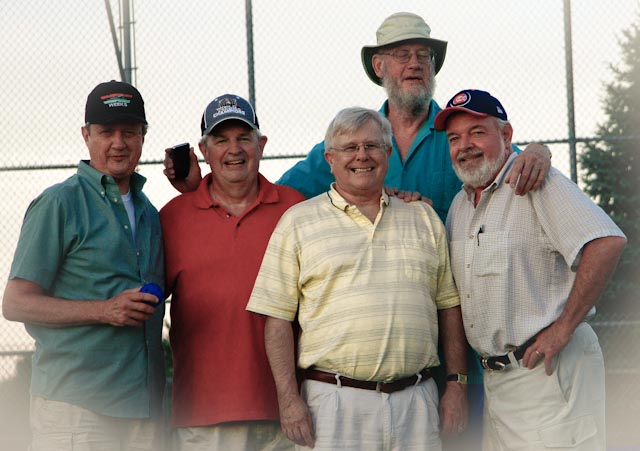
Picture of classmates with Harry Strong to the right

Picture of classmates - Harry Strong on the far right

Yesterday classmate Harry Strong,sent this by email in response to Steve and my reflection “Words from childhood” posted on Views from the Edge. I asked Harry for permission to publish part of his email here. Harry’s reflection ends with questions for your reflection.

–  by Harry Lee Strong, San Juan Mountains, Colorado, sent April 28, 2012

While teaching adult classes at the Church of the Wildwood in Green Mountain Falls, I led a course called: “Could I Sing That Song and Mean It?”  We sang and listened to a number of sacred and secular pieces on various topics. This was one of them.

“Child Again” (Beth Nielsen Chapman) 

She’s wheeled into the hallway
Till the sun moves down the floor
Little squares of daylight
Like a hundred times before
She’s taken to the garden
For the later afternoon
Just before her dinner
They return her to her room

And inside her mind
She is running
She is running in the summer wind
Inside her mind
She is running in the summer wind
Like a child again

The family comes on Sunday
And they hover for a while
They fill her room with chatter
And they form a line of smiles
Children of her children
Bringing babies of their own
Sometimes she remembers
Then her mama calls her home … CHORUS

Playmate, come out and play with me
(It’s raining, it’s pouring, the old man is snoring)
And bring your dollies three
(Bumped his head on the edge of the bed)
Climb up my apple tree
(Never got up in the morning)
Slide down my rain barrel
(Rain, rain, go away)
Into my cellar door
(Come again another day)
And we’ll be jolly friends
(Little Johnny wants to play)
Forevermore
(Some more) … CHORUS

  1. Do you have family members or friends who are suffering from Alzheimer’s or dementia? 
  2. What counsel, wisdom, or inspiration do you have to offer  to caregivers and loved ones who are trying to be helpful companions  to those whose mind is not what it used to be?

A Song for each kind of day

Scheduling Calendar - differrent kinds of days

Scheduling Calendar - different kinds of days

Two years ago during my step-daughter’s final months with terminal cancer, I spent three days in quiet reflecton at Saint John’s Abbey in Collegeville, MN.Worshiping with the Benedictines was part of the structure of my day, the chants and readings opening space for fresh air to enter my angry soul…except for…the Psalms. Outrageously violent, vindictive, intolerant, self-righteous…horrible expressions of emotions I had gone there to revoke.

One day following morning prayer, I asked my Benedictine spiritual guide “Why do you read them aloud? Over and over again. They’re horrible.”

“Yes,” he replied, “because they’re real.” And words to this effect: “All those emotions are in us. Every one. Only if we recognize and remember can hate be transformed into love, fear into trust, self-centeredness into compassion. The gospel makes no sense unless it is a word spoken directly into these parts of ourselves we wish weren’t there, the sides of us we deny or from which we take flight into illusions of perfection.”

The words of another Benedictine, Dom Sebastian Moore of Downside Abbey in England, had hit the mark once before during the greatest personal crisis of my life – a time filled with the greatest joy and the greatest sorrow at the very same time. The words are heavily underlined in my copy of Moore’s The Crucified Jesus Is No Stranger. They were a lifeline to a drowning man.

“We have to think of a God closer to our evil than we ever dare to be. We have to think of God not as standing at the end of the way we take when we run away from our evil in the search for good, but as taking hold of us in our evil, at the sore point which the whole idealistic thrust of man is concerned to avoid.”

Or, as Steve concludes his poem, “there is a Psalm for each one of our days.”  Here’s the poem.

“A Song for Each Kind of Day”

Steve Shoemaker, April 12, 2012


One Hebrew word for “god” was “jah.”

(It was a time of many words

for god–and many gods.)  To say

“hallel” was for all to sing praise,

so HALLELUJAH meant “Praise God!”

(or “Thanks to you, oh God!”– for some

words could be truly translated

more than one way.


And so, a Psalm, or Song, that offered thanks or praise

might well be paired with a lament:

a cry of pain from one who prays

for help, relief, from gods who sent

disaster.  (But, of course, some Psalms

wisely acknowledged that some wrongs


were caused by those who sang the songs!)

There is a Psalm for each one of our days…