President Abraham Lincoln (first DEI president) and Sojourner Truth
Lincoln’s Character
Abraham Lincoln is said to have spoken of his life as plucking thistles and planting flowers. Thanks to L.K. Hanson’s “You Don’t Say” (Minnesota Star Tribune, Feb, 17, 2025)
Die when I may, I want it said of me by those who know me best, that I have always plucked a thistle and planted a flower where I thought a flower would grow. – Abraham Lincoln, 16th President
When there is no character
The structure of Lincoln’s statement remains the same this Presidents’ Day, but the thistles are taking root where flowers grew.
Die when I may, I want it said of me by those who know me best, that I have always plucked a flower and planted a thistle where I thought a thistle would grow.
Where have all the flowers gone? Gone to thistles every one. When will we ever learn?
Where have all the flowers gone?
Gone to thistles every one. When will we ever learn?
“He who saves his Country does not violate any Law.”
Donald J. Trump
Gordon C. Stewart, Brooklyn Park, Minnesota, Presidents Day, Feb. 17, 2025
Who we shall become is as cloudy as who we have been. Whatever pasts and futures we Americans imagine differently, we know we are in the midst of a national and global crisis. Whether or not we wear a mask, social distance, or march on the streets, we sense it in our bones. Anxiety is everywhere. We cover our eyes and wait to see who and what shall become of us.
Crisis as terrible, wonderful, and . . . .
Crisis – that is, the serious encounter of a man (sic) with exactly that which now threatens his own life, with that which represents, signifies, and warns of his own death – is always terrible, wonderful, eventually inescapable, saving and holy. ― William Stringfellow, A Private and Public Faith.
Re-imagining America
Re-imagining America begins with facing reality as we experience it, and asking why. No two people experience America the same way, yet all of us experience the same America. How it looks from the shores of Palm Beach and La Jolla or the banks of the Potomac is different from East Harlem where “street lawyer” William Stringfellow worked and bore witness in “Jesus the Criminal” in Christianity and Crisis in 1970:
We who are Americans witness in this hour the exhaustion of the American revolutionary ethic. Wherever we turn, that is what is to be seen: in the ironic public policy of internal colonialism symbolized by the victimization of the welfare population, in the usurpation of the Federal budget—and, thus, the sacrifice of the nation’s material and moral necessities—by an autonomous military-scientificintelligence principality, by the police aggressions against black citizens, by political prosecutions of dissenters, by official schemes to intimidate the media and vitiate the First Amendment, by cynical designs to demean and neutralize the courts.
Yet the corruption of the American revolutionary ethic is not a recent or sudden problem. It has been inherent and was, in truth, portended in the very circumstances in which the Declaration of Independence was executed. To symbolize that, some 30 white men who subscribed to that cause at the same time countenanced the institutionalization in the new nation of chattel slavery, and they were themselves owners of slaves. That incomprehensible hypocrisy in America’s revolutionary origins foretells the contemporary decadence of the revolutionary tradition in the USA. — “Jesus the Criminal,” Christianity and Crisis, June 8, 1970.
Some things remain the same
Some things remain. Some things never go away. Some things that look different are the same. Jesus of Nazareth and Jesus Barabbas shared more than a name. Both were criminals in Roman custody. One was convicted and executed; the other was released. Both are with us still.
A numbing detachment from others
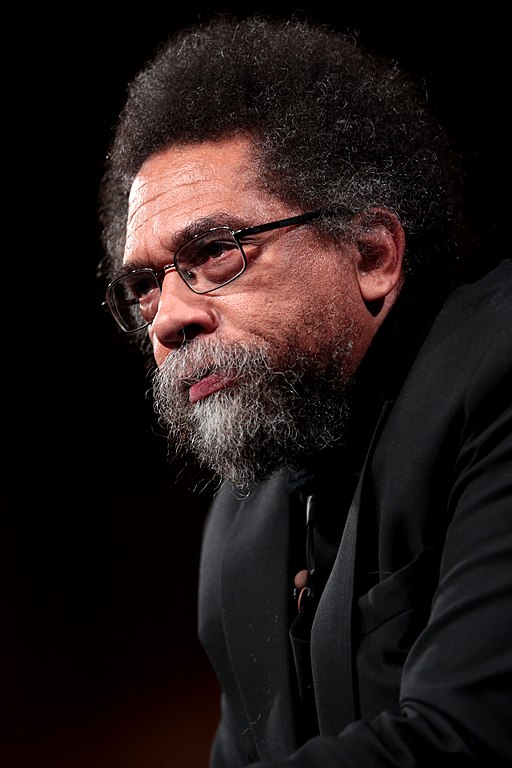
In 2020, it is no longer only the descendants of slaves in East Harlem who cope with the horrifying sense of meaninglessness, hopelessness, and lovelessness Cornel West described in Race Matters.
THE PROPER STARTING POINT for the crucial debate about the prospects for black America is an examination of the nihilism that increasingly pervades black communities. Nihilism is to be understood here not as a philosophic doctrine that there are no rational grounds for legitimate standards of authority; it is, far more, the lived experience of coping with a life of horrifying meaninslessness, hopelessness, and (most important) lovelessness.
The frightening result is a numbing detachment from others and a self-destructive disposition toward the world. Life without meaning, hope, and love breeds a cold-hearted, mean-spirited outlook that destroys the individual and others. — Cornel West, Race Matters (1994).
Alternative revolutions
Two revolutionary Jesuses are with us still. The prisoner who was released re-builds the haunted house on sand. The other builds a house on rock. We can rebuild the house on shifting sands that wash away our loftiest intentions, or we can build a house on the rock of meaning, hope, and love.
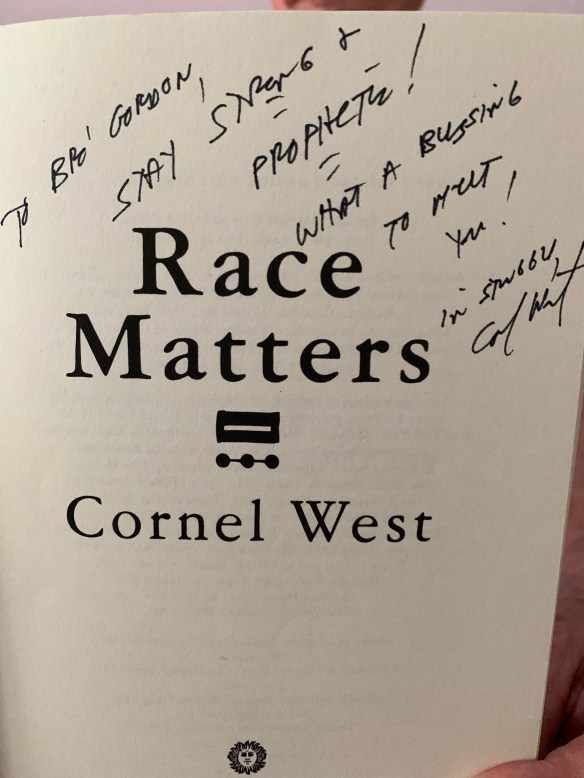
While visiting the Westminster Town Hall Forum in Minneapolis years ago, Cornel West inscribed Race Matters with a gracious personal charge and benediction.
All these years later, I still don’t know how to fulfill the charge or honor his blessing. I have not stayed strong, I am not, and never have been, prophetic. But the instruction and the blessing are with me still.



 Views from the Edge