“I’m So Sorry”

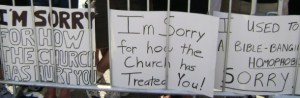
Marin Foundation photo of signs at Chicago Pride parade

I’m a pastor. But there are days when I wonder whether I belong in the Christian Church, whether I’m really a Christian. Ever wonder that about yourself? Or have you left the church as a matter of dissent, embarrassment, or protest?

Take the last two weeks. President Obama shares his faith at a National Prayer Breakfast. He declares that we are “our brother’s keeper”. I feel proud. The comments on CNN run heavily against him. Ayn Rand’s “the virtue of selfishness” – not the story of Cain and Abel or the teaching of Jesus – has won the hearts of the people. Rick Santorum tells an Ohio audience that Obama’s agenda is based on “some phony theology, not a theology based on the Bible.” I feel sad…and angry. I read the story about the church court case of the Rev. Jane Spahr, a lesbian Presbyterian minister rebuked for officiating at same-gender marriages, one of them the wedding of Lisa Bove. Lisa was an ordained student elder at the church I served at The College of Wooster. She went on to seminary and was ordained a Minister of Word and Sacrament. I feel proud of Janie and Lisa, their tenacity, their courage, their strong and gentle spirits, their deep faith. I feel sad that the church still doesn’t get it.

I’m embarrassed by how ridiculous the church debate is and how absurd this church family feud looks to the world. I want to withdraw, pull the covers over my head, go to sleep, take a sedative maybe. But I’m also angry. I want to fight. I want to weigh in on the debate. Yet to do so will only continue the polarization, the disrespect for others, the tendency on all sides of a church argument to proclaim with Little Jack Horner, “What a good boy am I!” If I stick my thumb in the pie, I’ll just continue the ludicrous display of Christian arrogance. What to do? To keep silence feels like abdication of conscience. To speak adds my voice to the appearance of the church’s absurdity. But I’m give fan of the Theater of the Absurd and Albert Camus, as well as Jesus.

I decide to stick my thumb in the story. My comment is the first thumb in a hot pie:

“I know Jane Spahr and Lisa Bove as colleagues and love them both. Lisa was a student leader at the Westminste­r Presbyteri­an Church at The College of Wooster where I served as Pastor. Jane is that rare minister of the gospel who has managed to remain gentle and bold, acting in conscience and ecclesiast­ical disobedien­ce without becoming hard or cynical. Lisa is the same. When you’ve been working for GLBT full inclusion as long as Jane and Lisa, that’s a testimony to their soulfulnes­s. For Jane, Lisa, and so many of us, the Bible calls disciples of Jesus to live in love and to be advocates for justice. The Presbyteri­an Church (USA) last year restored an older principle of church order that removes the restrictio­n against ordaining GLBT members. The issue of marriage remains contentiou­s in the church, as it is in the society as a whole. Some pastors have declared that until church and civil law permit them to officiate at same-sex marriages, they will not marry anyone as a witness to justice. Jane and Lisa are sweet, sweet spirits whose lives bear witness to justice, love and peace, working from that inner light of courage, conscience and consolation that keeps them sane and strong.”

Three replies come quickly:

1) “You are a faithful and honest servant of God.  It has taken a long time, but every year there are more like you” (i.e., “What a good boy am I Good boy!”); and

2) “Pastors should know and preach the truth of God’s word. Please read: 1 Tim: 3:1-7 and Titus 1: 5-9  When folks go against the truth of God’s word, then they are following deceit and you should know who the great deceiver is”  (“Bad boy! Bad boy!”)

3) “Let’s hope this church sees the light and retracts the rebuke.  And perhaps even apologizes­.”

Then this morning a classmate sends me this story about an apology: “Christian Group Shows Up to Chicago Gay Pride Holding Apologetic Signs“.

Marin Foundation photo of signs at Chicago Pride parade

I wish I’d been there to hold one of these signs.

I’ve experienced the forgiving hugs of gay and lesbian church members like the guy in the underwear. And when I write comment or a commentary like this one, I hear a little voice inside myself: “Good boy! Good boy!” Then, as soon as I feel the relief, I know I’ve fallen into the very self-righteousness I despise in others. “Bad boy! Bad boy!” and I’m back where I started: “God help us ALL!”

Read the story. Ponder it. Then stick your finger in the pie with a comment here on the blog.

Huffington Post story on Lesbian Presbyterian Minister case

Photo of Rev. Jane Spahr (L) and Lisa Bove (R)

Today’s Huffington Post carries the story of two lesbian Presbyterian colleagues I know and love, Jane Spahr and Lisa Bove (“Jane Spahr, Lesbian Presbyterian Minister Case to be Reviewed“).

Lisa was a student leader at the Westminste­r Presbyteri­an Church at The College of Wooster where I served as Pastor (1977-1983). She was an elder and campus leader there. She went on to seminary and was ordained a Minister of Word and Sacrament.

Jane and Lisa are those rare ministers of the gospel who, have managed to remain gentle and bold, acting in conscience and ecclesiast­ical disobedien­ce without becoming hard or cynical. When you’ve been working for GLBT full inclusion as long as Jane and Lisa, it’s a testimony to their soulfulnes­s that they have not become bitter or plunged into the quick sand of self-righteous. For Jane, Lisa, and so many of us, the Bible calls disciples of Jesus to live in love and to be advocates for justice. The Presbyteri­an Church (USA) last year restored an older principle of church order that removes the restrictio­n against ordaining GLBT members. The issue of marriage remains contentiou­s in the church, as it is in the society as a whole. Some pastors have declared that until church and civil law permit them to officiate at same-gender marriages, they will not officiate at any marriage, as a witness to justice. Jane and Lisa are sweet, sweet spirits whose integrous lives bear witness to justice, love, and peace, drawing from that inner light of courage, conscience and consolatio­n that keeps them sane and strong.

I wish them well, and pray the Spirit’s guidance on the Permanent Judicial Commission reviewing the case.

The Shadow of the Grand Inquisitor

Conscience is the “still, small voice” (a whisper) that makes ancient truth appear uncouth. Conscience and dissent change the world.

It is a great sadness to learn of Archbishop Nienstadt’s reported threat of disciplinary measures against priests in the Archdiocese of Saint Paul and Minneapolis who openly dissent from the proposed amendment to the Minnesota State Constitution that would restrict marriage to a man and a woman (“Priests told not to voice dissent,” Star Tribune, 1/18/12).

The protest of the priests and parishes under Archbishop Niensted’s jurisdiction will be mostly silent. They will simply go on about the business of being the church. Their Protestant brothers and sisters either stand by in quiet support or choose to speak out loud what they cannot.

It is customary practice – and a good one – to regard the internal matters of another church as off limits to non-members. Both as a person of significant frailty and as a Presbyterian minister, Jesus’ injunction to take the log out of my own (Presbyterian) eye before reaching for the speck in my (Roman Catholic) neighbor’s eye gives me great pause.

I choose to speak out of great love and respect fore the Roman Catholic Church, my priest colleagues and friends. I tremble that my words will be mistaken as disrespect or that they will turn the clock back to the era before the Second Vatican Council (“Vatican II”) that blew fresh air across the whole Christian world. Before Vatican II, Protestants and Catholics lived in self-imposed religious ghettos on opposites sides of the main street. Today the dividing line has been erased. People are talking, and what many of them are saying is the same…whether out loud or in the chain of whispered protest that happen when the old authoritarian patterns squelch conscientious dissent.

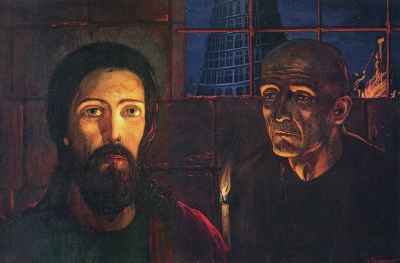
Jesus the Prisoner and the Cardinal, the Grand Inquisitor

We all do well to remember Fyodor Dostoevsky’s The Brothers Karamazov where it is the Church, not Satan, that puts Jesus on trial in the parable of the Grand Inquisitor. The setting is the City of Seville during the 16th Century Spanish Inquisition. The night sky is lit with the fires of heretics being burned at the stake.

Christ has returned to the City of Seville – an unexpected Second Coming without notice or fanfare – to take his place once again among the poor and destitute. As at the first coming, his love for human dignity and freedom of conscience threaten the civil and religious order that has lit the fires of heretical burning martyrs – in his name and for his sake, at the command of the Cardinal of Seville.The Cardinal takes Jesus prisoner – a prisoner of the Church. He tells him that since his departure, the Church has corrected each mistake he had made in the temptations in the wilderness. He tells Jesus that he is a fool for failing to provide the people with what they most want – a hero who will take away their dread of standing alone in freedom before God.

“You thought too highly of them (i.e. ordinary people),” says the Cardinal, “for they are slaves, though rebellious by nature. Look around and judge, Jesus; fifteen centuries have passed. Look at them!   Who have you raised up to yourself?  I swear, man is weaker and baser by nature than you have believed him to be! Can he do what you did? By showing them so much respect, you failed to feel for them; you asked too much from them – you who loved them more than yourself!”

In the end the Cardinal does not execute him. With loss from his “bloodless lips” he sends the Church’s Prisoner off into the night and tells him never to return.

The Archbishop of the Diocese of Saint Paul and Minneapolis is not the Cardinal of Seville. But the Grand Inquisitor’s dark shadow has fallen across the Diocese among those sworn to obedience to the Archbishop’s authority. It has also fallen over their parishes and their Protestant friends. A pall of silence has fallen over the parishioners for whom the Prisoner had “too much respect.” The conversations take place in whispers and in privacy over back fences, or in parish councils where priests and Catholic lay leaders discuss how to be faithful to their own consciences while living under the vow of obedience.

It is one thing for the Church to promulgate an official position on marriage; it is quite another for an Archbishop to tell a priest he must be silent if he dissents on a theological matter, much less on a political and possibly partisan matter.

The Second Vatican Council (Vatican II) strongly re-affirmed the doctrine of the priesthood of all believers.  It made clear that the entire baptismal community constitutes the Church, and that the Church’s teaching office and hierarchy exist to serve the people, not the people the hierarchy. Vatican II lifted up doctrines that date back to the Early Church Fathers: the sensus fidelium (the sense of the faithful) and the sensus fidei (the sense of the individual’s faith).

Among the documents produced by Vatican II was Dignitatis Humanae that celebrated the dignity and freedom of religious conscience. The document opened the Church’s arms to other religions, and there was a great swelling of joy within the Roman Catholic Church and in other Christian churches touched by the Spirit of respect for other views and practices.

No longer were conscience and dissent regarded ipso facto as enemies of the Gospel or of the Church. Those of us in churches separated during the 16th Century Protestant Reformation were embraced by our Roman Catholic brothers and sisters as partners in ministry.  The Second Vatican Council’s spirit of ongoing reform (“aggiornamento”) re-awakened in Protestant communions the call to continual renewal and reform by the Holy Spirit, a 20th Century reformation that refreshed us all.

The proposed Marriage Amendment is a moral question, and the Church’s leadership has a right and responsibility to address it, in light of Traditio (sacred tradition, or the movement of the Holy Spirit among earlier disciples) and the movement of the Holy Spirit among disciples today.

Priests, ministers, and lay people – Roman Catholic and Protestant – on both sides of the pre-Vatican II divide – do not share a single view on the question of the proposed Marriage Amendment that Minnesota voters will decide next November. What we do share is a deep belief in the freedom of the pulpit, the freedom of conscience, and the freedom of the Holy Spirit to work through an informed laity and the church’s ordained leadership in together interpreting Scripture and tradition. We share a deep belief in the sensus fidelium embraced by the Second Vatican Council.

Jesus leaving the city never to return

“By the light of burning martyrs, Jesus’ bleeding feet I track, Toiling up new Calvaries ever With the cross that turns not back; new occasions teach new duties, time makes ancient truth uncouth; They must upward still and onward, Who would keep abreast of truth” (James Russell Lowell, 1845).