Gordon C. Stewart – copyright – a memoir
Five years before my father’s death in July of 1999, the first of many false alarms had called me home to Pennsylvania. I had brought some reading material for the flight from Minneapolis to Harrisburg – James Carse’s Breakfast at the Victory, an autobiographical reflection on the mysticism of ordinary experience.
I sat down for the flight, strapped myself in for take-off, opened to the Preface, and soon found my eyes flooded with tears. Dad had developed Parkinson’s and had been hospitalized following a fall and several transient ischemic attacks, i.e., small strokes that had left my mother in a constant state of worry. I could see him wasting away, yet his spirit was strong and he continued to insist that my brother Bob sneak him over to the golf course for nine holes. “Dad, I’d love to, but you can barely stand up without a walker. How you gonna play golf?” “I can do it! I can still swing a golf club. Come on, just drive me over.” “I think Mom might have some thoughts about that!” “Come on. Just you and me – Mom doesn’t ever have to know.”
So there I sat, strapped in, reading the Preface, the story of James Carse’s visit to this friend Charles who was dying of cancer. Carse had gone to visit Charles before walking an old pilgrimage route in Spain that leads from the French border to Santiago de Compostela in northwest Spain.
“Maybe you’ll find my boots in Spain,” said Charles. “They just gave out. So I put them on a stone wall by the road and limped on my bare feet.”
As Carse made his solitary pilgrimage across Spain, slogging through the mud and cow dung produced by heavy rain and snow, he came upon “the outline of a familiar object crushed in the mire.” He tugged at the old boot until it came loose from its moorings in the mud to find the sole gone but its essential structure in tact. Could it be Charles’s boot? He took a picture which he presented to Charles when he next visited him.
My face was flooded with tears. I choked back the sobs.
Charles’s boots had been the essential equipment of a pilgrim, yet in the end they had not served him well. He had had to make the journey in his bare feet. So would Dad. My father’s boots were the role of ordained Minister of Word and Sacrament. One is ordained for life, he would remind me, not just for a particular job. Yet I always wanted him to take off his boots, expose his naked self, experience the squish between his toes in the primordial muck that is more real than social roles and expectations, the more ordinary sacred ground that required Moses to take off his shoes.
Thirty-thousand feet in the air, I took out a pen and scribbled in the margin of Breakfast at the Victory:
“Dad and his boots – his soles worn out, only his bare feet for the rest of the journey. At some point your boots wear out and it’s just you and your bare feet and the mud – the self shorn of the ego.”
I sobbed for Dad. I sobbed for myself, fearing that he and I would both die with our boots on. I cried for losing him. I cried for him to be free. I cried for barefoot authenticity.
Five years later – it was July – I again flew to Harrisburg. Expecting my father’s death, I had worn a suit and my black Johnston & Murphy shoes, highly polished by the best shine man in the Minneapolis-St Paul International Airport, as a tribute to Dad – his shoes were always polished – but also because I have inherited Dad’s appreciation of good grooming, especially a pair of good shoes, shined to the max as a sign of dignity and self-respect.
When I arrived at my folks’ apartment at the retirement complex, I took off my shoes and placed them carefully next to the grandfather clock in the living room. My mother had continued to live in the independent living apartment they had shared until seven months earlier when Dad’s deteriorating health had required moving him to the dreaded “Care Center.” The Parkinson’s had left my father weak and wobbly to the point where my mother could no longer manage his needs, and, with great distress, the move had been made that separated them after 62 years of marriage.
My trip to Cornwall Manor, however, had been planned three months before. I had promised to drive my mother to a Titus family reunion in South Paris, Maine, our version of “A Trip to Bountiful,” a return to my mother’s roots. When we had laid those plans in April, the doctor had told us that my father had two weeks at most to live. Believing the end was near and knowing that my mother’s health had declined under the stress of watching Dad slowly fade away, I had made the plane and car reservations in the expectation that the July Titus family reunion would be several months after Dad’s death.
To everyone’s surprise, when it came time for the Maine reunion, my father continued to survive against all odds. He had broken the doctor’s crystal ball. Although he appeared to be near the end – his ability to swallow was all but gone – it had been so for some time, and both Dad’s doctor and my parents’ pastor urged us to make the trip for the sake of my mother’s health. I explained to Dad that I was taking Mom home to South Paris for a few days for the family reunion. He smiled and nodded his consent, giving approval to meeting her need, knowing, perhaps, that it was the best thing for them both that he slip away without her having to watch and knowing that both he and she would be surrounded by family when he went.
The call came three days later at two-thirty in the morning. “Mr. Stewart, I’m sorry to tell you….” “My father’s dead,” I said, less perhaps to make her job easier than to get a grip on death myself. “We’re so sorry,” she said. “The girls went to turn him at one-thirty. He seemed fine. He was comfortable. When we went back in at two o’clock, he was gone. Although we’ve been expecting it for a long time, we were surprised. I’m very sorry.”
I was two years old again. My mother and I were back on the train following my father’s departure for the South Pacific in World War II. Only this time he wasn’t coming back. We wept. We talked. We engaged the guilt of having left him alone at the end. Yet I also believed that it was as it was supposed to be. My father had gone quietly into the night, knowing that he could go without taking care of my mother or my mother having to take care of him. It was for her that he had stayed alive; he had received permission to go. He knew she would not be alone when he went.
While my mother and I prepared to return to Harrisburg, it fell to my brother Bob and sister-in-law Janice, who lived nearby, to gather the belongings from the room at the Care Center and deliver to the funeral director the clothes my mother had carefully laid out on the bed for Dad’s burial – his favorite blue suit, a silk tie, and my father’s favorite blue shirt.
The morning of the funeral, I showered and pulled from the closet the white shirt and tie I had worn on the plane for just this occasion. All was well. With the sole exception of Bob and Janice who were to meet us at the funeral home, the family had gathered in the living room and was ready to go. We were running on schedule when I returned to the grandfather clock to put on my shoes. No shoes! My shoes were missing. I scoured the apartment without success, rifling through the closets of stuff Bob and Janice had brought home from the Care Center.. I was grumping about, cursing my brother for packing up my only good shoes, and in a terrible state of mind when I found the black cap-toed Johnston & Murphy’s. I breathed a sigh of relief and put them on. My feet were swimming in them – then it dawned on me: “These are Dad’s! My shoes are on Dad!!!”
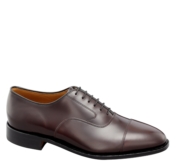
Johnston and Murphy shoes
Dad was wearing my shoes. I was wearing his. Laughter shook the rafters of that living room, relieving the tension of whatever dread was there. My cousin Gina and her husband Norman from Massachusetts; my brother Don and sister-in-law Bonnie from Kentucky; my son Douglas, who had come in from New York City; Kay, and my mother – all were convulsed with laugher and a lightness of being. “They’re on Dad. Dad’s wearing my shoes!”A jovial, somewhat irreverent debate such as only families can have followed. “I love it,” I said. “Dad always loved shined shoes and he’s wearing the very best. He’d like this.” “No, why don’t you call the funeral director,” Mom said, “You should have your own shoes. Those shoes may feel okay now, but they’re going to kill your feet by the end of the day. You need your own shoes. Besides, I don’t think they bury them with their shoes on.”
“Well, I wonder,” I said. “How in the world would they be able to get those on him – they’re two sizes too small. His feet must be killing him!”
At the funeral home we made the switch, giving the director Dad’s shoes, just in case those who major in illusions are right and shoes are part of the pilgrimage to the other side. Which, of course, they aren’t. We all go out with bare feet.
Over the five years between the first summons to Harrisburg and my father’s final breath, Dad and I had each discovered his bare feet. Each of us had begun to learn not to try to fill shoes that aren’t ours. For Dad it was the shoes of Harold, his older brother and a family icon. For me, it meant exchanging my father’s and my uncle’s imagos for their humanity. Physical weakness has a way of compelling onlookers to see reality. Any illusions about enduring greatness are dashed by the ticking of time in the human body.
Yet if I had made some progress toward releasing myself from the icon of my father’s goodness, I have also learned that the recovery is never quite complete. Expectations lurk in the night, waiting to cast their shadows.
Sometimes a shadow crosses over us and we don’t even know it. One crossed over me during the funeral service, although I did not recognize it until two weeks later, when the presiding pastor, Richard Cassel, a wonderful friend to my parents who had urged the trip to Maine, started his homily with the question “Should I eulogize Ken, or preach the gospel?”
He went on to say that everyone there would want him to say something personal about what a gift from God Ken Stewart’s life was for us all. He extolled his selfless, joyful giving of himself for others. He did not say, nor perhaps did he know, that it was hard to tell how much of my father’s generosity and “selflessness” arose from his need to win others’ approval, how much of it arose from the stolen self-esteem that lived in Harold’s lengthy shadow, how much of it arose from the unconscious suppression of his own needs, and how much arose from the call to follow his Lord.
Yet for all of that, the pastor’s words rang true: “He had all the dignity of his calling without one bit of the pomposity that sometimes afflicts lesser clergy-folk; all the confidence in the truth of the gospel without one wit of judgment or condemnation for those who believe differently. Ken was a proud man – proud of his family first of all – his beloved wife, Muriel, who was his devoted, loving, caring partner in all the ups and downs of life – proud of his three sons, all of them giving their lives to helping, healing, encouraging others, and of their families – proud of his Scottish ancestry (even his golf game!) – of his profession – proud, but without one molecule of arrogance. He was a compassionate pastor and friend whose life was given away to be sure you were certain that you mattered – to him, to God, and that he would do whatever he could to make your life better, happier, more whole.”
All of that was true. Memory took me back to age 13 when I had brought home a seventh grade report card filled with Fs. My mother had wept and responded the only way she knew how: “Wait ‘til your father comes home!” I went upstairs to my room to await his arrival. The wood stairs in that 125-year old manse creaked with every ascending footstep, but the steps were slow and soft, not fast and hard. What Dad saw when he entered the room was an ashamed first-born son sitting on the edge of the bed with his head down. Without a word, he sat down next to me, put his arm around my shoulder and said, “Hi Skip. It must be pretty bad. Tell me how it is.” Compassion was his middle name. It all rang true.
The preacher returned to his original question, “Should I eulogize Ken or preach the gospel?” and proceeded to bring my father’s answer into that chapel loud and clear. “Richard, a funeral is an occasion for the praise of God, not the deceased – and I certainly want God, not me, to be praised at my memorial service. So…preach the gospel, Richard.”
At those words, my body convulsed. My hand involuntarily squeezed Kay’s and my Mom’s, a vein of grief tapped deep in my soul. It was as though my father were saying to me, “Gordon, preach the gospel” – the same charge he had delivered to me at my ordination 32 years before, a charge which I had failed.
Again, the preacher’s voice: “I can hear Ken say that to me. But then it occurred to me,” he said, “that I must not choose between eulogizing and preaching the gospel. Ken’s life among us was the gospel.”
I wanted to scream:“No! My father’s life was not the gospel. It bore witness to the gospel, but his life was not the gospel. My father was not Jesus Christ. He was just another child of God who struggled to get it. He was a child of God and of John Thomas and Sophia Campbell Stewart of Prince Edward Island and east Boston, brother of Mary, Harold and Olive, husband of Muriel, father of Gordon, Donald and Robert, who, for a time, bore the privilege of ordained pastoral ministry, his humanity as broken and scarred, as imperfect and flawed and complicated and messy as the worst rogue that ever occupied a pew.” The preacher had elevated my father to sainthood, to an icon, an image that bears little resemblance to the human reality.
In his best moments my father understood that the gospel is not about our achievements. In his worst moments of living in the shadow of Harold’s image, he believed it was. His whole life was a fight against that perversion, that belittlement. He preached because he needed to be convinced again day by day that there was a greater light than Harold’s shadow. He preached it, as in an anthem he had written, sung by the Choir of St. Andrews Presbyterian Church at his funeral, “from mountaintops filled with promise” but also “from valleys of deep despair”. He was a stranger to neither.
Two weeks after the funeral service grief had overtaken me. I couldn’t sleep. After several days of waking at three in the morning, I went to a friend to talk it out. When I told him about the funeral, I became momentarily speechless when I recalled the preacher’s line, “Preach the gospel, Richard.”
I was back in the pew convulsing with unspeakable guilt and sorrow. I could never make it right.
Then I remembered the shoes and recalled my father’s unconditional support during the most traumatic time of my life that had led me to ministry outside the church at the Legal Rights Center. It was right that I have a pair of shoes that fit my own feet.
Dad no longer needed to fill Harold’s shoes. I no longer needed to fill my father’s shoes. When the end comes, it is altogether clear. Our boots wear out. Bare feet are all we have – just us, our bare feet, and mud, the self shorn of all ego.


 Views from the Edge