
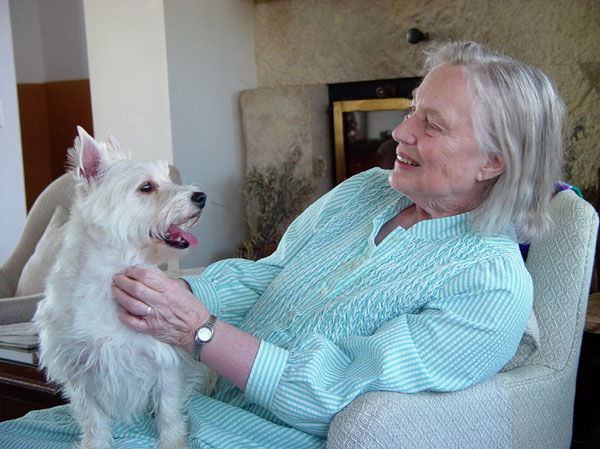
Mary with my dog Maggie
Visiting with a 91-year-old friend with terminal cancer, the discussion turns to her final wishes. Mary is a child psychologist by profession, a retired professor whose pioneering work with children at the University of Minnesota and Minneapolis’ Children’s Hospital is a legacy that will remain long after she is gone.
Raised in a strict Calvinist Christian tradition in Michigan, her soul long ago had come to drink from gentler wells – the quiet gatherings of the “Quakers,” the naturalist spirituality of St. Francis of Assisi and of American indigenous spiritualities that saw the sacred in the cirrus clouds, the fluttering of a leaf, a chickadee at the bird-feeder on the deck, or the circling of an eagle overhead.
When her husband died three years before, the family gathered privately to inter Doug’s ashes in a small opening in the woods on their farm near Wabasha. Doug, like Mary, is legendary in Minnesota…in a different sort of way…the street lawyer with the pony tail who started and led the Legal Rights Center with leaders of the American Indian Movement (AIM), the chosen intermediary between the federal troops and the AIM members at the Wounded Knee occupation in 1973 – Dennis and Russell Means, Clyde Bellecourt, Leonard Peltier, et. al..
The family marked the spot with four stones pointing North, East, South and West – the “four directions of the four corners of the earth.” Early the next morning, the day of the public celebration of Doug’s life, one of Doug and Mary’s daughters had walked out to that tiny clearing in the woods. A bald eagle was sitting very still in the center of the four stones above Doug’s ashes.
I asked Mary at the time what she made of that. With great respect, she paused…and said she didn’t know, and something to the effect that native peoples seem to be in touch with mysteries that elude the rest of us. er statement struck me at the time because in our talks about death and dying, she had always indicated that she believed that life is lived between the boundaries of birth and death. The eagle sitting on Doug’s ashes in that tiny opening in the woods didn’t seem to convince her of something beyond the grave, but she held a kind of sacred openness to the possibility, a respectful not-knowing about human destiny, the universe, and our place in it.
Now, three years after Doug’s death, we sit together, as we often have, over a lunch of shrimp, salad and fresh bread at the table that looks out at the bird feeders in the old converted mill on the farm up the hill from Wabasha. Three of her five children are there.
Missy asks Mary whether she has told me her plans for her service when the end comes. There is a long silence as she goes away to some far off inner place – some wooded glen where no one else can go. Her eyes are distant, dream-like, looking off to some far off place, sorting through her long spiritual journey to fetch the right words out of the forest of 91 years of memory.
Finally she speaks… softly. Quietly. Deliberately. “I want you to do the prayer and I want the benediction.” “What kind of prayer?” I ask. She looks at me quizzically, as if I should know. “Something classical with the gravitas of tradition?” “Yes,” she says. “And what kind of benediction?” I ask. “Blessed are the peacemakers,” she says. “And music. What about music?” “Oh, yes” she says, “Bach, Mozart, Beethoven…and ‘Let there be peace on Earth’”… and she wanders off again into that most personal space where no one else can go.
Ninety-one years summed up in four-words “Blessed are the peacemakers” from Jesus’ Sermon on the Mount.
She is growing weary now. It’s time for her afternoon nap. We say good-bye. I leave this sacred place of Mary’s world, get behind the wheel to drive home, turn on the radio, listen to news that is so far removed from Mary’s world and Jesus’ with all the saber-rattling and the name-calling, and I wish we all could have lunch with Mary or take a walk to the wooded glen where the eagle sat still above Doug’s grave at the center of the four corners of the earth.
———————————————-
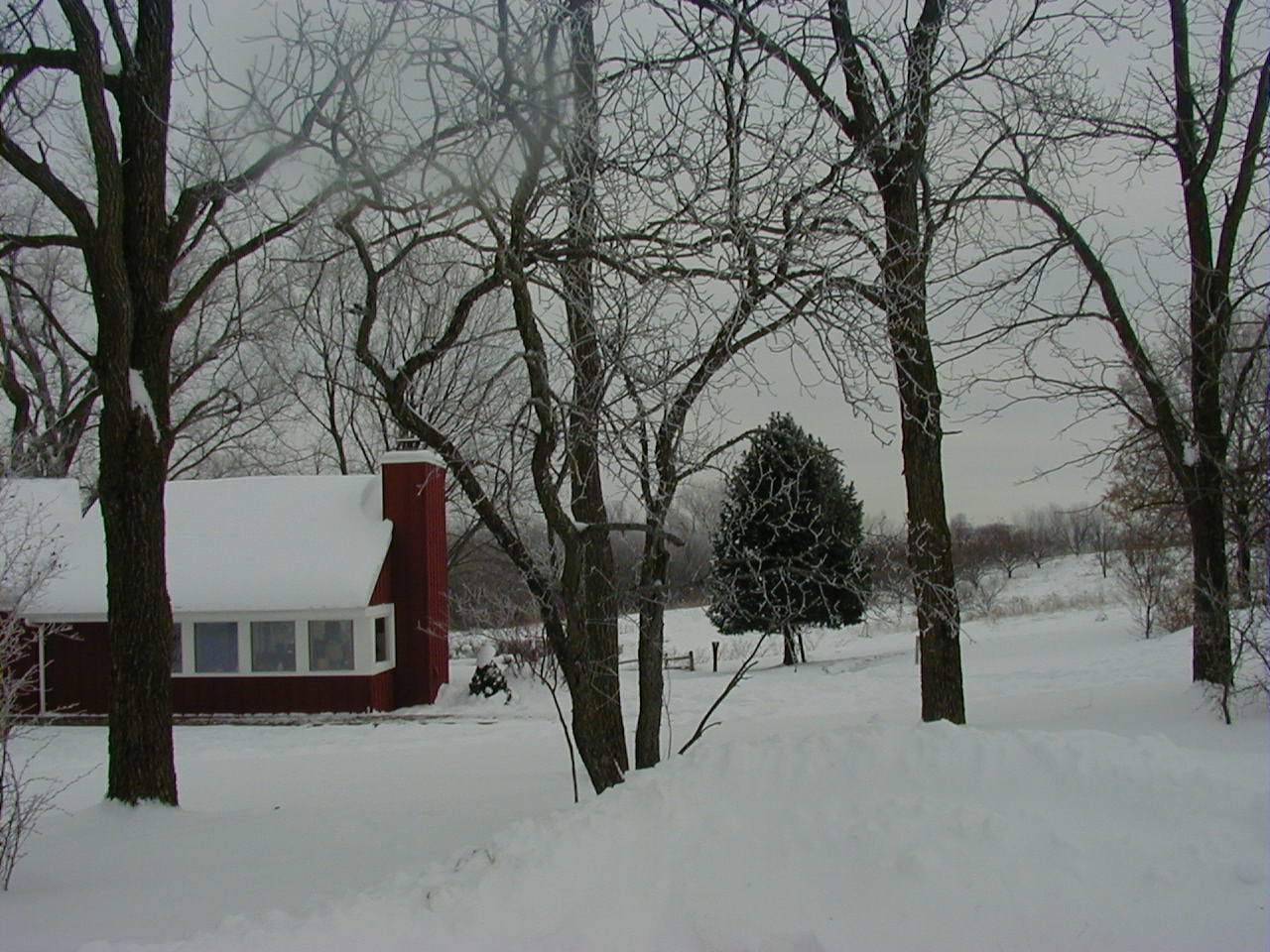
 For eight years Doug and Mary Hall’s farm was a second home. Mary’s pensive spirit and Doug’s activism made them natural parents of the state-wide movement for restorative justice in Minnesota and the Minnesota Restorative Justice Campaign.
Blessed are the peacemakers. RIP.

 Views from the Edge