
How a single voice threatened to set the world on fire

Minnestota Public Radio (MPR, 91.1 FM) published this commentary after a Florida pastor threatened to burn the Quran. Some things don’t seem to change.

– Gordon C. Stewart, September 28, 2010

Everyone from time to time feels insignificant. As I did, while watching fires burn across the world, lit by the words of one pastor in Florida. I felt like a spectator in the stands watching the game I care about go terribly wrong, a hostage of verbal terrorism uttered in the name of Christ.

I would imagine that the Rev. Terry Jones and his small congregation also had felt insignificant before they announced the 9/11 Quran burning, and that they were stunned when their pastor’s voice, although terribly misguided, lit the forest on fire without ever burning a Quran.  One of their own, one who had felt insignificant, had raised his voice and now had the ear of a commanding general, the secretary of defense and the president of the United States.

The difference between the Rev. Jones and most people is that he has a pulpit.  On any given Sunday he speaks and a few people actually listen.  Most of us do our ranting and raving in the shower, at the water cooler or with like-minded people at the coffee shop, but we don’t much expect anyone to listen.

But as the Jones story developed, those of us with pulpits were feeling no less beside the point.  Then, as I prepared for worship, I was drawn by some old lines about spiritual arson. “Consider what a great forest is set on fire by a small spark. The tongue is a fire … a restless evil, full of deadly poison” and “the seeds of righteousness are sown in peace by those who make peace” (Letter of James 3).

The thought crossed my mind: We could invite a Muslim friend to join me in the pulpit, perhaps my neighbor Muhammad or Abdi or one of their children, whom I meet daily while walking the dogs.  I decided to invite Ghafar Lakanwal, a Pashtun Afghan-American cultural diversity trainer, a Muslim and naturalized U.S. citizen, to bring greetings of peace and share some passages about peacemaking from the Quran in our Sunday worship on 9/12.

Our little church in Chaska welcomed Ghafar, and his words about the spiritual “obligation to learn, not burn” still ring in our ears. Our service drew media attention, and Ghafar’s words were heard on the evening news  and noticed by a stranger in Australia, who sent a message through the church website. “I was touched,” he wrote, “when I read about your recent Sunday service in the news. …  I for one can testify that it has certainly comforted a far away Muslim to know that there are neighbors who will stand together in difficult times.  My salaam [to you].  May we all grow together to attain Allah’s pleasure.”

“Ah!” someone will say. How can any Christian rejoice when the author uses the name “Allah” for God?  But the reaction to the “name” is misbegotten.  It is not the name of God; it’s the Arabic word for what we in English call God.   The forest fire lit in defense of “God” in advance of the anniversary of 9/11 reminds us that two kinds of religion potentially exist everywhere people gather to practice their faith. One kind burns. The other kind learns.  One hates; the other loves.

As James, writing to those who would follow Jesus, put it: “With [the tongue] we bless the Lord and Father, and with it we curse those who are made in the likeness of God. From the same mouth come blessing and cursing. My brothers and sisters, this ought not to be so” (James 3:9-10).  We can set the forest ablaze with our small spark or we can use it to light a candle of hope and peace. But, after the events of this month, none of us can again think that what we say is insignificant.

I would imagine that the Rev. Terry Jones and his small congregation also had felt insignificant before they announced the 9/11 Quran burning, and that they were stunned when their pastor’s voice, although terribly misguided, lit the forest on fire without ever burning a Quran.  One of their own, one who had felt insignificant, had raised his voice and now had the ear of a commanding general, the secretary of defense and the president of the United States.

The difference between the Rev. Jones and most people is that he has a pulpit.  On any given Sunday he speaks and a few people actually listen.  Most of us do our ranting and raving in the shower, at the water cooler or with like-minded people at the coffee shop, but we don’t much expect anyone to listen.

But as the Jones story developed, those of us with pulpits were feeling no less beside the point.  Then, as I prepared for worship, I was drawn by some old lines about spiritual arson. “Consider what a great forest is set on fire by a small spark. The tongue is a fire … a restless evil, full of deadly poison” and “the seeds of righteousness are sown in peace by those who make peace” (Letter of James 3).

The thought crossed my mind: We could invite a Muslim friend to join me in the pulpit, perhaps my neighbor Muhammad or Abdi or one of their children, whom I meet daily while walking the dogs.  I decided to invite Ghafar Lakanwal, a Pashtun Afghan-American cultural diversity trainer, a Muslim and naturalized U.S. citizen, to bring greetings of peace and share some passages about peacemaking from the Quran in our Sunday worship on 9/12.

Our little church in Chaska welcomed Ghafar, and his words about the spiritual “obligation to learn, not burn” still ring in our ears. Our service drew media attention, and Ghafar’s words were aired on the evening news and heard by a stranger in Australia, who sent a message through the church website. “I was touched,” he wrote, “when I read about your recent Sunday service in the news. …  I for one can testify that it has certainly comforted a far away Muslim to know that there are neighbors who will stand together in difficult times.  My salaam [to you].  May we all grow together to attain Allah’s pleasure.”

“Ah!” someone will say. How can any Christian rejoice when the author uses the name “Allah” for God?  But the reaction to the “name” is misbegotten.  It is not the name of God; it’s the Arabic word for what we in English call God.   The forest fire lit in defense of “God” in advance of the anniversary of 9/11 reminds us that two kinds of religion potentially exist everywhere people gather to practice their faith. One kind burns. The other kind learns.  One hates; the other loves.

As James, writing to those who would follow Jesus, put it: “With [the tongue] we bless the Lord and Father, and with it we curse those who are made in the likeness of God. From the same mouth come blessing and cursing. My brothers and sisters, this ought not to be so” (James 3:9-10).  We can set the forest ablaze with our small spark or we can use it to light a candle of hope and peace. But, after the events of this month, none of us can again think that what we say is insignificant.

The Shadow of the Grand Inquisitor

Conscience is the “still, small voice” (a whisper) that makes ancient truth appear uncouth. Conscience and dissent change the world.

It is a great sadness to learn of Archbishop Nienstadt’s reported threat of disciplinary measures against priests in the Archdiocese of Saint Paul and Minneapolis who openly dissent from the proposed amendment to the Minnesota State Constitution that would restrict marriage to a man and a woman (“Priests told not to voice dissent,” Star Tribune, 1/18/12).

The protest of the priests and parishes under Archbishop Niensted’s jurisdiction will be mostly silent. They will simply go on about the business of being the church. Their Protestant brothers and sisters either stand by in quiet support or choose to speak out loud what they cannot.

It is customary practice – and a good one – to regard the internal matters of another church as off limits to non-members. Both as a person of significant frailty and as a Presbyterian minister, Jesus’ injunction to take the log out of my own (Presbyterian) eye before reaching for the speck in my (Roman Catholic) neighbor’s eye gives me great pause.

I choose to speak out of great love and respect fore the Roman Catholic Church, my priest colleagues and friends. I tremble that my words will be mistaken as disrespect or that they will turn the clock back to the era before the Second Vatican Council (“Vatican II”) that blew fresh air across the whole Christian world. Before Vatican II, Protestants and Catholics lived in self-imposed religious ghettos on opposites sides of the main street. Today the dividing line has been erased. People are talking, and what many of them are saying is the same…whether out loud or in the chain of whispered protest that happen when the old authoritarian patterns squelch conscientious dissent.

Jesus the Prisoner and the Cardinal, the Grand Inquisitor

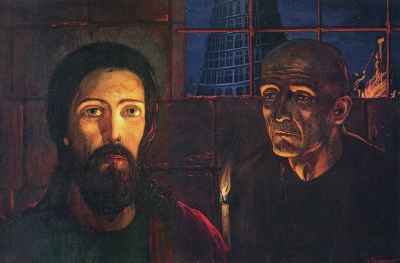
We all do well to remember Fyodor Dostoevsky’s The Brothers Karamazov where it is the Church, not Satan, that puts Jesus on trial in the parable of the Grand Inquisitor. The setting is the City of Seville during the 16th Century Spanish Inquisition. The night sky is lit with the fires of heretics being burned at the stake.

Christ has returned to the City of Seville – an unexpected Second Coming without notice or fanfare – to take his place once again among the poor and destitute. As at the first coming, his love for human dignity and freedom of conscience threaten the civil and religious order that has lit the fires of heretical burning martyrs – in his name and for his sake, at the command of the Cardinal of Seville.The Cardinal takes Jesus prisoner – a prisoner of the Church. He tells him that since his departure, the Church has corrected each mistake he had made in the temptations in the wilderness. He tells Jesus that he is a fool for failing to provide the people with what they most want – a hero who will take away their dread of standing alone in freedom before God.

“You thought too highly of them (i.e. ordinary people),” says the Cardinal, “for they are slaves, though rebellious by nature. Look around and judge, Jesus; fifteen centuries have passed. Look at them!   Who have you raised up to yourself?  I swear, man is weaker and baser by nature than you have believed him to be! Can he do what you did? By showing them so much respect, you failed to feel for them; you asked too much from them – you who loved them more than yourself!”

In the end the Cardinal does not execute him. With loss from his “bloodless lips” he sends the Church’s Prisoner off into the night and tells him never to return.

The Archbishop of the Diocese of Saint Paul and Minneapolis is not the Cardinal of Seville. But the Grand Inquisitor’s dark shadow has fallen across the Diocese among those sworn to obedience to the Archbishop’s authority. It has also fallen over their parishes and their Protestant friends. A pall of silence has fallen over the parishioners for whom the Prisoner had “too much respect.” The conversations take place in whispers and in privacy over back fences, or in parish councils where priests and Catholic lay leaders discuss how to be faithful to their own consciences while living under the vow of obedience.

It is one thing for the Church to promulgate an official position on marriage; it is quite another for an Archbishop to tell a priest he must be silent if he dissents on a theological matter, much less on a political and possibly partisan matter.

The Second Vatican Council (Vatican II) strongly re-affirmed the doctrine of the priesthood of all believers.  It made clear that the entire baptismal community constitutes the Church, and that the Church’s teaching office and hierarchy exist to serve the people, not the people the hierarchy. Vatican II lifted up doctrines that date back to the Early Church Fathers: the sensus fidelium (the sense of the faithful) and the sensus fidei (the sense of the individual’s faith).

Among the documents produced by Vatican II was Dignitatis Humanae that celebrated the dignity and freedom of religious conscience. The document opened the Church’s arms to other religions, and there was a great swelling of joy within the Roman Catholic Church and in other Christian churches touched by the Spirit of respect for other views and practices.

No longer were conscience and dissent regarded ipso facto as enemies of the Gospel or of the Church. Those of us in churches separated during the 16th Century Protestant Reformation were embraced by our Roman Catholic brothers and sisters as partners in ministry.  The Second Vatican Council’s spirit of ongoing reform (“aggiornamento”) re-awakened in Protestant communions the call to continual renewal and reform by the Holy Spirit, a 20th Century reformation that refreshed us all.

The proposed Marriage Amendment is a moral question, and the Church’s leadership has a right and responsibility to address it, in light of Traditio (sacred tradition, or the movement of the Holy Spirit among earlier disciples) and the movement of the Holy Spirit among disciples today.

Priests, ministers, and lay people – Roman Catholic and Protestant – on both sides of the pre-Vatican II divide – do not share a single view on the question of the proposed Marriage Amendment that Minnesota voters will decide next November. What we do share is a deep belief in the freedom of the pulpit, the freedom of conscience, and the freedom of the Holy Spirit to work through an informed laity and the church’s ordained leadership in together interpreting Scripture and tradition. We share a deep belief in the sensus fidelium embraced by the Second Vatican Council.

Jesus leaving the city never to return

“By the light of burning martyrs, Jesus’ bleeding feet I track, Toiling up new Calvaries ever With the cross that turns not back; new occasions teach new duties, time makes ancient truth uncouth; They must upward still and onward, Who would keep abreast of truth” (James Russell Lowell, 1845).