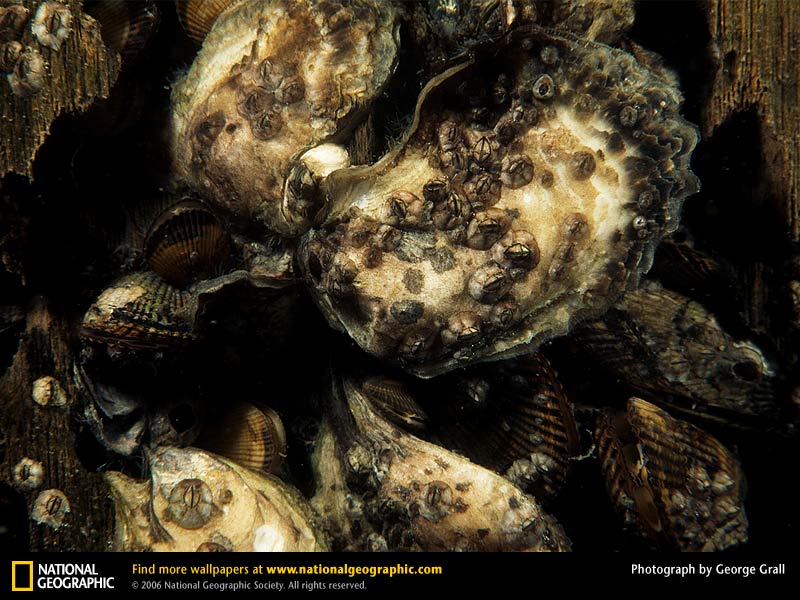
The World in an Oyster – an Earth Day reflection

Oysters

A COMMENTARY FOR EARTH DAY – Rev. Gordon C. Stewart | Friday, June 4, 2010 – published by MinnPost.comThe “spill” in the Gulf of Mexico raises the most basic questions about how we humans think of ourselves.

We’re at a turning point. The crisis we can’t seem to kill in the Gulf of Mexico puts before us the results of a more foundational crisis than the black goo that is choking the life out of the Gulf. The uncontrolled “blow-out” raises basic questions about how we think of ourselves and the order of nature.

Fifteen years ago I was with a group of pastors who spent four days with the Chesapeake Bay Foundation, whose mission is to protect and clean up the Chesapeake Bay. Our time there began with a day on the bay on a Skipjack, one of the last remaining motorless sailing vessels that used to harvest oysters by the tens and hundreds of bushels from oyster beds. The director of the Chesapeake Bay Foundation and an old waterman named Earl, who had worked the bay for 54 years, took us to school.

Back then the oyster population had shrunk to a fraction of 1 percent of what it used to be. Fifteen years before our visit the oyster population would filter all the water in the bay in three days’ time. A single oyster pumps five gallons of water through its filtration system every day.

The oysters were close to extinction; the bay’s natural filtering system was in danger. “It’s humans who’ve done this,” said the old waterman. “They’ll come back; I have to believe they’ll come back.”

Others were less hopeful. The Maryland Department of Natural Resources discussed the damage to the wetlands and the estuaries, the seedbeds of life. It had sounded the alarm for public action to protect the birthplaces of all the seafood we eat, the places on which the whole chain of life depends.

Deepwater Horizon fire

This week we heard from the Gulf of Mexico that the attempted “top kill” has failed and that the “spill” is spreading in every direction — not only on the surface, but below the surface — a glob the size of the state of Texas. I think of Earl and his Skipjack as I see the poisoned oysters in the hands of Louisiana oystermen whose livelihood depends on clean Gulf waters. “It’s humans who have done this.”

But it’s not every human who has done this violence to the Gulf. It was not the indigenous people of North America, nor was it the Moken people (“the sea gypsies”) who, because they see themselves as part of nature, anticipated the 2004 Asian tsunami while the rest of the world was caught by surprise. It was a specific form of humanity known as Western culture that sees humankind as the conqueror of nature.

Our language is not the language of cooperation with nature. “And God said, ‘… fill the earth and subdue; and have dominion over the fish of the sea and the birds of the air and over every creeping thing that creeps upon the earth’ ” — (Genesis 1:28), a conquering view based in the idea of species superiority expressed in the phrase “top kill” for the attempt to plug the hole that is killing the oysters and fish of the sea.

Insofar as interpreters of the Book of Genesis have shaped this Western hubris, my Judeo-Christian tradition bears responsibility for this crisis. The idea of human exceptionalism springs from the Bible itself.

But no sooner do I sink into confession and despair than I remember a prayer that Earl called to my attention on the Skipjack 15 years ago, the prayer of St. Basil from the third century that offers a more hopeful understanding of ourselves, a view like Moken people’s that knows that the whole world’s in an oyster:

“The Earth is the Lord’s and the fullness thereof. O God, enlarge within us the sense of kinship with all living things, our brothers and sisters the animals to whom You have given the Earth as their home in common with us. We remember with shame that in the past we have exercised the high dominion of man with ruthless cruelty, so that the voice of the Earth, which should have gone up to You in song, has been a groan of travail. May we realize that they live not for us alone, but for themselves and for You, and that they have the sweetness of life.”

 

Muskrat Heaven

A story in preparation for Earth Day, April 22, 2012

Muskrat

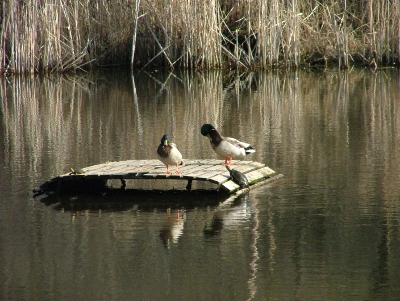
I stand looking through the picture window at the pond behind the house.  The small nature raft in the middle of the small pond is peopled with Canadian geese preening in the mid-morning sun.   To their left, three or four ducks paddle across the pond – but something is different.

They’re moving much faster than usual. They don’t seem frightened; they’re just moving faster.

Then I see why.  A muskrat is chasing them – ten yards or so behind.  I’ve seen this before – mallards and muskrats playing a game of catch us if you can.  Speed up, slow down, speed up.  Nobody ever catches anybody and nobody ever gets caught.  They just chase and get chased.  It’s play.

As the mallards paddle past the raft with the muskrat in hot pursuit, the muskrat makes a sudden 90 degree turn, races at full speed and leaps up for the raft, the geese flapping their wings, scattering in flight just as the muskrat lands and springs into the air. A flying-muskrat in hot pursuit, an air-Jordan muskrat suspended in mid-air, a flying goose wanna-be, leaping and laughing for joy. Muskrat heaven!  Sheer unadulterated play.

I envy the muscrat, the ducks and the geese today. I know I’m making the story up, but the story I tell speaks aloud a yearning for more playfulness.  An enjoyment of each other with natural games that keep away the boredom and challenge our pretensions.

Nature raft with mallards

Nature raft with Mallards

I watch the pond a lot these days to learn about myself and us.  Oh, I know!  There’s also terror and danger in that pond – the snapping turtle lurks beneath the surface, the fox roams the edges, and my neighbor sometimes stands on his deck with his shotgun aimed at the little muskrat who dares to burrow his home under his manicured lawn.  But today all of that is beside the point – upstaged by ducks and geese and a muskrat in self-forgetful play. I stand looking through the window and give thanks for quacking mallards, honking geese and a funny little creature whose muskrat heaven restores my natural sense of play and joy.

Earth Day Poem

Sunday, April 22, is Earth Day. My friend Steve sent this poem this morning.

Hope it lifts your spirits and causes you to do something crazy for the Earth.

“Earth Day” Steve Shoemaker, April 20, 2012

Kites - Morro Bay Kite Festival

Earth Day is best observed with string and kite.

A little bit of wind is nice, but not

Required:  just hold the spool and run–take flight!

To make a kite, buy line and glue, get

Help by recycling– all the rest is free:

Day-old newspapers can be cut just right,

And sticks from fallen branches, two or three.

Your spirits will fly up just like the kite!

The House We Live In

Gordon C. Stewart, April 3, 2012

The economy is broken. While most of us have been holding our breath, some of us have been out buying the most expensive jewelry at Tiffany’s. Investor’s Business Daily reported that Tiffany’s profits rose by 56 percent during the 2nd Quarter of 2011.

‘Economics’ is about the house we all live in. We get the word from the Greek word oikos (household).   Economics (Oikonomia) is how we arrange things in the one household. They don’t teach that in MBA programs.

This is not an economy. It’s something else. It’s an anti-economy, the antithesis of one household in which all residents are housed, fed, secure, and peaceful.

Profit vs. loss is not a way to manage a household. It divides the members of the household into winners and losers, owners and renters, charitable givers and those who receive, or do not receive, the winners’ charity.

What we call the American economy is spiritually and morally bankrupt. It’s not just broken financially.  Warren Buffett’s proposal to increase taxes on those who can afford to shop at Tiffany’s only scratches the surface of the household problem.  One could argue that the system – free market capitalism – is working the way it’s set up to work. Or one could argue that it isn’t.

It all depends on what floor of the house one lives in.

Two percent of the rooms are in the penthouse. They’re very large, decorated by the best interior designers and decorators. The furnishings are custom-made.  Those who live in the penthouse have a private elevator to leave the for lunch at the country club or the yacht club.  Over lunch they discuss how to maximize their profits with more blue chip stocks or bonds and whether to leave the penthouse for a week, a month, a season in exotic places. They discuss their charitable giving, encouraging each other to give to their favorite causes. Sometimes, in the best of clubs and social circles, they argue vociferously, just like the rest of us, about the economy in the Greek sense, the oikos. They are not all of one mind.  Some belong to the  Buffett Fraternity, others to the Trump Circle, even if they wish “the Donald”  would be more subtle.

The other 98 percent of the rooms in the house are rentals of various sizes. Some very large, some modest, and some small.  Only a few of the tenants have long-term leases or the protections of rent control.  The most vulnerable of us live downstairs on the smallest rooms on the lower levels. A growing number of us have been forced into the cellar.

And the rest?  We watch “the Donald” to catch a glimpse of life in the penthouse. We watch our neighbors and family members move to smaller rooms or to the basement, fearing that we, too, will end up in the cellar, but hoping that someday we’ll win the lottery and move upstairs to the penthouse.

Meanwhile, the folks who own Tiffany’s are laughing all the way to the bank, confident that the 98% are too preoccupied to get what’s happening…right there under our noses in the one house where we live.

Economics 101: “The Earth is the Lord’s and the fullness thereof, the world and all who live in it” (Psalm 24:1). How, then, shall we re-arrange the one house? How will we Occupy it?