Bubbles

i used to run through fields

laughing, blowing bubbles

floating up, away

off to Who-knows-where

now I watch the bubbles

burst, burst, burst –

dreams, illusions, hopes,

bursting into nothingness

time and death bursting

all our bubbles

for we are here

but for a time

till some child runs

again through fields

of green, blowing bubbles

that float… up and up

swelling, rising, not yet bursting

each bubble its own

never to be repeated self

precious beyond belief

while we in our old age

move toward the end of time

evaporating into eternity

returning Whence we came.

Bubble

– Gordon C. Stewart, @ 2004

Knuckle Dancing

Click Knuckle Dancing to start your day, as I did this morning. Courtenay of Bluebird Boulevard is one of my favorite writers.- always fresh, inviting, mind-bending, heart-stirring, awakening a deeper consciousness. Had to share it with “Views from the Edge” readers this morning.

Domino Wars

dominos

In Texas and in downstate Illinois

a game of dominos is played by four

(in pairs) with bidding, tricks like Bridge, and more

trash-talking, bragging, cussing, and then boisterous

hollers than at a rodeo or

a harness race.

Each State will grimly say

the other stole the game and does not play

exactly by the rules.  And if a poor

bystander cannot understand how 42

points are made in 7 tricks, then

a Western drawl and terse Midwestern twang

will clash in trying to explain the score.

A hand that takes all points earns 84;

but neither State will play fair anymore…

– Steve Shoemaker, Ubana, IL – April 25, 2012

What QUESTIONS did you ask?

“When I would come home from grade school, my parents would NOT ask, ‘What did you learn at school today?’” reports brilliant scientist Ellis Cowling, North Carolina State University Professor and later Research VP at the University of North Carolina.

“My parents would ask me, ‘What good questions did YOU ask today in school?’”

Thanks to Steve for sharing this memory from his friend at NCSU.

It occurs to me that the question to Ellis is a good one for adults, as well for children. What good questions are you asking today?

A critical mind may not be the key to bliss, but it is the only antidote to answers that make no sense. “The unexamined life is not worth living” (Socrates). Which also means, I suppose, that “the examined life IS worth living.”

After two weeks of partisan convention answers without questions, “What good questions are YOU asking?”

Share them here, if you like. NO platitudes, please. No answers. Just good questions.

Thanks,

Gordon

Critique of American Exceptionalism published today by MinnPost

MINNPOST published “In the 2012 race for the White House, Is religion fair game?” this morning. Click THIS LINK to read the piece on MinnPost.com.

The first commenter on MinnPost didn’t like it. Here’s the comment:

September 5, 2012 – 8:21am.

but you’ve overlooked the obvious.

This nation was founded on the principle of religious liberty.  The Declaration of Independence mentions God four times and describes the uniqueness of America in that, unlike Europe, where power flows from God to the Throne to the People, in America “we are endowed by our Creator” … power flows from God to the people and then to government.

The issue of religion in this campaign hasn’t been about whether the Mormon practice of tithing is one this society should consider adopting (“If 10% is good enough for God it should be good enough for government.”  –  Romney gave $4 million to the church last year) or whether Obama’s connection to black liberation theology and its demand for “social justice” is compatible with a free society.  No, it’s been more basic than that.

When Paul Ryan reminded us in his acceptance speech that “our rights come from God,” leftwing websites and TV talking heads took issue with that.  Some even expressed outrage as if they’ve never read the Declaration.  They insisted that our rights come not from God but from Government!

And as if to formalize their party’s transition to secular humanism this week, we’ve learned that the democrats have removed any mention of God from their party platform.

So the discussion of religion IS fair game in this election, but not in the minutiae that you suggest, but whether the majority of the citizenry even understands that our founding was based on religious liberty and inalienable rights and is codified in the Constitution that exists to protect them, because frankly, Reverand, I’m beginning to doubt it.

Leave your own comment on the MINNPOST site or here on Views from the Edge. See previously published commentaries on the intersection of religioin and politics, and American exceptionalism on Views from the Edge for more on the subject

“It’s Muhammed Ali!”

I only saw him once. Close up.

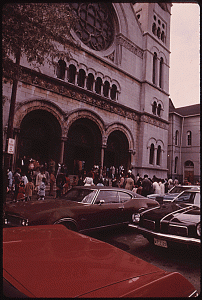
Holy Angels Catholic Church

Holy Angels Catholic Church, the African-American Catholic Church in South Side Chicago, was packed. Father George Clements, a bold community leader on the South Side, had convened the community meeting.

I don’t recall why we were there that afternoon. I only remember who was there.

Two pews in front of us sat a Michelangelo-chiseled figure of flesh and blood in a black suit. Massive square shoulders, thick muscled neck, beyond regal…a Greek god, Atlas perhaps, sitting erect and still, near the back of the crowed church. There was no mistaking who he was.

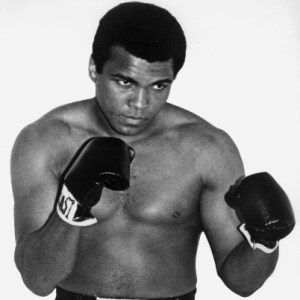
Muhammed Ali

“It’s Cassius Clay!” I blurted out to my fiancee…in what I thought was a whisper… pointing to the large man two rows in front of us.

MUHAMMED ALI!” came the woman’s corrective voice from behind us. The young, embarrassed, white Christian seminarian thanked her, apologized, and sat quietly the rest of the afternoon.

Ali, the World Champion, had changed his name from Cassius Clay. He had joined the Nation of Islam. Ali refused military induction as a conscientious objector. His conviction would overturned by the U.S.Supreme Court. At the time he refused to step forward for induction to serve in the Viet Nam War, he asked:

“Why should they ask me to put on a uniform and go ten thousand miles from home and drop bombs and bullets on brown people in Vietnam while so-called Negro people in Louisville are treated like dogs and denied simple human rights?”

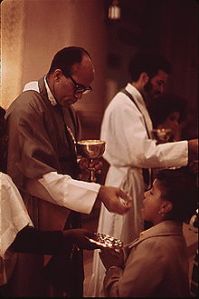
Father George H. Clements went on to become the first African-American in the Archdiocese of Chicago to be appointed to the position of Pastor.

Father George H. Clements at Mass

As Pastor of Holy Angels, Fr. George Clements moved a statue of St. Anthony and set up an altar honoring Dr. King following Dr. King’s assassination. When the archdiocese expressed its disapproval, Fr. Clements refused to reconsider.

Acclamatio populorum—”the people acclaim a saint,” he said. “If the cardinal wants it down, he’ll have to take it down himself.”

The Martin Luther King, Jr. statue remained in place.

Fr. Clements would later become famous as the first priest to adopt a child. He added a new title -“Dad” – as the adoptive father of four African-American children, and founded One Church – One Child, a movement in his parish inviting African-American families to adopt homeless African-American children. The program became nation-wide and still exists today.

The Dogs’ Life

There is only now.

The Master, the Top Dog,

(the alpha male) is gone.

The new guy feeds us:

our eyes begin to go first to him.

We wait, we lounge, we mope

when he puts us out in the pen.

There is room to play,

but he may never return,

never let us back with the pack,

with the kind one, with the shorties…

He’s here now!  We’re back inside!

There may be more food!

Search, bark, gambol, sniff,

tumble, lick, pretend to fight–

why is he taking us back outside

to the pen?

– Steve Shoemaker, Urbana, IL, Sept. 3, 2012

Jack Baker’s Church

A small, white dairy barn had stood alone upon that hill for years.

The town had grown around it.  Now a university professor, architect,

will try and see if he can build a church for students there.

They have almost no money.  But they are Reformed, still Puritans with

simple tastes:

a concrete floor will do with folding chairs, clear windows open to

the light, the street, the passers-by, invite all in.  They meet

around a table, pulpit, bowl, and hear the word.  The room is filled

with song and prayer– the walls, inside and out, like milk are white.

Up high, no steeple, but a box of light, a cupola like on a barn:

just right…

Hessel Park Church

Hessel Park Church

– Steve Shoemaker, Urbana, IL, September 2, 2012

Republican Convention Religious Crusade

The rousing video from the Republican National Convention (“Believe”) played like an evangelistic crusade waiting for an altar call.

From the musical crescendos to the hyped voice to the pentecostal elation of the crowd, it was religious to the core. Here’s the definition of “religion” that leads to the claim:

“Religion is the state of being grasped by an ultimate concern, a concern which qualifies all other concerns as preliminary and which itself contains the answer to the question of a meaning of our life.”Paul Tillich

The makers of the video know how quick we are to shed a tear. Especially when at a crusade that plays all the chords of American “civil religion” as argued in the recent “Views from the Edge” post on American religion and American politics.

Tillich was the first professor dimissed from his university teaching position by the  German Third Reich. Like the Germans at the Service Club meeting in an earlier post here, he knew that religion is not confined to the four walls of a church, synagogue, or mosque. It is the state of “being grasped by….”

What “grasps those who viewed the “Believe” video?
A poor attempt to answer the quesiton appeared yesterday (“Believe in America“). The post was too obscure to make its point. Thus, this folllow-up elaboration.
The god of the “Believe” video is America iteself. It is the god of American exceptionalism. The video stirs the heart with the cunning of Kafka’s Green Dragon and the seductive voices of Kafka’s The Sirens who know they cannot deliver what we long for. Their wombs cannot give birth to any kind of future.

The following exchange followed the earlier “American Religion and American Politics” post. Both C.A. and I see the world as the theater of God’s glory but also as the Theater of the Absurd.

C.A. left this comment:

If my small experience is any guide, you may get hammered on this one, Gordon.  When someone has been brought up on American exceptionalism, especially if coupled with Caucasian exceptionalism, and one kind of Christian belief the three can be so ingrown as to be more than subconscious,  virtually unconscious.  Working together, they justify any negative behavior that the person believes, and cause outright rejection of much that he or she hears or reads about as impossible. …

I replied:

C.A., You just wrapped it all up very nicely. Willem Zuurdeeg, a Dutch philosopher of religion, linguistic philosopher and phenomenologist, concluded that our deepest “convictions” are unexamined – below the surface of conscious awareness, so obviously true to us that they are what you call “virtually unconscious.” The compelling conviction hinted at by American civil religion is what Zuurdeeg described as an Ordered Home , a world order. In this case. the world revolves around tjhe doctrines of white supremacy and national supiority. These are the spiritual and moral centers.

“Views from the Edge’s” most popular post is the one about the Germans at the Service Club.  It’s gone viral.

“Five folks from Germany recently visited central Illinois as part of a local service club program to improve international understanding.

At one point they asked me about something they did not understand:  why do Americans begin so many gatherings with a ‘”patriotic” song, the Pledge of Allegiance, and a prayer?

Perhaps especially because they were from Germany, remembering the horrors of two world wars begun partly from excessive beliefs in the superiority of their nation and religion, they were sensitive to expressions of exceptionalism at U.S.A. sports events and service club meetings.

What Tillich, Zuurdeeg, and the Germans at the American service club meeting were seeing was a religious people hypnotized by Kafka’s Sirens and Green Dragon.

Go to yesterday’s post “Believing in America” to see the juxtaposition of the Kafka parables and the Convention video.

Leave your comment or question. And thanks again for visiting.

“Believe” in America

The Sirens

These are the seductive voices of the night; the Sirens, too, sang that way. It would be doing [the Sirens] an injustice to think that they wanted to seduce; they knew they had claws and sterile wombs, and they lamented this aloud. They could not help it if their laments sounded so beautiful.

 Franz Kafka, Parables and Paradoxes

The Green Dragon

The door opened and what entered the room, fat and succulent, its sides voluptuously swelling, footless, pushing itself along on its entire underside, was the green dragon. Formal salutation. I asked him to come right in. He regretted that he could not do that, as he was too long. This meant that the door had to remain open, which was rather awkward. He smiled, half in embarrassment, half cunningly, and began: “Drawn hither by your longing, I come pushing myself along from afar off, and underneath am now scraped quite sore. But I am glad to do it. Gladly do I come, gladly do I offer myself to you.”

Franz Kafka, Parables and Paradoxes

Click HERE for Franz Kafka biographical information published by The Kafka Project.