A sermon at Shepherd of the Hill Presbyterian Church in Chaska, Minnesota. It could also be called “Take a Risk – Stand for Something!”

A sermon at Shepherd of the Hill Presbyterian Church in Chaska, Minnesota. It could also be called “Take a Risk – Stand for Something!”
Today MinnPost re-published yesterday’s Views from the Edge piece. They do a fine job of editing and draw a wider audience. Here’s the link: Irony of Ironies: Honoring King, then entertaining a potential strike on Syria. It appeared here yesterday as “The Abel Project in the City of Cain.”
Thanks to MinnPost and to you for coming by.
Nothing happens outside of context. Why are we intent on a military strike against Syria? Is it a matter of compassion?
Retired General Wesley Clark spoke about a “policy coup” at the time of the 9/11 attacks. Russ Baker writes: “In this video, he reveals that, right after 9/11, he was privy to information contained in a classified memo: US plans to attack and remove governments in seven countries over five years: Iraq, Syria, Lebanon, Libya, Somalia, Sudan and Iran.
“[General Clark] was told: ‘We learned that we can use our military without being challenged …. We’ve got about five years to clean up the Soviet client regimes before another superpower comes along and challenges us.’”
Click HERE for the story and the speech by Wesley Clark. This is one of those articles I wish I hadn’t read. Life is much more comfortable in a bubble of ignorance. But truth eventually bursts every bubble. So…is our “national interest” related to the issue of the use of chemical weapons in Syria, or is this great tragedy the pretext for implementing a policy coup to take out the regimes in the Middle East formerly aligned with the Soviet Union in the Cold War?
Please take eight minutes to listen to the speech and chime in with a Comment here on Views from the Edge to share what you think.
The same day America honored the 50th Anniversary of the March on Washington most remembered for Dr. King’s “I have a dream” speech, America’s first black President, who had just delivered a great speech in honor of Dr. King’s dream, appeared on the Newshour to discuss military strikes in Syria.
Irony of Ironies
Martin Luther King, Jr. was as deeply committed to peace and to non-violent, non-military solutions to global problems as he was to ending racism. As his analysis of the national, international, and human condition continued to develop, he became an outspoken critic of the Vietnam War, capitalism, and imperialism. He grasped as well as any public figure of his time, and of ours, the insidious institutional power of an unelected, undemocratic web of the economic-military-corporate complex at work behind the scenes of American public life.
President Obama’s speech from the same spot where where Dr. King had stood 50 years before at the March on Washington was a potential seminal moment of American history. It was a great contradiction to that potential to view the President’s interview on The Newshour (PBS) later in the day regarding Syria. I couldn’t put together the President’s honoring of Dr. King’s dream just hours earlier with his entertainment of military action in Syria. For whatever reason, the media did not seem to notice the incongruity and the irony.
The Newhour also featured a conversation among foreign policy experts about the advisability of “punishing” Syria for crossing the red line of chemical weapons. University of Chicago Professor John Mearsheimer’s raised the gravest voice of caution. “Stay out militarily.” He also reminded the other two panelists and the viewing audience that the United States is the only nation ever to have dropped the bomb. The world has not forgotten. Click HERE to listen to the conversation.
Martin Luther King, Jr. rose to national prominence because he issued a clarion call for the dawning of the City of Peace in the midst of the City of Cain, the city of bloodshed. In King’s view you can never get to the City of Peace by means of the methods of the City of Cain: violence, the lex talionis, or worse.
Ethical decisions, in personal life or in international affairs, are rarely simple. Our hearts go out to the innocent children, women, and men who died from chemical weapons in Syria. We want to be our brother’s and sister’s keepers. We want to help. We want to stop it. That sense of compassion is as it should be. All hearts should break over this horror. But something else is called for before we act on the impulses of the compassion.
It is also worth remembering who it was that first asked the question “Am I my brother’s keeper?” It was Cain, who made the statement to God to put the blame for his own homicide back on the One who held him responsible for the senseless murder of his brother Abel in a fit of anger. “Sin is crouching at your door, and you must master it.” Dr. King and others who choose the methods of non-violent resistance to great tragedies like the one in Syria interpret the instruction to Cain – you must master your anger – as the instruction to master one’s own knee-jerk retaliatory response. Patience is required. Taming the lion that crouches at our own door is a chief task of becoming genuinely human.
The Blood of Abel and the City of Cain
For Martin Luther King, Jr., Mohandas Gandhi, the Dalai Lama, and a host of un-noted, anonymous souls, the way of violence, even in behalf of the good, represents a failure to tame the lion crouching at our door and further entrenches the City of Cain.
Beyond the philosophical-ethical-theological considerations are other facts. The “red line” of chemical weapons is one that was crossed years ago. It was crossed in Vietnam. A trip to the nearest Veterans Hospital is a humbling reminder. It was the United States that used Agent Orange and Napalm in Vietnam, Laos, and Cambodia as part of Operation Ranch Hand. Our hands are not clean. As much as we might like, we do not speak from moral high ground. We have already crossed the red line. The moral finger we point toward Syria points back at us. To unleash even the most minimal, narrowly targeted Cruise Missile strike on Syria from a warship from the coast of a tinder-box in a far off place is like throwing out a boomerang expecting that it will not return to us in retributive violence. As Dr. King understood so well, violence begets violence.
As if that were not enough, the struggle in the Middle East is confounded by another form of political-economic-cultural-religious-military violence: the American corporate presence in the oil fields, arranged by American and Saudi elites (Sunni Muslims), and the expropriation through the United Nations of Bedouin Arab land to create a homeland for the survivors of the holocaust of World War II Germany. The intent, so far as the general public was concerned, was compassion. Provide a safe place, a homeland. But the homeland belonged to someone else when the United Nations expropriated it for the creation of the State of Israel, and the Arab world has never forgotten the way it happened.
“Am I my brother’s keeper?” drove popular sentiment to support the creation of Israel. Why the homeland was not carved out of Germany or perhaps France is an interesting question. Or why the United States did not carve out of our vast geography a territory in the United States of America as a safe haven, is a question long since ignored by nations who thought they were taking the moral ground but not forgotten by Palestinians, Shiites, and most of the Middle East.
Those questions aside, Israel today is a sovereign State in the midst of an Arab world that resents both its presence, the history of its creation, and the United States as its most faithful ally and supporter.
Behind it all stands a military-industrial-technological-corporate complex that feeds on mistakes like Iraq and Afghanistan, and the question of whether we are our brother’s keeper, responsible to play policeman to the world. Martin Luther King, Jr. never lunched on the food at the lunch counter of the military-industrial-technological-corporate complex. Nor should we. Neither should the President. Neither should Congress.
The Abel Project: We are the World
An alternative to a military response with potential catastrophic consequences for the Middle East and for us is the neglected methodology of nonviolent, passive resistance by which Martin Luther King, Jr. and Mohandas Gandhi changed the world.
If we and the rest of the world believe in the City of Peace and wish to redeem the blood of Abel in the City of Cain, let the recording artists of the world with the full support of the United Nations, the Vatican, the World Council of Churches (Orthodox and Protestant Christians), the Organisation of Islamic Cooperation, and international Jewish organizations representing the spectrum of Judaism lift the people’s voice so clearly across the world that it cannot be ignored.
Call it “The Abel Project” – named for the innocent who was lost to the world, the slain brother of Cain, whose blood still cries out to God from the ground.
Let there be candlelight prayer vigils for an end to the way of Cain in Syria. Let the lighted candles in every national capitol, every state or provincial capitol, and in cities and towns around the world make the statement that we, the people of the world, led by the three warring children of Abraham and Sarah (Jews, Christians, and Muslims), stand for the transformation of the redemption of the blood of Abel and in the name of the City of Peace.
The President can contribute to that effort but he must not attempt do it alone. Nor can he lead it.
Unleashing the potential of a worldwide vigil in the spirit of “We are the World” must rely on the untapped power of the United Nations as a force for peaceful resolution, the original dream that inspired its Charter. He must do it not only with our closest allies in the West but with the leaders of nations that resent our history in the Middle East and Southeast Asia who are suspicious of American saber-rattling from the Western presumption of moral high ground. The voice of the world must include the two warring branches of Islam – Sunni and Shiite – whose tensions and hatreds also lie at the center of the conflict in Syria and most of the Middle Eastern Arab States.
If he does, the irony between the August 28, 2013 commemoration of the 50th anniversary of the poor people’s march on Washington and the evening news will resolve itself in a new decision to honor the legacy of the fallen witness to the power of non-violent resistance and the power of love as the only method and power that ever really change the City of Cain. For the sake of Abel, our slain ancestral brother, let the candles be lit across the world.
Verse – Ten and Twelve
The high-caffeine pop was a mistake…
but when the older asked for it,
the younger had to have it, too.
The ping-pong chatter natter
never stopped. Good-natured,
but louder and shriller (I turned down,
then took out my hearing aids…)
Day 5 of our week caring for
the grand-kids. Their parents
love going to Burning Man–
what’s temporary noise
in the service of Art?
– Steve Shoemaker, Urbana, IL, September 2, 2013
“President Obama’s decision-making will be guided by what is in the best interests of the United States,” National Security Council spokeswoman Caitlin Hayden said following the UK vote [to disapprove of military action in the Syrian civil war]. “He believes that there are core interests at stake for the United States and that countries who violate international norms regarding chemical weapons need to be held accountable.”
Hmmm. So…. what were Napalm and Agent Orange if not chemical weapons?
When you point the finger demanding accountability, it’s always best to make sure it doesn’t point back at you.
Our hands are NOT clean.
Of course a tower is built by starting from
the bottom. Strong workers and machines make
a joint to earth with wet, grey gravel–form
with time a foundation almost like rock.
Orange steel is welded, riveted, and made
to stand naked pointing skyward. Then blocks
and bricks are hoisted slowly up the side
providing covering flesh the tower lacks.
…
Small children make towers in trees, and these,
though only made of rotting boards, still stand
as proudly strong in little children’s eyes
as those from which much older men descend.
But both kind of towers still seem to say
with their builders: we look down on the sky.
[from The Anglican Theological Review, early 1970s]
Steve Shoemaker, Urbana, IL
The same day America honored the 50th Anniversary of the March on Washington most remembered for Dr. King’s “I have a dream” speech, America’s first black President appeared on the Newshour to discuss military strikes in Syria.
Martin Luther King, Jr. was as deeply committed to peace and to NON-VIOLENT, non-military solutions to global problems as he was to ending racism. As his analysis of the national, international, and human condition continued to develop, he became an outspoken critic of the Vietnam War, capitalism, and imperialism. He grasped as well as any public figure of his time the institutional power of an unelected, undemocratic web of the economic-military-corporate power at work behind the scenes of American public life.
I was proud of President Obama’s speech from the same spot where where Dr. King had stood 50 years before at the March on Washington. I can’t put that together with his entertainment of military action in Syria. For whatever reason, the media did not seem to notice the incongruity.
Last night’s PBS Newhour featured a conversation about the advisability of “punishing” Syria. University of Chicago Professor John Mearsheimer’s statements, in my opinion, hit the nail on the head. “Stay out militarily.” Click HERE to listen to the conversation.
The military-industrial-technological-corporate complex feeds of mistakes like Iraq and Afghanistan. Martin Luther King, Jr. never lunched on their food. Nor should we.
Ever since Hegel , the view of inevitable progress has held sway in much of philosophy and in some schools of theology. In Christian theology, which is my faith context, fundamentalists project the ideal world backward in time to human origins in the Garden of Eden. For them, the Garden is not myth; it’s fact. “The Bible tells me so” and that’s that. Those who view the Genesis story as myth (not “untrue” but a literary genre expressing a timeless truth) tend to look at evolution as the unfolding of the Will of God toward what the Bible calls the Eschaton, the Great Last Thing, perceived as the achievement of the ideal or perfected state toward which the whole creation groans. The Ideal is not behind us but ahead of us as the conclusion of history.
Ever since my undergraduate philosophy professor, Esther Swenson, plunged me into existentialism – which was and still is a protest against all idealistic suppositions and conclusions about the world and humankind – I’ve been a skeptic of idealism. The projection of an Ideal or perfect world ignores, it seems to me, the fact that the end point of the planet itself is death, as it is for all of life. There is no permanence. There was no Garden of Eden in the past and there will not be one in the future. Projections or imaginations that place the Garden ahead of us are as flawed as the fundamentalist assumption that human history began with one.
Franz Kafka remains my favorite writer, in part because of his honesty and in part because of his economy of words. Dom Sebastian Moore, a rather eccentric Benedictine theologian, is linked with Kafka only in this one shared conclusion: the human project of an ideal human being or society is a flight from death into the arms of death itself.
Moore writes that the flight from death “is opting for an ultimate solitude.
“This choice can be made not only by the individual as the unconscious of his desperation, but also by the whole human race. It is being made by the whole human race, as between two poles, taking seriously only our self-awareness. Ignoring our being-part-of, that is the ecology of whose balance we are partly animals. The human race thinks it can go on with all its Narcissistic human normalities, of war, of politics, of religion, and that somehow the vast other side of the picture will look after itself. So in opting for ‘himself as conscious’, man is opting for an ultimate solitude.
“And ultimate solitude is death. It is to be cut off from the tree of life, and to whither.”
– Sebastian Moore, The Crucified Jesus Is No Stranger
Two parables of Kafka offer food for reflection. They are reverse images of the Genesis story of the Tower of Babel.
The Tower of Babel
If it had been possible to build the Tower of Babel without ascending it,
the work would have been permitted.
The Pit of Babel
What are you building? – I want to dig a subterranean passage.
Some progress must be made. My station up there is too high.
We are digging the pit of Babel.
On Monday mornings I meet for an hour with a group of wise octogenarians. When Kate had listened to the reading of Jeremiah – “my people have committed two evils: they have forsaken me, the fountain of living water, and dug out cisterns for themselves, cracked cisterns that can hold no water” (Jeremiah 2:13) – she had a far off look in her eyes. “What are you thinking, Kate? Where did you go?”
“Oh,” she said, “I went way off track. I couldn’t help but think of those leaking nuclear reactors in Japan.”
A penny for your thoughts.
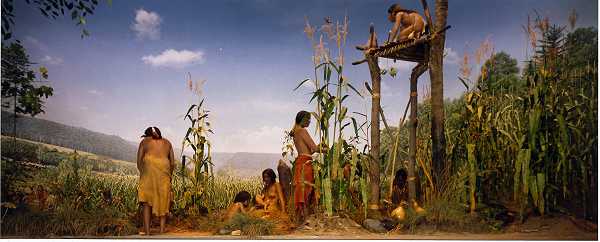
Squash was planted by the Iroquois
Under corn stalks with the climbing beans.
Protecting the soil from weeds, the leaves
Even shaded earth worms. Illinois
Researchers much later found the genes
Sweeter than the rest to make the corn,
White or yellow, taste best from the store.
Even though corn from the garden has
Enough health inside to cure most ills,
There are some who still will go buy more.
Corn that’s grown to be so super sweet
Offers all a treat to taste and eat:
Rush the husks from stalk to table–feast!
Never argue: roast OR boil is best!
– Steve Shoemaker, Urbana, IL August 27, 2013
 Views from the Edge