Today is the second anniversary of Katie’s death after a valiant battle with leiomysosarcoma, a rare terminal cancer.In today’s earlier reposting of Kay’s reflection on her blog, www.rawgrief.com, I quoted the last line of a great hymn.
The composer, T. Tertius Noble, spent his summers in the big house at the top of the wall of Old Garden Beach in Rockport, MA, one block from my grandparents’ home. Only later in life did I learn that this favorite hymn was composed by the man in the house above the wall at the beach.
Here are the lyrics and an organ rendition of the hymn that flooded my mind this morning, as I gave thanks for Katie and thought of Kay’s reflection.
Come, labor on. Away with gloomy doubts and faithless fears!
No arm so weak but may do service here; By feeblest agents
may our God fulfill His righteous will.
Come, labor on. No time for rest, till grows the western sky,
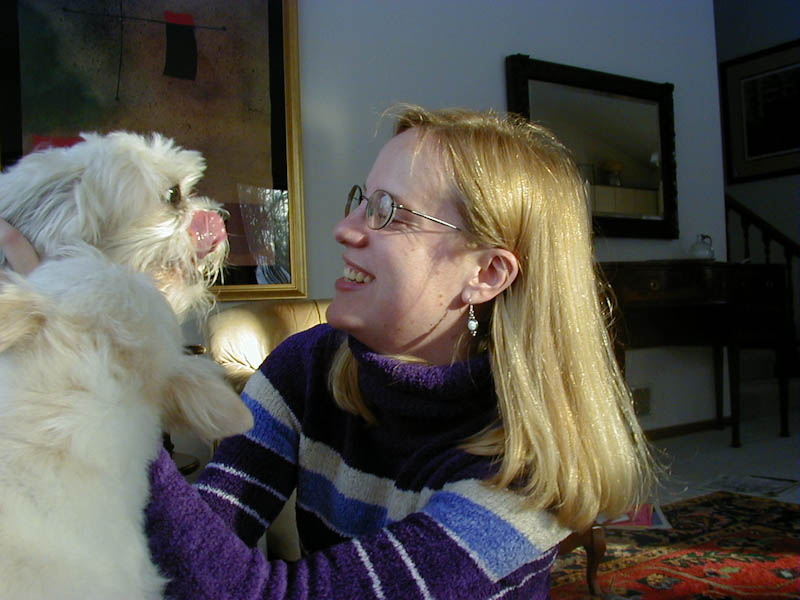
Two years ago today we said goodbye to 33-year-old Katherine (“Katie”), RIP. Today her mother Kay posted this amazing reflection. Click the link above the photograph for Kay’s recollection and reflection.
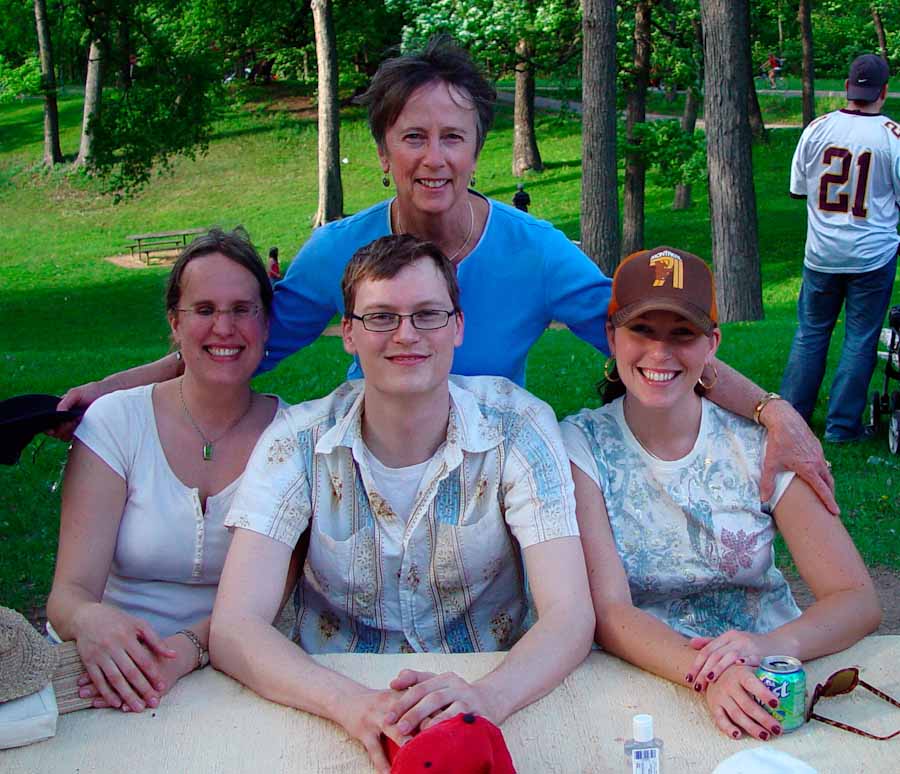
Below is a photograph of Katherine (she preferred her formal name in her adult years) and Christopher (“Chris”), her husband and best friend, during a family trip to Costa Rica in 2009. Chris, you were the best of the best. Payers for Chris Katie’s father, Steve, sister Kristin, brother Andrew, and Kay. “And a glad sound comes with the setting sun: ‘Well done! Well done!'” – final stanza, hymn “Come, Labor On.”
Some days have a way of focusing one’s attention. Today is one of them.
Kay, author of www.rawgrief.com, is the focus. She always holds my complete attention. But this week is special.
Kay in the Boundary Water Canoe Wilderness Area
Three things coalesced today: 1) This week, May 9, is the second anniversary of Kay’s daughter Katherine (“Katie” to her family. 2) Last night Kay posted a joyful motherly reflection on her day with Chris, Katie’s widower, sorting through Katie’s writings and photographs, some of which Kay was seeing for the very first time. 3) Unedited Politics posted a Bob Kerrey campaign ad for U.S. Senate (re-posted minutes ago here).
When Bob returned from Vietnam, nursing himself back to health, making the hard adjustment to living without a leg as an anti-war veteran, Kay met Bob in an Economics class. Kay, Bob and others became close friends. Bob Kerrey has never forgotten.
So…today Kay, Katherine (“Katie”), and Bob have the full attention of Views from the Edge, as do the other postings that appear today. The photograph of Kay with her morning coffee was taken by the edge of the Boundary Waters Canoe Wilderness Area in Northern Minnesota.
The following is a dialogue from dinner last night with the oppositional waiter.
Can I get you something to drink?
Yes, two Mojitos, please.
A Mojito for the gentleman?
Yes. Two Mojitos, please.
You both want a Mojito.
Yes.
We have a very nice strawberry drink…a strawberry basil lemonade – very nice for the lady.
Well… (Kay is hesitant…)
Or maybe the Hibiscus…very nice: Absolut Pear, St. Germain, and Lunetta sparkling wine with a sugared hibiscus flower. I think you’ll really like it. It’s very nice…
No… I don’t think so. I’ll have the Mojito.
(Waiter stares and frowns at “the Lady”)
And we’d like the spicy shrimp appetizer and the calamari.
Sure. One spicy-shrimp. Good choice. Do you like Sushi?
Yes.
May I suggest the crunchy crab roll? I think you’ll really like it. It’s one of my favorites.
Hmmm… Is it soft-shell crab?
Yes. It’s really good. Very nice.
Okay. Okay with you, honey?
Sure.
One spicy shrimp and the crunchy crab roll.
Very good, and I’ll leave you with the menus.
(Waiter departs. Kay and I – each incredulous – turn to each other with wide-eyed smiles.)
What just happened? Who is this guy?
He’s oppositional defiant (Kay works in the mental health field, she knows about Oppositional Defiant Disorder [ODD] where I say it’s green, he says it’s red.). Can you believe that? Everything we said we wanted, he opposed. It was weird. Have you ever seen anything like that?
What was even weirder is that we did what he said! How crazy is that! Reminds me of the old Steve Martin waiter routine, except that this guy’s on top of it. He got us to change our order!
Why did we do that? At least I got my Mojito. I didn’t want something with strawberries.
(Waiter returns)
And what can I get you for an entrée?
We’ll have the Macadamia chicken to share.
(Waiter makes a face.)
And we’d like the garlic mashed potatoes.
The best thing on the menu – my favorite – is the sea bass. Really special.
(Kay and I hesitate … look at each other)
I don’t know. Is it Chilean Sea Bass? There’s a lot of bad press about Chilean sea bass and mercury.
Hmmm. I don’t know. I can find out if you really want to know. But there are 13 different kinds of sea bass. (Kay, who’s not hard of hearing, tells me later that he had told us that this is a very rare endangered seabass! If I’d have know that…)
What’s it come with?
A very nice rice pilaf. But if you like, I can substitute the garlic mashed potatoes. This is very special. My favorite.
Okay. We’ll go with the sea bass.
Very good choice. You’ll really like it.
(ODD Waiter leaves. We’re alone again.)
Did you really want the sea bass?
No, I wanted the Macadamia Chicken.
(Laughter again.)
Why did we do that?
I don’t know. He’s a terrorist!
I can’t believe it. We did whatever he said. What’s wrong with us?
It’s like he’s the ODD Waiter – the ODD junior-high waiter. And we were the parents who buckled ‘cause we didn’t want to make him mad. We’re afraid of the juniorhigh terrorist.
(The sea bass arrives….. With rice pilaf. No garlic mashed potatoes. The rice pilaf is fabulous. So was the sea bass.)
We’re all cut from our parents’ cloth. It falls to each of us to finish their unfinished business.
Following my mother’s death, it fell to the three sons and our spouses to clean out the apartment and arrange for distribution or disposal of the belongings.
My father had died two years earlier.
Don, Bob and I spent an afternoon alone in the apartment using a rotation method to divide the belongings. By order of birth, we would each choose what we wanted. Round one: Gordon, Don, Bob; round two: Gordon, Don, Bob – I-2-3; 1-2-3 – until everything any of us wanted was chosen. The rest would go to auction or to Goodwill.
Among my parents’ personal art was an oil painting of my father. In my early years, I loved that painting. Handsome man. Robed in his clergy robe, dignified, smiling, tender eyes, a man of stature, our Dad. The painting had been in the family for as long as I can remember and, as best I can recall, had hung in Dad’s pastor’s office at Marple Church when I was a teenager. Now it hung in the narrow hallway just inside the entrance to my parents’ apartment. It was the first thing a visitor saw – a reminder to all who entered that Dad had once been someone special, a man of the cloth.
One-two-three, we chose our favorite pieces. We agreed that monetary value made no difference to our selection process. All that mattered the value each of us placed on an item. The grandfather clock was clearly worth the most in dollars, but the clock had been purchased late in our parents’ marriage; it bore only the most recent memories, not the memories of home. It could not compare with the knicknacks – one of our mother’s Hummel figurines, a Baltimore Oriole paper weight, my father’s dog tags from World War II, a dish, a lamp, a photo, or the original painting given by a parishioner that reminded me of Robert Frost’s “Stopping by the Woods on a Snowy Evening” – artifacts of precious times now gone except for memory.
But there was another painting, a portrait of Dad in his ministerial robe.
As we went around the room, the painting didn’t move. Nobody picked it. Finally, Don asked with a smile, “Who wants Dad’s painting?” Deferring to me, Bob chimed in. “You’re the oldest! You should have it. It’s okay with me. I don’t want it!” “Sure,” said Don, “I don’t want it. Go ahead, Gord, you should have it. You’re the oldest!”
We all looked at each other and began to laugh about the elephant that had been sitting for years in the living room.
I looked at the picture. There was Dad, clear as day, a keepsake that had meant so much to our father and mother, and we didn’t want his picture? “I don’t want it,” I said, and started to say more but couldn’t get the words out. Grief had overcome me. I couldn’t speak. I shuddered with sobbing. My brothers watched and waited in silence. When finally I composed myself enough to complete the thought through the tears, the words came out slowly . . . in staggered gulps. “I hate that thing! I always wanted to rip that robe off him! He never took it off! He was always the minister. I just wanted him to be his own naked self. I just wanted him to be Dad.”
Reflecting on it years later, that moment was one of many breakthrough moments of taking off my own robe. I hadn’t worn mine for five years and hadn’t missed it. I began to find my own naked self bereft of the robe while working for a poverty criminal defense law firm founded by African American civil rights activists and founders of the American Indian Movement. Unconditional love was not a creedal statement; it was a daily fact of life, the treasure of grace held by many kinds of vessels. “We hold this treasure in earthen vessels….”
I took the painting of Dad and took him with me on the long flight home to the Legal Rights Center. When I got there, I put the painting in storage, as a reminder that the work isn’t finished for me or my offspring. Who knows, someday one of the great-grandchildren may bring Dad’s painting out of the closet.
“WHY, in a world filled with yelling and screaming, would you ‘PREACH’? Are you off your rocker?”
I can’t help it. I’m a preacher. I have to preach. But it’s the time in the rocking chair that matters most, times when I sit in Jacob Miller’s Amish rocker preparing for Sunday that I love the most. Jacob made the rocker just for me in his Amish shop in Millersburg, Ohio on a farm that spoke volumes about peace and love.
I approach the pulpit in fear and trembling, knowing that it is sacred space where people expect to hear a different kind of word, its sacredness only as real as the humanity that walks into it. The requirements of preaching result in a daily discipline: a fresh cup of strong coffee with the Scriptures in one hand the newspaper in the other.
We live in a crazy world where religion is a source of great sorrow as well as a source of joy. Religion divides and religion unites. It opens us up to the Other, or it walls us off. It broadens us or narrows us. It increases our circulation or it constricts our arteries.
Not long ago American Christians seemed to take for granted that Christianity and our country were simply flip sides of the same coin (a curious blending of the Judeo-Christian idea of an “elect” people and the national misappropriation of Jesus’ “city set upon a hill” as a light to the other nations). That bogus idea is dead, but the news is still reaching our ears, like the news of the town crier in Frederich Nietzsche’s The Gay Science:
Have you heard of that madman who lit a lantern in the bright morning hours, ran to the market place, and cried incessantly, “I seek God! I seek God!” As many of those who do not believe in God were standing around just then, he provoked much laughter…Whither is God,” he cried. “I shall tell you. We have killed him – you and I. All of us are murderers…. God is dead. God remains dead. And we have killed him….
– Friedrich Nietzsche, The Gay Science (1882), Section 126.
That god is already dead, but the message is still reaching our ears. The death of this god “clears the decks for the God of the Bible,” wrote Dietrich Bonhoeffer in a letter from a prison cell July 18, 1944 before his execution by the Third Reich:
Christians range themselves with God in his suffering; that is what distinguishes them…. As Jesus asked in Gethsemane, “Could ye not watch with me one hour?” That is the exact opposite of what the religious man expects from God. Man is challenged to participate in the sufferings of God at the hands of a godless world. He must therefore plunge himself into the life of a godless world, without attempting to gloss over its ungodliness with a veneer of religion or try to transfigure it. He must live a ‘Worldly” life and so participate in the suffering of God. He may live a worldly life as one emancipated from all false religions and obligations. To be a Christian does not mean to be religious in a particular way, to cultivate some particular form of asceticism (as a sinner, a penitent or a saint), but to he a man. It is not some religious act which makes a Christian what he is, but participation in the suffering of God in the life of the world.
– Dietrich Bonhoeffer, Letters and Papers from Prison
I’m no Dietrich Bonhoeffer. But his words and life frame the way I look at the world. To whatever extent the sermons and commentaries that appear here reflect Bonhoeffer’s spirit, I am grateful to him and to others who have shaped my ministry: Ted Campbell, Paul Louis Lehmann, Lewis Briner, William Sloan Coffin, Jack Stotts, William Stringfellow, James Cone, Sebastian Moore, and a host of others. When my attempts fail to keep faith with their examples, they reflect my shortcomings and foibles. If and when any of them manages to speak a Word through my human frailty, it is because I have stood on their shoulders on the watchtower, grasped again by the Spirit of the Living God.
“I will take my stand to watch, and station myself on the tower, and look forth to see what G-d will say to me, and what G-d will answer concerning my complaint. And the LORD answered me, ‘Write the vision; make it plain…so those who run may read it. For still the vision awaits its time….'” (Habakkuk 2:1-3a)
Jacob Miller’s Amish rocker is my watchtower. A cup of coffee, Habakkuk, and the morning newspaper. Thank you, Jacob, for the place to be on your rocker when I’m about to go off mine!