Verse – Septet Celebrating Illness

Some medicines make pain go away–
My visitors know just what to say.

Most doctors speak in just the right tone–
I see nurses smile, yes, through the phone.

Family and friends recall each good time–
Poets send limericks–some even rhyme!

Greet each new sun–I’m still having fun…

  • Steve Shoemaker, Mayo Clinic, Rochester, MN, Dec. 2, 2015. Also posted on Steve’s Caring Bridge page.

“We wither and perish, but…”

Video

ISIL’s terrorist attacks have put the world on high alert.  Anxiety is high. How do we provide security against the threats of religious madness while honoring the Bill of Rights against illegal government intrusion?

Times like this also remind us of the need for prayer and thoughtful reflection, the need for something less knee-jerk, less urgent, more principled, wiser and more lasting.

People of my faith tradition often turn to the church’s music. We look to great hymns like “Immortal, Invisible, God Only Wise” from whose poetry a favorite line came to mind yesterday.

“We blossom and flourish, like leaves on the tree, and wither and perish, but naught changeth Thee.”

Until darkness descends, it’s easy to forget we are mortal. We unconsciously indulge the illusion that we are immortal, that we will forever blossom and flourish without withering and perishing. These great hymns and the scriptures which inspired them help to recover our bearings in the search for the deeper wisdom that does not wither and perish, “the true life of all.”


  • Gordon C. Stewart, Chaska, MN, November 18, 2015

Verse – MY HERO

The pain is constant
How can he hammer a nail
The middle of the stomach
Abdomen hurt first
How can he still care
About the chronic pain of others

Then he noticed his back ached
Why does he still write and give speeches
The aches spread around both his sides
Where will he fly next around the world
Habitats here peacemaking there
When did the CT scan confirm cancer

Pancreatic a quick killer
What will he teach this Sunday
The codeine cuts agony in half
But constipation adds new pain
Is his faith a factor
What is he smiling about

  • Steve Shoemaker, Urbana, IL, November 18, 2015

Ordinary people, Socrates, and the Psalmist

Last Sunday was my first experience with the Adult Forum at Trinity Episcopal Church. It was a brainstorming session for the church’s adult faith formation program.

A woman introduced herself as “the octogenarian in the group” to lots of laughter since a number of them were well on their way to their 80s. She proposed “living well in anticipation of dying and death” as her topic of interest. The group’s response was immediate. They were hungry for it.

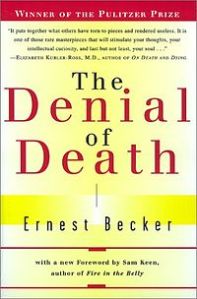
DenialofdeathcoverThey went immediately to the practical considerations like Living Wills, leaving clear instructions for children. But the discussion soon moved to the deeper matter of mortality itself, our culture’s juvenile denial of death (a la Ernest Becker), and the desire to go deeper into the philosophy and theology of wellness, death, and dying.

Two days later at last night’s Republican presidential debate, when Senator Marco Rubio drew roaring applause for his put down of philosophers – “We need more welders, less philosophers” – I wanted to invite the senator and everyone in the auditorium to join the 20 people  next Sunday in the Fireside Room where ordinary people will heed the wisdom of Socrates to “apply themselves in the right way to philosophy”:

“Ordinary people seem not to realize that those who really apply themselves in the right way to philosophy are directly and of their own accord preparing themselves for dying and death”

Death is always the elephant in the living room. So is philosophy when it is scorned. It’s easy to be glib about it, to knock it, ignore it, or mock it. Not so easy to face it “of [our] own accord”, as Socrates and the psalmist urge those who would live well – with gladness and and mercy – in anticipation of dying and death.

“So teach us to number our days, that we may apply our hearts unto wisdom. … O satisfy us early with thy mercy; that we may rejoice and be glad all our days.” – Psalm 90:12,14, KJV

Gordon C. Stewart, Chaska, MN, November 11, 2015.

Flip Saunders and the Media

Yesterday morning Minnesota media announced the untimely death of Flip Saunders, one of Minnesota’s most beloved public figures.

Cheered long ago as the diminutive starting point guard of the University of Minnesota Gophers basketball team, Flip worked his way through the ranks of the CBA to become a successful NBA Head Coach with Minnesota, Detroit, and Washington before returning “home” to Minnesota as both President and Head Coach of the Minnesota Timberwolves.

There is a deep sadness over his loss. At 60 years old, he was looking forward to the fruits of his labor, the makings of a future world championship team developed by Flip’s extraordinary draft picks, trades, and the return to Minnesota of Kevin Garnett, the NBA star who credits Flip with his development when Kevin was fresh out of high school.

Like Garnett himself, Flip Saunders was not a native Minnesotan. But he, and Garnett, came to see this as home, as do many out-of-state transplants once they taste the beauty and culture of Minnesota.

Today it’s that culture that should be lifted up along with the love for Flip: the respectful silence kept by the media in response to the Saunders family request for privacy during the long hospitalization that began in early September.

Readers and sports pundits who feed on sensationalism might have misinterpreted the absence of detailed coverage as meaning the sports writers and the media didn’t give a flip about Flip. It’s rare that the need for privacy is honored, even when a family requests it.

Team owner Glenn Taylor and the Minnesota Timberwolves were a class act from the first announcement of his diagnosis and encouraging prognosis to the heartbreak of his long hospitalization and death.

Flip’s illness and death were handled with the rare discretion that represents the very best of Minnesota Nice. Minnesotans don’t like prying into each others’ business unless invited, and quiet respectfulness is a Scandinavian characteristic that held back the pens of sports writers and voyeurs until there was something to share.

The StarTribune headline, quoting the NBA Commissioner, reads “Flip Saunders ‘leaves gaping hole in the fabric of the NBA”.  In the fabric of NBA culture of bigger-than-life heroes, Flip Saunders brought something smaller, more private, and all too rare.

Verse – The Memorial Service

The day we remember
at the Memorial Service
a friend of 55 years, some
will say he was a human
having a spiritual experience,
looking to the skies for the
one who’s “passed on”.

Others of us remember
the face, the smile, the stride,
the fitness, the speech
and mannerisms during
walks in the mountain woods
of a real human having a
spiritual experience.

Are we flesh and blood,
living on the eternal’s shore
turned back to dust?
Or are we stardust that
never dies, immortals
experiencing mortality
before returning to the sky?

Has he died or passed on?
Are the ashes and memories
of Phil what remain of him
or were his smile, his walk
and talk just time-bound
expressions of a spiritual
being locked in a cage?

I hear no bird singing but
the funeral dirge and hymn
reminding us to think
less of ourselves and our
not-so exceptional species
of flesh and blood, dust and
ashes left in cemetery urns.

“O God, our help in ages
past, our hope for years to
come, we fly forgotten as
a dream dies at the opening
day. Be Thou our guide
while life shall last and
our eternal home.”

Today our tears again will
fall, as do all creatures
great and small when
time’s short river returns
to the eternal ebb and flow
whence we came and to
which all soon return, with
sobs of humility and praise.

  • Gordon C. Stewart, Chaska, MN, October 17, 2015, written in anticipation of today’s Memorial Service for college and seminary classmate and friend Philip Conner Brown. At the same time as the Memorial Service today at White Bear Lake United Methodist Church, he will be remembered in a Chapel service for Maryville College alumni who died during the last year.


Professors and Jack-hammer Operators

Is there a difference between being retired and being dead?

Is there a difference between being employed and being dead?

It all depends, perhaps. Is your retirement deadly boring? Is your employment deadly meaningless? It all comes down to “calling” – the sense that one is called to something.

Eugen Rosenstock-Huessey

Eugen Rosenstock-Huessey

Social philosopher Eugen Rosenstock-Huessey noted how curious is was that in their leisure time professors read books and jack-hammer operators rode motorcycles. If it really was leisure, he said, the professors who worked with ideas would be riding motorcycles; the jackhammer operators whose ears were filled with noise all week would be reading philosophy, history or novels.

I think  need a motorcycle!

P.S. My audiologist said I have the ears of a 45 year old jack-hammer operator.

  • Gordon C. Stewart, Chaska, MN, Oct. 1, 2015

Mortality and Morality

‘Mortality’ knows nothing of ‘morality’.

The words are separated by one letter, but they are foreign to each other. Mortality always trumps morality. The young die before the older without explanation or moral reasoning.

Tonight 92 year-old Bob Cuthill will participate in the celebration of his younger 72 year-old friend Phil Brown. Bob and Phil became friends professional colleagues years ago. Over the years Bob had been to Phil the wise older mentor, confidant, and friend.

Phil, 20 years Bob’s younger, was not supposed to die. He was the picture of health until two months before they diagnosed a rare, hidden Lymphoma, performed emergency surgery, and watched his life ebb away organ by organ in the post-surgery ICU. If life were ordered by moral reasoning, Phil was not supposed to die before Bob.

Tonight I’m thinking of Bob and Phil’s dear wife, Faith, gathered with Phil’s local friends at the White Bear United Methodist Church for pizza, vanilla ice cream (Phil’s favorite flavor), and story-telling back in Minnesota.

The older survivors of the deceased often ask Why? Why him? Why her? Why not I?  The answers never come. What comes instead to the fortunate is a great thanksgiving for the life that has passed and the life one has for yet awhile before others gather for pizza and ice cream.

– Gordon C. Stewart, friend and classmate of Phil Brown (1942-2015), July 6, 2015.

Would you like to see Walter?

“Would you like to see Walter?” asked the funeral director to the 19 year-old college student who’d just arrived at the funeral home.

“Walter who?”

“Walter Fraser,” said Mr. Gibson, who only an hour before had recruited the 19 year-old to ask whether he owned a dark suit, and could he serve in a pinch as the greeter for the visitation the night before funeral. The staff person who normally welcomed people at the front door had called in sick at the last moment. Because the Gibsons, Stewarts, and Frasers were friends and members of the same church, Mr. Gibson turned in desperation to the inexperienced 19 year-old as the greeter’s substitute.

So far as I had known before arriving at the funeral home, Walter wasn’t dead. Mr. Fraser was a highly respected member of the community, and the father of my friend ‘Fuzzy’ Fraser, the star offensive guard on the Marple-Newtown High School football team. Last I knew, Mr. Fraser was as healthy as my father and Mr. Gibson. Mr. Fraser wasn’t supposed to die.

Suddenly “Mr. Fraser” – a man of great dignity and stature – was “Walter”.

“Would you like to see Walter?”

Stunned by Mr. Fraser’s death, I said, “No thanks,” before realizing my refusal was a kind of insult to Mr. Gibson’s work and skill. After the Masons had finished their private ritual of white gloves and strange prayers pretending that Walter was not really dead, Mr. Gibson led me into the viewing room where the guests would see Walter in his open casket.

My family wasn’t into open caskets. When you die you’re dead; you’re gone. A painted corpse, though it may console some of the survivors — “Doesn’t he look good!” they say, or “He looks so peaceful” or “Didn’t they do a nice job” — serves, as Jessica Mitford and other critics of American funeral practices have said, as a denial of death.

Seeing the previously presumed-to-be-alive Mr. Fraser laid out in a casket as ‘Walter’ came as a shock to the senses that underlined the responsibility to offer a friendly greeting at the door, all dressed up, like Walter, in a dark blue suit.

“Would you like to see Walter?”

“Walter who?” remained the question after I left the Gibson Funeral Home. Who was Walter? Was he Mr. Fraser? Or just Walter, all dressed up, like the rest of us, with no place to go, as naked as the day he was born? I’d like to see him again to ask what he can tell me that I don’t yet know.

— Gordon C. Stewart, GeorgetownLake, MT, July 8, 2015

Verse – He was not supposed to die!

“He was not supposed to die!”
Said Faith and Joanie when
Phil and Mac died unexpectedly
While still vigorous and young.

Our years are three score years
and ten, and if by some reason
they be fourscore years, yet are
their days labor and sorrow,

said the old sage on bended
knee, lamenting the inscrutable
puzzle of life and death beyond
the ordering of moral reason.

But I have days to live and time
enough for joy as well as toil,
for beauty as well as sorrow
before I’m not supposed to die.

Gordon C. Stewart, Georgetown Lake, MT, July 7, 2015.