I've always liked quiet. And, like most people, I've experienced the world's madness. "Be Still! Departure from Collective Madness" (Wipf and Stock Publishers, Jan. 2017) distills 47 years of experiencing stillness and madness as a campus minister and Presbyterian pastor (IL, WI, NY, OH, and MN), poverty criminal law firm executive director, and social commentator. Our cat Lady Barclay reminds me to calm down and be much more still than I would be without her.
There are times to stay silent. This is not one of them. Views from the Edge’s long silence does not imply consent. It was born of despair. Philosophy is born in a cry, wrote Willem Zuurdeeg in Man Before Chaos.1
Finding words to describe the origins of my protest failed me until the line “the walls of gold entomb us” came to mind and wouldn’t let go until I found it. Identifying its source felt like finding a breadcrumb pointing me home to my heritage and my deepest self. “O God of Earth and Altar” by G. K. Chesterton says what I believe, think, and feel in this “Golden Age.”
“Our earthly leaders falter, Our people drift and die”
O God of earth and altar, Bow down and hear our cry;
Our earthly rulers falter, Our people drift and die; The walls of gold entomb us, The swords of scorn divide; Take not Thy thunder from us, But take away our pride.
From sleep and from damnation, Deliver us good Lord! From all that terror teaches, From lies of tongue and pen; From all the easy speeches That comfort cruel men; From sale and profanation Of honor and the sword; From sleep and from damnation, Deliver us, good Lord!
Tie in a living tether The prince and priest and thrall; Bind all our lives together, Smite and save us all; In ire and exultation Aflame with faith, and free, Lift up a living nation, a single sword to Thee.1
Faith and Politics
Poetry is timeless. The lyrics Chesterton wrote in 1906 bubbled up from a hidden sea deep within me, the greater ‘Yes’ that includes the ‘No’ –– the protest of a primal cry against this new ‘Golden Age’ which moth and rust will inevitably consume.
“O God of Earth and Altar” strikes me now as a kind of catechism––a set of cliff notes on what it means –– and does not mean –– to follow Christ. Christian faith and ethics stand at the intersection of the divine and secular, prayer and politics, profession and profanation, truth and lies, salvation and damnation.
Three years after Chesterton said ‘No’ to life entombed within the ‘the walls of gold’, American poet priest Walter Russell Bowie spoke of walls when lust and greed no longer “Wring gold from human pain. “O Holy City, Seen of John” expresses the inseparability of faith and the ethic of compassion.
O Holy City, seen of John, Where Christ, the Lamb doth reign, Within whose four-square walls shall come No night, nor need, nor pain, And where the tears are wiped from our eyes That shall not weep again!
O shame on us who rest content While lust and greed for gain In street, and shop and tenement Wring gold from human pain, And bitter lips in blind despair Cry, “Christ hath died in vain”!2
Gordon C. Stewart, author of Be Still! Departure from Collective Madness (2017 Wipf and Stock), January 6, 2026.
1 Willem Zuurdeeg, “Man Before Chaos,” Abington Press, 1968.
2 Gilbert Keith Chesterton (1874-1936), “O God of Earth and Altar,” in The Commonwealth, 1906.
3 Walter Russell Bowie (1882-1969), “O Holy City Seen of John,” 1909.
“Here am I,” says Isaiah, ”Send me,” in reply to the question of the Holy One,” “Whom shall I send? Who will go for us?”––Young’s Literal Translation
Christian Nationalism is a Parasite
Propaganda is a parasite. It can’t live without a host. ‘Christian Nationalism’ sucks the blood out of sacred texts. Few biblical texts are as beloved as the calling of Isaiah. In the original Hebrew text, Isaiah speaks in the present tense: “In the year that king Uzziah died, I see the Lord, high and lifted up, and his train is filling the temple.” He sees the seraphs flying above the throne, singing “Holy, holy holy, [is] Jehovah of hosts, the fullness of all the earth [is] his glory.”
A Homeland Security promotional recently featured an ICE recruit attributing his sense of call to become an ICE agent to Isaiah in the temple, “Hear am I, Send me.” The Homeland Security promotional [since taken down from X] turns Isaiah’s call into a parasite that sucks the blood of compassion from its host. “We will cut you down,” the voice-over of a helicopter sighting two migrants moving through the night toward the U.S. southern border, displaces the “Holly, holy, holy.” The whole earth that is full of God’s glory is shrunk to the parcel of earth.
An Autobiographical Reflection
It was in college that the calling of Isaiah took hold of me. I don’t remember who put Frederick Buechner’s The Hungering Dark in my hands, but I’ve never forgotten the impact of Buechner’s reflection on the call of Isaiah (Isaiah 6:1-8). I was not in the Temple in Jerusalem; my dormitory room was not filling with smoke; I knew nothing of seraphim, let alone seen them flying overhead or heard them calling to each other their song of praise for God’s holiness. No seraph had touched my lips with a hot coal from the altar. Even so, I knew this story the way a child ‘knows’ a story before the codes of reason ridicule its sense of wonder. Like Isaiah in the year that King Uzziah died, the foundations of what I once thought to be solid were trembling. The world was a mess. So was I. I was a man of ‘unclean lips’ living among ‘a people’ of unclean lips.
The summer before reading The Hungering Dark, my foundations had been shaken by the daily trips on the Red Arrow bus and Philadelphia subway that took me back and forth between where I lived and the squalor of Opal Street in north Philadelphia. Two landmark institutions gave stability to north Philadelphia: the Pennsylvania State Penitentiary and Corinthian Avenue Chapel. The eight homeless men with whom I had spent the afternoons that summer had been guests of the penitentiary before they were released to the streets. Corinthian Avenue Chapel, the empty shell of a once thriving Presbyterian church, vacated by white flight, was three blocks north of the prison.
It was a game of dodgeball with the kids who lived in the tenements on Uber Street that introduced me to the men of Opal Street and set the course for the rest of the summer. There was no traffic on Opal Street. My focus shifted from working with kids to an altogether unexpected summer with “the Brothers of Opal Street.”
An errant throw sent the dodgeball through the circle of ‘winos’ (their designation, not mine) who gathered every afternoon, seated on wooden orange crates, in the middle of Opal Street . After apologizing for interfering, I continued walking to the far end of the block. Like the condemned tenements that lined the east side of Opal Street, the far end of the street was blocked by a boarded-up fence. The chalk outline of a body was still fresh on the pavement
When I returned with the ball, the men asked what I was doing there. When I spoke of games for the kids, one of them drew laughter when he asked, “Do you have any games for us?” “I do,” I said. “Any of you ever play quoits?“ “Quoits?” Again there was an uproar of laughter. “Well, how about horseshoes?” Corky had played horseshoes in the Army. The next day I set up the Quoit stakes on the street. Every afternoon, we played Quoits until the men could no longer stand.
On my last day with them, the men wanted to have “a little talk.” I had expected the sharing of good-byes. What happened was something else. In retrospect it was life-changing, A one-of-its-kind Isaiah in-the-Temple moment. No seraphim flew above us, singing “Holy, holy, holy.” But there was smoke, a red-hot coal striking my lips, and a realization that I was a man of unclean lips among ‘a people of unclean lips’.
“Why did you come here?” they asked. “Don’t come back here. ‘Your people’ own this place. Look around. You don’t see any white faces. Your people never show up around here, but they own this place. It’s too late to help us. But the kids? If you want to make a difference here, go back to ‘your people’ and change things there.”
I had come to Opal Street as a disciple of Jesus, wanting to be of service among the “less fortunate,” like the good Samaritan who crossed the road to show compassion to the man who’d been left half-dead in the ditch. It had seemed that simple at first. I had assumed the western Main-line suburbs and Opal Street were worlds apart. One was wealthy, the other was poor. One was white, the other was black.
Now, after a long, hot summer, the ‘winos’ and ‘junkies’ of Opal Street had shattered the myth of separate worlds. Power and powerlessness, parasites and hosts live in the same world. I returned to college, confused, at sea, questioning everything I had been taught, and threw myself into contemporary philosophy and political science in search of answers to questions that have lasted a lifetime.
Years later, Kai Erikson’s Wayward Puritans provided a sociological framework that deepened my understanding of why and how we human beings ‘other’ each other. Cultures need deviants, outsiders, stereotypes who threaten the majority’s view of itself. Witches became the scapegoats that served to define what the majority was not. The Massachusetts Bay Colony was Christian and moral; witches were neither. The witches of Salem, the banishment of Mr.s Anne Hutchinson and the execution of Mary Dyer, served to save the Bay Colony’s religious–racial consensus from fraying further.
A BURNING COAL melts ICE
The Department of Homeland Security likening the call of Isaiah to a call to join ICE is chilling. It’s bad theology, bad faith, and bad patriotism. But heat always melts ice. Isaiah’s calling is remarkable for its sense of holiness and wonder. The Homeland Security rendering of “Here am I, Send me” is a call to cruelty and unmatched power over the ‘other’. It confuses divine calling with a call to dominate. In the ICE propaganda, there is no sense of the young man feeling lost, no sense of woe, no awareness of unclean lips or of one’s own people as a people with unclean lips, no hot coal from the altar burns away the sin. ICE’s adaptation of Isaiah is a parasite. It replaces the burning coal with an ice cube. Where the seraphim sang of the whole earth filled with God’s glory, border patrol helicopters buzz overhead migrants seeking a better life with the message, “We will cut you down!”
Every person of honest faith and good will is being called in this moment of American history to answer “Here am I, Send me!” Isaiah’s call is not past tense. It is now.
Gordon C. Stewart, Presbyterian Church (USA) pastor and public theologian, author of Be Still! Departure from Collective Madness (2017 Wipf and Stock), writing from Brooklyn Park, Minnesota, August 6, 2025.
Congressman Elijah Cummings (RIP) took congressional oversight seriously. Overseeing the Department of Homeland Security, he is like a mother bear protecting her cubs. His judgment rises from compassion. Addressing convicted felon Michael Cohen, he speaks like a grandfather to a grandson.
Rep. Elijah Cummings (RIP), former Chair of the U.S. House of Representatives Oversight Committee
We have met the enemy
The Truth and Reconciliation Commission of South Africa broke through the wall of apartheid. Can a process of honest confession (truth-telling), and forgiveness reconcile us in America?
In the real world, I have often confused good and evil. I come up short until I remember that I live in Pogo’s world. “We have met the enemy, and he is us.” Like the biblical prophets, Elijah Cummings confronted the worst in us and encouraged the best in us. “We can do better,” he says. I wonder if we can. “We’re better than this.” I wonder whether we are.
STOP! Listen up!
“If you bite and devour one another,” wrote the Apostle Paul to a church whose people were biting and devouring each other, “watch out that you are not consumed by each other.” (Epistle to the Galatians 5:15). The warning is more than a suggestion. In the Greek text, “WATCH OUT!” is to morality and ethics what “Halt!” is to soldiers:“STOP! LISTEN UP!”
Groaning too deep for words
What makes us human is not power or the capacity to create chaos and division. Or to make noise. Or to take center stage. Noisy gongs and clanging cymbals distract us from hearing the groaning that rumbles deep within every human heart. These groans are the labor pains by which a better Michael Cohen, a better Donald Trump, a better America, a better world, and a better us are born.
Gordon C. Stewart, public theologian, author of Be Still! Departure from Collective Madness (2017 Wipf & Stock), Brooklyn Park, MN, July 16, 2025.
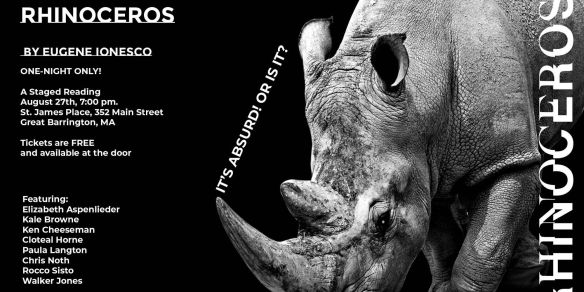
The video of a rhinoceros killing a lion and throwing it into the air like trash called to mind Eugene Ionesco’s Rhinoceros. As I remembered it, Rhinoceros, like other works of The Theater of the Absurd, tore back the curtain of presumption that keeps us from seeing who we really are. If Rhinoceros was about anything else, it was about order and chaos, dominance and subservience, power and the wannabe herd that surrenders its power to the Rhinoceros.
A day in Brooklyn Park
My sense of the absurd grows every day. I see myself as E.E. Cummings’ “Little i” –– Who am I, “little i” among the herd of “little i’s” clamoring for dominance? I know so much less than I once knew. The sense of absurdity has shredded my confidence in the unseen hand of divine providence.
Kay and I live in Brooklyn Park, Minnesota, where a police bulletin advised all residents to stay in our homes until a future advisory. Keep the doors locked while the police searched for a shooter at loose in our neighborhood. The man is armed and dangerous. Do not answer the door under any circumstances. The suspect may be dressed like a police officer. Do not answer the door for anyone until you receive a further advisory.
The next day we learned that a suspect had been arrested. He had shot and killed former Speaker of the Minnesota House of Representatives, Melissa Hortman and her husband, Mark, and had critically wounded MN state Senator John Hoffman and his wife, Yvette.
The Army of God and the ‘unhumans’
The shooter had abandoned his van to flee on foot. The van contained a hit list of 40+ public servants. Everyone on the list was prominent member of the Democratic-Farm-Labor Party (DFL). To some, it came as a shock that the suspect identified himself as a Christian. On most Sundays, he attended worship at an evangelical megachurch. Others were not surprised. They recalled Stephanie McCummen’s article, “The Army of God Comes Out of the Shadows” (The Atlantic, January 9, 2025). The far-right New Apostolic Reformation has quietly sweeps through charismatic-evangelical Churches with its message of Christian nationalism.
“Our study of history,” says a book endorsed by JD Vance, “has brought us to this conclusion: Democracy has never worked to protect innocents from the unhumans. It is time to stop playing by rules they [i.e.‘unhumans’] won’t [keep].”
Earlier in American public life, residents of Brooklyn Park did not imagine that hate, heartlessness, and cruelty would define their community. Nor would they have thought of a Christian drawing up a hit list, disguising himself as a police officer driving a squad car facsimile loaded with guns, rifles, and military-style weapons used for assassinations and executions of public servants. There was, as there always is among humans anger, frustration, scapegoating, and loathing of others, but the community, for the most part, observed its own cultural commandments of do’s and don’ts.
Living with the Absurd
The ethical norms required for a healthy society have been eroded so slowly that we wonder how we got to the America of 2025 so quickly. Like buildings of brick and mortar, nations, religions, and communities need maintenance. Without it, they crumble.
While a student at a small Christian college, the Theater of the Absurd suddenly came to make more sense than the “Life-of-Brian” view of divine providence in which God’s in his heaven and nothing can go wrong. Things were not right with world. Unless God is a sadist, the world made no sense. I was 19 years-old when Eugene Ionesco, Albert Camus, and Jean-Paul Sartre pulled me, dragging and screaming, into the Theater of the Absurd. I had experienced the angst to which Camus’ The Plague, Sartre’s No Exit, and Ionesco’s Rhinoceros gave expression, but I did not know enough history to understand the Sitz im Leben from which they wrote.
Don’t you see?
White Rhinoceros, courtesy of Working with Wildlife, South Africa
All these years later, I get it. Life in 2025 bears ghostly resemblance to these authors’ experience almost a century ago. In an interview published in 1983, Ionesco described the circumstances that led him to the image of a rhinoceros:
I first thought of the rhinoceros image during the war, as I watched Romanian statesmen and politicians and later French intellectuals accommodate themselves to Hitler’s way of thinking. They might say something like, “Well, of course the Nazis are terrible, terrible people, but you know, you must credit them with their good points.” And you wanted to say to them: “But don’t you see, if you start granting them a good point here, a good point there, eventually you will concede everything to them.” Which is exactly what happened. But they looked upon you as an alarmist, then a nuisance, finally an enemy to be run down. They looked like they wanted to lower their heads and charge.
Eugene Ionesco, Le Nouvel Observateur, February 1983
Conceding Everything
The statesmen, politicians, and intellectuals who today accommodate themselves to the thinking and morality of a rhinoceros are not Romanian, German, or French. They are Americans. The way of thinking is the same. The psychology is the same. Though the targets are different, the phenomena are the same. If Jews, gypsies, and homosexuals became the scapegoats that propped up the illusion of Aryan racial superiority in Germany, today in America, the enemy is leftists, socialists, communists, people of color, immigrants, and migrants poisoning the blood of our country. The scapegoat mechanism is the same. The excuses and accommodations are the same. The results are the same.
The strategy and tactics that now threaten democracy in the U.S.A. have a history. Too little has been made of the similarity of the Nazi’s failed coup d’etat –– the Beer Hall Putsch (November 8-9,1923) in Munich –– and the attempted coup d’etat in Washington, D.C. on January 6, 2021. Or of the fact that Adolf Hitler was tried and found guilty of treason and the charges in the second impeachment trial of Donald Trump in the wake of January 6. Or that the book Hitler wrote in prison, Mein Kampf, and the Speeches of Hitler, were, according to members of the Trump family and the co-author of The Art of the Deal, Tony Schwartz, were the only books in his bedroom. Most poignant is the Nazi decision to shift from the strategy of violent revolution to a slower evolutionary road to victory. It would happen more slowly and less spectacularly, but it would succeed. They would destroy democracy from within. And they did.
“Hitler’s lesson from the failed putsch,” wrote historian Christopher Browning in the February 2022 issue of The Atlantic, “was that he needed to pursue revolution through ‘the politics of legality’ rather than storm Munich City Hall. The Nazis would use the electoral process of democracy to destroy democracy.”
The late Bill Moyers (RIP) described Donald Trump as a man who has an open sore where a soul should be. Eugene Ionesco saw a Rhinoceros, and a herd of wannabe rhinoceroses, tromping behind the Rhinoceros whenever a snort tells them to lower their heads and charge.
Gordon C. Stewart, Presbyterian Church (USA) pastor, social critic, and public theologian, author of Be Still! Departure from Collective Madness (2017 Wipf and Stock), 49 brief commentaries on faith and public life, Brooklyn Park, MN, July 9, 2025.
The date June 14 had multiple layers of meaning for my family this year. June 14 (Flag Day) was my mother’s birthday. Muriel Eva Titus Stewart would have been 110 this year. It was Donald J. Trump’s birthday; it was the day of the military parade celebrating the President’s birthday and the 250th Anniversary of the United States Army.
It was the day a gunman killed Minnesota Speaker of the House emerita Melissa Hortman (DFL-Brooklyn Park), her husband, Mark, in their own home, and critically wounded Sen. John Hoffman (DFL-Champlin) and his wife, Yvette, in their home.
A Brooklyn Park Police advisory to secure our property and stay put during the search for the suspect.
Later that day, downtown Minneapolis Interfaith Clergy representing Christian, Jewish, Muslim, and Unitarian-Universalist congregations published the following statement on hate and violence.
Downtown Interfaith Clergy Statement, Jun 14, 2025
We are a multi-faith coalition of clergy representing more than 35,000 Minnesotans from congregations across the city of Minneapolis.
Many of us have had the honor of offering prayers in the chambers of the Minnesota House of Representatives and the Minnesota Senate. As clergy, we pray for unity, peace, and guidance for our elected officials—public servants working toward the well-being of all Minnesotans.
It is unimaginable that Speaker Emerita Melissa Hortman and her husband, Mark, and Senator John Hoffman, his wife Yvette, and their daughter were targeted in an act of extreme political violence. We mourn alongside the family of Speaker Emerita Hortman and her husband in their time of inconceivable grief, and we send our prayers for a complete healing of body and spirit to Senator Hoffman, Yvette, and their daughter.
In these deeply troubling times, we stand united against the rising culture of hatred and fear that has been allowed to take root in our communities. Violent words lead to violent actions, and we must not let depravity become the new normal in our world. Together, we will work to counter it wherever we see it.This is a time of great divisiveness in our country. As people of faith, we are called, as the prophet Jeremiah teaches us, to seek “peace in the city, and in the places where we dwell.” (Jeremiah, 29:7) As interfaith religious leaders, we have worked to maintain connections across faiths through thoughtful and respectful dialogue, even when we disagree. Such conversations between people of faith offer a powerful alternative to division and hostility.
Interfaith relationships have brought us closer to our own faith and convictions. This work has opened the door to deeper engagement with our holy texts, our sacred communities, and our relationships with God. In the words of Dr. Martin Luther King Jr., “The arc of the moral universe is long, but it bends toward justice.” But it does not bend on its own. We must bend it—with courage, conviction, compassion, and action.
God help us to live our lives with moral courage, to strengthen our communities, and to stand together for justice.
Rabbi Marcia Zimmerman, on behalf of the Downtown Interfaith Clergy
Rev. Jeffrey Japinga, Westminster Presbyterian Church; Rev. Dan Adolphson, First Christian Church; Rev. Jullan Stoneberg, First Unitarian Society; Rev. Elizabeth Macaulay, Hennepin Ave United Methodist Church; Pastor Elijah McDavid III, Fellowship Missionary Baptist Church; Rev. Timothy M. Kingsley, Saint Mark’s Episcopal Cathedral; Rev. Jen Crow, First Universalist Church; Rev. Peter Nycklemoe, Central Lutheran Church; Makram El-Amin, executive director, Al-Maa’uun; Father Daniel Griffith, Basilica of St. Mary;Father Kevin Kenney, St. Olaf Catholic Church.
Downtown interfaith Clergy statement, Minneapolis, MN, June 14, 2025
Gordon C. Stewart, public theologian, host of Views from the Edge, author of Be Still! Departure from Collective Madness (2017, Wipf and Stock), Brooklyn Park, MN, June 30, 2025.
Before Mitchell Dahood’s Anchor Bible Commentary on the Psalms (Psalms II) caught my attention, I had read Psalm 94 as addressing ‘the God of vengeance’. I don’t like vengeance, retaliation, or retribution. I see their results every day in others and in myself. “I am your retribution,” says Donald Trump on the campaign trail. The way of Jesus counters vengeance with mercy, retaliation with forgiveness, retribution with the sweet taste of kindness.
The God of vindication, Yahweh,
The God of vindication, shine forth.
It was the God of vengeance whose wrath terrified Augustinian monk Martin Luther until Paul’s Epistle to the Romans relieved his distress. “God of vengeance” is mistaken; God was sovereign, yet His heart was for us; not against us. We were no less sinful than Luther had said, but Divine love surpasses our sin. One is ‘justified’ by divine grace through faith.
Father Dahood, Professor of Language and Literature at the Pontifical Institute in Rome, translates the Hebrew word which most translations render as ‘vengeance’ altogether differently. Psalm 94 addresses” the God of vindication.”
I confess that I sometimes hope for vengeance. “’Vengeance is mine; I will repay,’ says the Lord.” So where is it? Is it hiding? If so, why? Is it a projection? Painting God in our image? A Benedictine spiritual guide once replied to my statement, “I don’t believe in Hell” with “Well, we Benedictines say that Hell is real… but there’s probably nobody in it.” The monk was preserving God’s sovereignty as Judge, while maintaining God’s essence as Love.
Whether it’s God of vengeance or vindication, I feel the psalmist’s cry for God to show up, shine forth, come out of hiding. Show Yourself. Vindicate Yourself!
Dahood’s translation is also strange for spelling out the Hebrew Name for God. The Hebrew name was originally four consonants without verbs: YHWH, the inscrutable Name given to Moses out of the burning bush on Mount Horeb. “I Am,” “I Am Who I Am” or “I will be Who I will be.” The Name too holy to speak is above every name – the Breath that breathes in me, in us, in all life. Who , then, am I––little I— to come before You. Who am I to shrink You to a name, you who are the Mystery beyond and within the chaos, neither friend nor foe, “Immortal, Invisible, God only wise, in light inaccessible hid from our eyes.”
Rise, judge of the world,
give the presumptuous their deserts
I want the world to be judged by an angry God, a vengeful God, but that God is AWOL –– either absent or indifferent to the carnage inflicted on the people of Gaza and Ukraine, indifferent to the wounded, dead and dying, the maimed and the starving, the blank eyes of babies and children dying of malnutrition.
Here in the USA, disinformation replaces reality. Presumption is everywhere without consequence. It sits behind desks in Moscow and in Washington, D.C. God’s name is spoken, but it is a god of vengeance that is invoked. Presumption waves a chain saw, smashes the good, destroys the boundaries that keep life human and humane.
How much longer shall the wicked, O Yahweh,
How much longer will the wicked exult?
I watch the still-to-be sentenced convicted felon entertain his followers, alone on stage at a campaign rally, moving awkwardly, like a teenager who never learned to dance, swaying to the music of YMCA. I see an arena full of adoring fans who have no problem watching the 35-minute visible display of self-absorption.
How long will they pour forth defiant words,
    shall all the evildoers flaunt themselves?
I watch the richest man in the world jump up and down on stage like a clueless clown, brandishing a chain-saw to rescue prisoners held captive by the forest whose shade and shelter keep them free and sane. I ask what is wrong with us. What has become of us?
Your people, Yahweh, they crushed, and your patrimony they afflicted. Widow and stranger they killed, the orphan they murdered, Thinking “Yah does not see, Jacob’ God takes no notice.”
There is no Higher Power to judge our cruelty, no Holy One to hear their speeches or rebuke their misuse of authority. Though God is dead to them, ‘God-talk’ remains useful for their purposes. “God saved me,” says the POTUS after surviving two assassination attempts. “I felt then, and I believe even more so now, that my life was saved by God to make America great again.”
Learn some sagacity, you dolts, fools, when will you understand? Yahweh knows how vapid are men’s thoughts.
Our thinking is askew and dangerous. Our thoughts are vapid, a narcissistic revolt against our finitude, presuming dominance over the web of nature, indifferent or willfully blind to the harm our presumption has wrought: the increasing frequency of 100-year storms, winds, and fire that leave wide swaths of Hawaii, Los Angeles, and Ashville in embers and ashes; the rising sea levels, floods, and tsunamis which the Māori and other aboriginal peoples see as signs that the gods were angry — a clear message to run to higher ground; the warning of climatologists that we are at the point of climate departure when there is no way back.
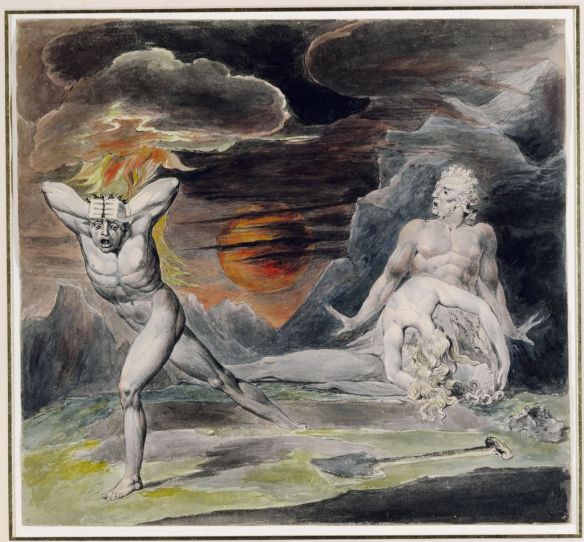
William Blake painting of “Cain fleeing from the wrath of God “as Adam and Eve look on in horror following the fratricide.
I think of ‘Hevel’ — The Hebrew name translated into English as Abel, the slain brother in the Genesis story of Cain (Kay-in) and Abel (Hevel) — and wonder what the story-teller is telling us by naming the murdered brother Hevel (a mere short breath) and by leaving us with the image of Hevel’s blood crying from the ground. I hear Hevel’s voice screaming from the ground in Palestine, Ukraine, Sudan, Sandy Hill, Uvalde, Parkland, Ferguson, Minneapolis. How ‘vapid’ are my thoughts. I am a puff of air, nothing less and nothing more than a vapor that appears in the morning and by evening vanishes. “What is your life?” asks the Epistle of James. “For you are a mist that appears for a little time and then vanishes.”
How have we mortals become such dolts that we would regard our species as inextinguishable? How does a Puff like me become wise? How does a descendant of Cain atone for spilling Hevel’s blood on the ground? How will I, a puff of air, live less pretentiously, more humbly before the Breath of Life itself, YHWH, God only wise, hid from my eyes?
I think of Elie Wiesel’s story of Rebbe Baruch and his grandson Yahiel. Wiesel tells the story in Four Hasidic Masters and Their Struggles with Melancholy. When Yahiel walks into his grandfather’s study in tears, Rebbe Baruch greets him with great tenderness. “Why are you crying, Yahiel?” His answer opens the door for Baruch to teach Yahiel about his relationship to God, and the character of God. Yahiel and his friend had been playing Hide-‘n-Seek, but the game ended before they had finished. Yahiel had hid so well that his friend gave up looking for him. He ran home in tears
“That’s not fair,” says Yahiel to his grandfather.
“God is hiding, too, Yahiel,” says the Rebbe. “God is crying because we have stopped searching.”
YHWH is hiding. God, too, is crying.
Gordon C. Stewart, public theologian, host of Views from the Edge, author of Be Still! Departure from Collective Madness (2017, Wipf and Stock), Brooklyn Park, MN, April 29, 2025
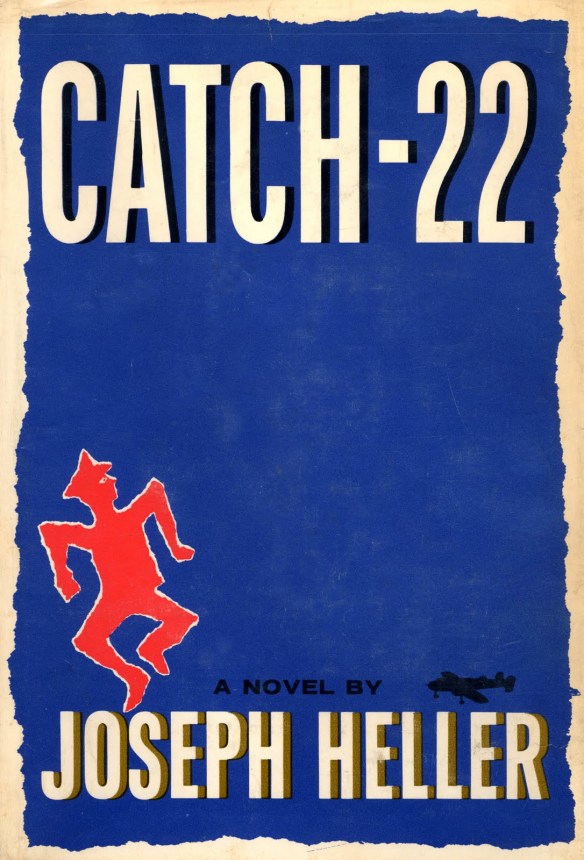
“Beware the Ides of March,” says the seer, warning Caesar that his reign would end that day. ”Well, the Ides of March are come,” declares Caesar, mocking the seer with a sneer. “Aye, they are come,” says the seer, “but they are not gone.” — Joseph Heller’s Catch-22.
A very long day
When words escape me, I look to a psalm, a poem, or work of fiction. Today I find words for what I feel in Joseph Heller’s Catch-22, and in the exchange between Caesar and the seer in the Ides of March. In 2025, it happens, if it happens, on more than one day. The day for us is longer––weeks, months and years – when we are suspended between Caesar’s sneer and the seer’s prophecy.
Donald Trump and Elon Musk continue to turn the Oval Office into a whipping post, the headquarters of a demolition crew, and a showroom for a car dealership. None of us has lived through a period like this. Which is why good fiction like Joseph Heller’s Catch-22 offers a different lens to see what is happening in real time.
Joseph Heller’s character without character: Milo Minderbinder
The setting of Catch-22 is a U.S. Army Air Corp base during World War II. First Lieutenant Milo Minderbinder, the squadron’s entrepreneurial mess officer, finds a way to turn the weapons of war to his financial advantage without a hint of principle or scruples.
The result, M&M (Milo & Minderbinder Enterprises) is all about Milo. Led by Lieutenant Minderbinder, M&M Enterprises amasses weapons of war through the black market and by a covert deal with the enemy. By the end, Milo takes pleasure watching the explosions that kill and maim his own troops.
Good fiction lifts the veil on reality,
How does an author describe someone like that? Heller calls him ‘a miracle’. “It was miraculous” is an apt description of what is happening to America now, in real time. Four years ago, it was unthinkable that the American electorate would return Donald Trump to the White House. It would take a miracle, or so it seemed. Until Mr. Trump, like Jesus, walked on water. Heller’s description of Milo Minderbinder jumps from the pages of Catch-22. “It was a miracle,” Heller says,
” It was almost no trick at all, he [Milo] saw, to turn vice into virtue and slander into truth, impotence into abstinence, arrogance into humility, plunder into philanthropy, thievery into honor, blasphemy into wisdom, brutality into patriotism, and sadism into justice. Anybody could do it; it required no brains at all. It merely required no character.” — Joseph Heller, Catch-22.
It takes a character like that to lead others to see you as a miracle, as happened in the Weimar Republic of Germany on Feb. 27, 1933, when the Reichstag (Parliament building) went up in flames. It happened a month after Hitler became Chancellor. Hitler and his devotees blamed the Communists.
Some events outlive their dates on the calendar. Like COVID, Polio, and Measles, they disappear, but never go away. They lie dormant until the circumstances are ripe for their return. Social, cultural, political, economic, and spiritual alienation is the challenge now as it was in Germany. A charismatic sociopath turned Germany into a cuckoo’s nest where morning becomes night, goodness becomes evil, the fear of death turns hearts into stone, mortality into delusions of grandeur, faith into demagoguery, courage into cowardice, patriotism into cruelty and carnage. It’s happening now in America.
Criminal Insanity requires no character
Serving churches and a public defense law office has brought me face-to-face with the likes of Milo Minderbinder. They were patients in the State Hospital for the Criminally Insane. Their delusions and illusions had created their own worlds. None of them had access to nuclear codes. They were burdened, but no one bore the burden of national security. They lived in secure quarters within the real world.
Aside from the nuclear codes, former daily national security briefings, drawing the global spotlight, extreme wealth and power, multiple women, wives, and lawyers, and well-practiced skills to avoid legal consequences, Donald Trump seems undistinguished from similar souls suffering from the worlds in their heads. He, Donald, is its center. His wants, wishes, and desires — and his alone — define reality. He is, in fact, the weak man, the needy man, the sick man who puffs himself up to be a man’s man, the strong man with authority to separate truth and falsehood, good and evil. He is the star who can do no wrong— in a lingerie section of an upscale department store, on an airplane, or in a Moscow hotel suite. His charm beguiles millions of Americans to believe January 6 was an act of patriotism, deserving of pardons, rather than a poorly executed insurrection, an act of treason.
Fiction and reality
Author George Saunders’ work of fiction, “The Moron Factory” (The Atlantic, March 2025) captures what many are feeling in the world’s very long day:
Sometimes feel life stinks, everything bad/getting worse, everyone doomed. Then day like today occurs, reminding one that yes, although life stinks, does not always stink to same extent, i.e., variations can occur in extent to which life, from day to day, may stink.
Today strange.
Maryanne Trump Barry speaks candidly of her younger brother Donald in terms akin to Heller’s description of Milo Minderbindinder:
“He [Donald] has no principles. None. None. And his base, I mean my God, if you were a religious person, you want to help people. Not do this. . . It’s the phoniness of it all. It’s the phoniness and this cruelty. Donald is cruel.”
Today is March 27. The Ides of March have passed, yet nothing has changed. Milo and M&M Enterprises are still undermining the country I thought I knew.
Get up and walk around
You can’t make this stuff up. But novelists and poets can and do. They remove the veil of ignorance. Creative imagination allows us to see reality as it is. Ken Kesey, author of One Flew Over the Cuckoo’s Nest, George Shakespeare, belong in the same guild as Heller and Shakespeare. Kesey saw in Shakespeare’s work a moral imperative.
“When Shakespeare was writing,” said Kesey, “he wasn’t writing for stuff to lie on the page; it was supposed to get up and move around.”
Poetry and fiction may yet save us from Caesar and Milo Minderbinder and our worst selves. That will only happen if we get up and move around.” This long day has not yet passed. Get up and move around!
Gordon C. Stewart, author of "Be Still! Departure from Collective Madness"(2017 Wipf and Stock), 49 brief commentaries on faith and public life, Brooklyn Park, MN; June 4, 2023.
President Abraham Lincoln (first DEI president) and Sojourner Truth
Lincoln’s Character
Abraham Lincoln is said to have spoken of his life as plucking thistles and planting flowers. Thanks to L.K. Hanson’s “You Don’t Say” (Minnesota Star Tribune, Feb, 17, 2025)
Die when I may, I want it said of me by those who know me best, that I have always plucked a thistle and planted a flower where I thought a flower would grow. – Abraham Lincoln, 16th President
When there is no character
The structure of Lincoln’s statement remains the same this Presidents’ Day, but the thistles are taking root where flowers grew.
Die when I may, I want it said of me by those who know me best, that I have always plucked a flower and planted a thistle where I thought a thistle would grow.
Where have all the flowers gone? Gone to thistles every one. When will we ever learn?
Where have all the flowers gone?
Gone to thistles every one. When will we ever learn?
“He who saves his Country does not violate any Law.”
Donald J. Trump
Gordon C. Stewart, Brooklyn Park, Minnesota, Presidents Day, Feb. 17, 2025
I’ve never been much into hell. I mean, I don’t believe in Hell, not that I’ve never been there, mostly of my own making. Though I think of Hell as a symbol of alienation and estrangement, it feels more real every day in America. The search for faith and hope that Love has the final word led back to this sermon from a decade ago. I am less the preacher than a listener now, in need of reassurance that cruelty and criminal insanity will not prevail.
Christus Victor: the Harrowing of Hell
Thanks for coming by Views from the Edge. Grace and peace,
Gordon
Gordon C. Stewart, PC(USA) minister (HR), public theologian and social critic; host of Views from the Edge: To See More Clearly; author of Be Still! Departure from Collective Madness (2017, Wipf and Stock), 49 brief meditations on faith and the news; Brooklyn Park, MN, January 25, 2025.
U.S. Senator Chris Murphy (D-Conn) entreats his Senate colleagues to stand up and be counted for the American Constitutional Republic and the survival of the rule of law and law enforcement. The three examples of January 6 violence are chilling. We’re better than that!









 Views from the Edge