
Personal Reflections in a time of vengeance
Before Mitchell Dahood’s Anchor Bible Commentary on the Psalms (Psalms II) caught my attention, I had read Psalm 94 as addressing ‘the God of vengeance’. I don’t like vengeance, retaliation, or retribution. I see their results every day in others and in myself. “I am your retribution,” says Donald Trump on the campaign trail. The way of Jesus counters vengeance with mercy, retaliation with forgiveness, retribution with the sweet taste of kindness.
The God of vindication, Yahweh,
The God of vindication, shine forth.
It was the God of vengeance whose wrath terrified Augustinian monk Martin Luther until Paul’s Epistle to the Romans relieved his distress. “God of vengeance” is mistaken; God was sovereign, yet His heart was for us; not against us. We were no less sinful than Luther had said, but Divine love surpasses our sin. One is ‘justified’ by divine grace through faith.
Father Dahood, Professor of Language and Literature at the Pontifical Institute in Rome, translates the Hebrew word which most translations render as ‘vengeance’ altogether differently. Psalm 94 addresses” the God of vindication.”
I confess that I sometimes hope for vengeance. “’Vengeance is mine; I will repay,’ says the Lord.” So where is it? Is it hiding? If so, why? Is it a projection? Painting God in our image? A Benedictine spiritual guide once replied to my statement, “I don’t believe in Hell” with “Well, we Benedictines say that Hell is real… but there’s probably nobody in it.” The monk was preserving God’s sovereignty as Judge, while maintaining God’s essence as Love.
Whether it’s God of vengeance or vindication, I feel the psalmist’s cry for God to show up, shine forth, come out of hiding. Show Yourself. Vindicate Yourself!
Dahood’s translation is also strange for spelling out the Hebrew Name for God. The Hebrew name was originally four consonants without verbs: YHWH, the inscrutable Name given to Moses out of the burning bush on Mount Horeb. “I Am,” “I Am Who I Am” or “I will be Who I will be.” The Name too holy to speak is above every name – the Breath that breathes in me, in us, in all life. Who , then, am I––little I— to come before You. Who am I to shrink You to a name, you who are the Mystery beyond and within the chaos, neither friend nor foe, “Immortal, Invisible, God only wise, in light inaccessible hid from our eyes.”
Rise, judge of the world,
give the presumptuous their deserts
I want the world to be judged by an angry God, a vengeful God, but that God is AWOL –– either absent or indifferent to the carnage inflicted on the people of Gaza and Ukraine, indifferent to the wounded, dead and dying, the maimed and the starving, the blank eyes of babies and children dying of malnutrition.
Here in the USA, disinformation replaces reality. Presumption is everywhere without consequence. It sits behind desks in Moscow and in Washington, D.C. God’s name is spoken, but it is a god of vengeance that is invoked. Presumption waves a chain saw, smashes the good, destroys the boundaries that keep life human and humane.
How much longer shall the wicked, O Yahweh,
How much longer will the wicked exult?
I watch the still-to-be sentenced convicted felon entertain his followers, alone on stage at a campaign rally, moving awkwardly, like a teenager who never learned to dance, swaying to the music of YMCA. I see an arena full of adoring fans who have no problem watching the 35-minute visible display of self-absorption.
How long will they pour forth defiant words,
    shall all the evildoers flaunt themselves?
I watch the richest man in the world jump up and down on stage like a clueless clown, brandishing a chain-saw to rescue prisoners held captive by the forest whose shade and shelter keep them free and sane. I ask what is wrong with us. What has become of us?
Your people, Yahweh, they crushed,
and your patrimony they afflicted.
Widow and stranger they killed,
the orphan they murdered,
Thinking “Yah does not see,
Jacob’ God takes no notice.”
There is no Higher Power to judge our cruelty, no Holy One to hear their speeches or rebuke their misuse of authority. Though God is dead to them, ‘God-talk’ remains useful for their purposes. “God saved me,” says the POTUS after surviving two assassination attempts. “I felt then, and I believe even more so now, that my life was saved by God to make America great again.”
Learn some sagacity, you dolts,
fools, when will you understand?
Yahweh knows how vapid are men’s thoughts.
Our thinking is askew and dangerous. Our thoughts are vapid, a narcissistic revolt against our finitude, presuming dominance over the web of nature, indifferent or willfully blind to the harm our presumption has wrought: the increasing frequency of 100-year storms, winds, and fire that leave wide swaths of Hawaii, Los Angeles, and Ashville in embers and ashes; the rising sea levels, floods, and tsunamis which the Māori and other aboriginal peoples see as signs that the gods were angry — a clear message to run to higher ground; the warning of climatologists that we are at the point of climate departure when there is no way back.
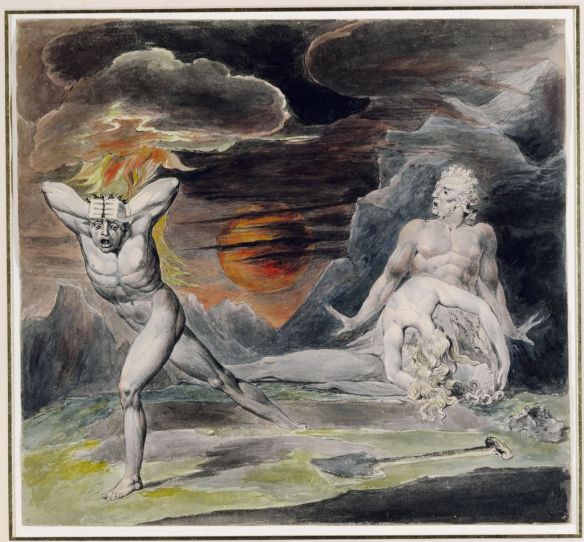
I think of ‘Hevel’ — The Hebrew name translated into English as Abel, the slain brother in the Genesis story of Cain (Kay-in) and Abel (Hevel) — and wonder what the story-teller is telling us by naming the murdered brother Hevel (a mere short breath) and by leaving us with the image of Hevel’s blood crying from the ground. I hear Hevel’s voice screaming from the ground in Palestine, Ukraine, Sudan, Sandy Hill, Uvalde, Parkland, Ferguson, Minneapolis. How ‘vapid’ are my thoughts. I am a puff of air, nothing less and nothing more than a vapor that appears in the morning and by evening vanishes. “What is your life?” asks the Epistle of James. “For you are a mist that appears for a little time and then vanishes.”
How have we mortals become such dolts that we would regard our species as inextinguishable? How does a Puff like me become wise? How does a descendant of Cain atone for spilling Hevel’s blood on the ground? How will I, a puff of air, live less pretentiously, more humbly before the Breath of Life itself, YHWH, God only wise, hid from my eyes?

I think of Elie Wiesel’s story of Rebbe Baruch and his grandson Yahiel. Wiesel tells the story in Four Hasidic Masters and Their Struggles with Melancholy. When Yahiel walks into his grandfather’s study in tears, Rebbe Baruch greets him with great tenderness. “Why are you crying, Yahiel?” His answer opens the door for Baruch to teach Yahiel about his relationship to God, and the character of God. Yahiel and his friend had been playing Hide-‘n-Seek, but the game ended before they had finished. Yahiel had hid so well that his friend gave up looking for him. He ran home in tears
“That’s not fair,” says Yahiel to his grandfather.
“God is hiding, too, Yahiel,” says the Rebbe. “God is crying because we have stopped searching.”
YHWH is hiding. God, too, is crying.
Gordon C. Stewart, public theologian, host of Views from the Edge, author of Be Still! Departure from Collective Madness (2017, Wipf and Stock), Brooklyn Park, MN, April 29, 2025
 Views from the Edge