
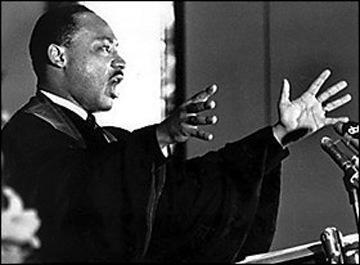
The Rev. Dr. Martin Luther King, Jr.
Forty-four years ago today the Rev. Dr. Martin Luther King, Jr. was assassinated in Memphis, Tennessee. Read this morning’s Washington Post story.I was with about 200 teenagers from “the projects” in Decatur, Illinois when the news broke. First Presbyterian Church and the Office of Economic Opportunity had partnered to create a youth program at the church. Charles Johnson, a former Blackstone Ranger from Chicago, and I (the 29-year-old Assistant Pastor) jointly administered the program.
We were in the church basement when the voice rang out from the steps, “Dr. King’s been shot! Dr. King’s been shot!” The room was filled with shock and anger. Some of the kids preferred Malcolm X to Dr. King, but on that night it didn’t matter. The room was united, overwhelmed by tragedy, another violent act of racial hatred.
Dr. King’s assassination came two months after the release of the report of the President’s National Advisory Commission on Civil Disorders (the “Kerner Commission”) that had concluded:
“Our nation Is moving toward two societies, one black, one white—separate and unequal.”
The conclusion of the Kerner Report about police violence had been demonstrated on the church parking lot two weeks before Dr. King’s assassination. On that night Decatur police officers, without warning, had stormed into the crowd of black kids in the church parking lot at the end of the evening program. They came waving billy clubs and spraying mace. I was there. I saw it. Forty store windows in downtown Decatur were broken out that night. A number of the kids were arrested.
While the Decatur Chief of Police and I squared off with our different accounts of the events on the front page of The Decatur Herald, the board of First Presbyterian Church, which included a prominent sitting Judge, stood united and firm. We would not close the program, as the Chief was demanding.

First Presbyterian Church, Decatur, IL
When the voice announced that Dr. King had been shot, the adult leaders of the program had reason to fear the worst. Quickly we rounded up tape recorders. We made an announcement inviting the kids into smaller circles, spread out throughout the church building, that would give each and all of them time to talk. We announced that, in light of what had happened two weeks before, we wanted their voices to be heard by the Chief, the Mayor, and the members of the Decatur City Council. We were all outraged; the feelings needed to be spoken and shared.There was no violence in Decatur that night. There was no riot.
The tapes were edited and played for the city officials.
The program continued without further interruption.
The Spirit of Martin Luther King, Jr. prevailed. And it still does.
 Views from the Edge
I appreciate your remembrance. Thanks for sharing it.
I’ve lived in Chicago all my life and I remember being afraid of the Blackstone Rangers, so it feels good to hear about Charles Johnson administering that program with you.
I remember my teacher in tears on the day after Mr. King was killed. She couldn’t help it any more than most of her students could. When we weren’t weeping, we were in a daze, together.
LikeLike
Did you live in Woodlawn? DO you live in Woodlawn? The Rev. John Frye, former pastor of the First Presbyterian Church in Chicago, believed that the Blackstone Rangers were the only organization that could change things there. They were terrorizing the neighborhood. John reached out to the leaders of the gang to ask them whether they wanted their younger brothers and sisters to die an early death, the way so many of the gang had, and the way many of them expected to die. He convinced them that they could be the greatest force for good, if they would turn their energies into organizing for economic empowerment and social change in Woodlawn. As a result of John’s ministry, the Blackstone Rangers surrendered their weapons to the church, following a negotiated agreement with the City Attorney and the Chicago Police Department. The weapons were placed in a safety vault at the church and were held there to insure that the police and city attorney kept their end of the bargain. John Fry was called before the McClellan Commission (U.S. Senate) for “unAmerican activiites”. John Fry was my preaching professor – a tough cigar-smoking ex-Marine who demonstrated the courage and love of Christ. The police broke the agreement, harrassing the Rangers on the street. Eventually, the Blackstone Rangers became the Black Panthers.
LikeLike
My family moved from Woodlawn a couple of years before Mr. King was killed. Around that time, the church we attended in Gresham (where I still Live) had regular meetings about the neighborhood that warned parents to be careful about their young teens, especially their boys, because the gangs had come in and were actively recruiting members. My mother was dismayed because she had hoped we’d left that in our previous neighborhood.
Thanks for giving me some history about how the gang changed. I knew things had gotten better in that regard, but I hadn’t realized that they became the Black Panthers. That’s really something.
LikeLike
It’s always easier to speak from the sidelines – where I live – about the terror experience in their neighborhoods. None o fus should have to live in fear. BTW, the Congressman who wore the hoody on the floor of the Hous of Representatives and was excorted off the floor was once a Black Panther.
LikeLike
Gordon, I was in Atlanta with the Institute for Presbyterian Industrial Relations led by Dr. Marshall Scott. Four of us went to Dexter Ave. Baptist to hear Daddy King but Martin was there. Less then two weeks later Dr. King, Jr. was assassinated. I was serving a congregation in Charleston, W. Va. My Maundy Thursday was entitled “The King and I” , reflecting how a small child was trying to figure why on Sunday his parents were shouting “Hossana!” and at the end of the week were shoutiong, “Crucify him!.” I didn’t change the title just the content. All I could see was Dr. King’s four year old daughter, Berniece, playing on the chancel and playing eye-tag with those of us who were in line to shake Dr. King’s hand. Where Dr. King had been standing could only be recalled as a blank space. Such a tragedy. A little girl robbed of her father by a bullet made with hatred and bigotry. I still see this little girl in dreams. I shall never forget how hate kilss in more thasn one way.
LikeLike
We could easily write a book! Thanks for sharing, Jim.
LikeLike
That is amazing – you were there. I would love to hear more. I am starting a wall full of pictures of famous people – I plan to add him to the list. What a wonderful story – I look forward to talking to you in person about that event.
Thank you for sharing that with us.
LikeLike
Thanks, Christina. I’m old! 🙂
LikeLike